No Country for Old Men: Fate as an Excuse for Evil
This essay discusses the film’s ending.
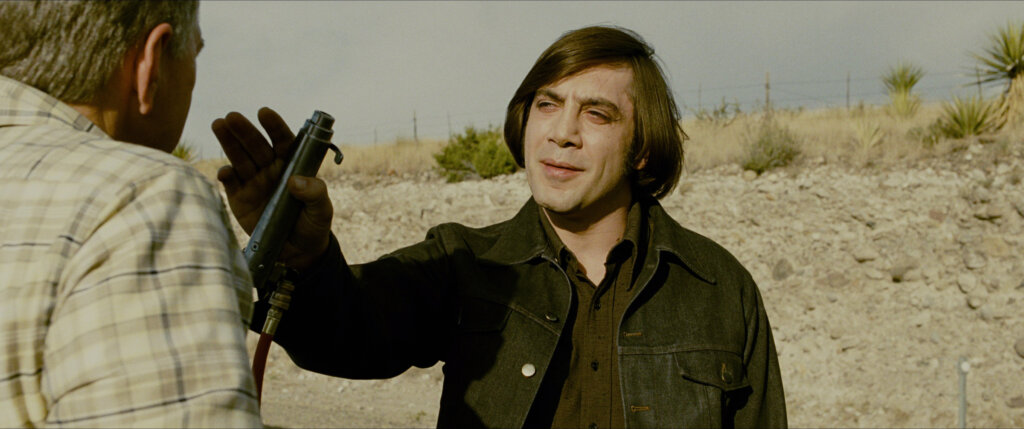
The most frightening thing Anton Chigurh does in No Country for Old Men (2007) may be to ask a stranger to call a coin toss. The gas station proprietor does not know that his life depends on the answer. Chigurh created the danger, made the rules, and hid the stakes. Yet he behaves as though the coin, rather than the man holding it, possesses the final authority. For a moment, a murder he might commit can be described as an event that simply happened.
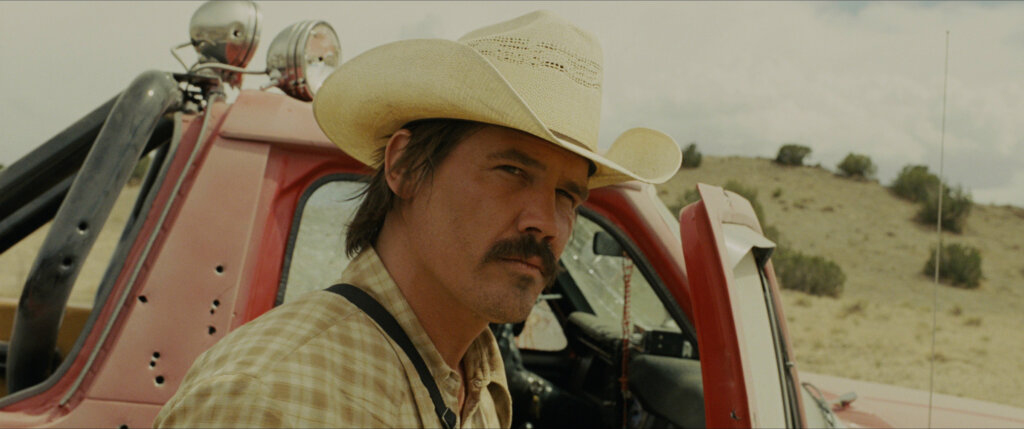
Joel and Ethan Coen’s adaptation of Cormac McCarthy’s novel follows three men across a West Texas landscape marked by a failed drug deal. Llewelyn Moss finds the bodies and takes a case containing millions of dollars. Chigurh pursues the money and kills people who impede him. Sheriff Ed Tom Bell follows the violence without ever feeling able to catch up. The pursuit gives the film its suspense, but the coin gives it a central ethical problem: when a person says that fate determined an outcome, what happens to the choices that helped produce it?
Chigurh’s claim is more complicated than the idea that everything is predetermined. Philosophers distinguish causal determinism, under which an event follows from prior conditions and laws of nature, from fatalism, under which an outcome will happen whatever a person chooses to do. In a deterministic world, choices would still be among the causes of what occurs; their place in a causal chain would not make them irrelevant. Fatalism, by contrast, can make deliberation seem pointless. In No Country for Old Men, Chigurh repeatedly describes violence as an unavoidable destination while taking deliberate steps to arrive there. The same distinction is explored more broadly in my list of films about free will and determinism, but this film puts it inside a single unsettling conversation (Coen & Coen, 2007; Talbert, 2024).
At the gas station, Chigurh grows hostile after learning that the proprietor acquired the business through his wife’s family. What begins as idle conversation becomes an interrogation about whether the man understands his own life. Then the coin comes out. Chigurh insists that the proprietor has been wagering everything for years without knowing it. That story turns an arbitrary threat into the supposed culmination of an entire biography. A man who came to work expecting to sell gasoline must suddenly accept that the ordinary path of his life has led to a life-or-death test.
The proprietor wins. His survival can look like mercy until we recall who made him need it. Chigurh does not surrender control by flipping the coin. He retains the power to initiate the game, withhold its meaning, interpret its result, and leave the store. No coin could have killed the proprietor on its own. The ritual lets Chigurh experience his decision as obedience to something external, while leaving his victim to experience an ordinary purchase as a narrow escape from death.
There is genuine contingency in the film. Moss happens upon the aftermath of a drug transaction. A tracking device hidden among the money makes his resourcefulness less effective than he believes. Later, Chigurh will survive one encounter only to be badly injured by a driver running a red light. The Coens do not present a universe in which careful planning guarantees safety or decency earns protection. But the existence of chance cannot explain why Chigurh holds a weapon, whom he threatens, or why he sometimes lets a person call a coin and sometimes offers no such chance. An unpredictable world gives him occasions to act. It does not write his actions for him.
The distinction can be understood through moral luck. Philosopher Dana K. Nelkin (2025) describes the difficulty of judging people for outcomes influenced by circumstances beyond their control. Moss, for instance, cannot know every consequence of taking the money. The fact that he returns to the desert with water for a wounded man complicates any reading of him as simply greedy. That return also exposes him to danger. Compassion does not erase his earlier choice, and his earlier choice does not make every subsequent harm something he intended.
Chigurh exploits a different version of the problem. He takes something no one controls completely—the results of a coin toss—and treats that uncertainty as a substitute for his own judgment. But luck may affect what a person succeeds in doing without becoming the author of what that person tries to do. A missed shot and a fatal shot can express the same murderous intention. A coin that comes up heads does not retroactively make it ethical to have threatened the proprietor in the first place.
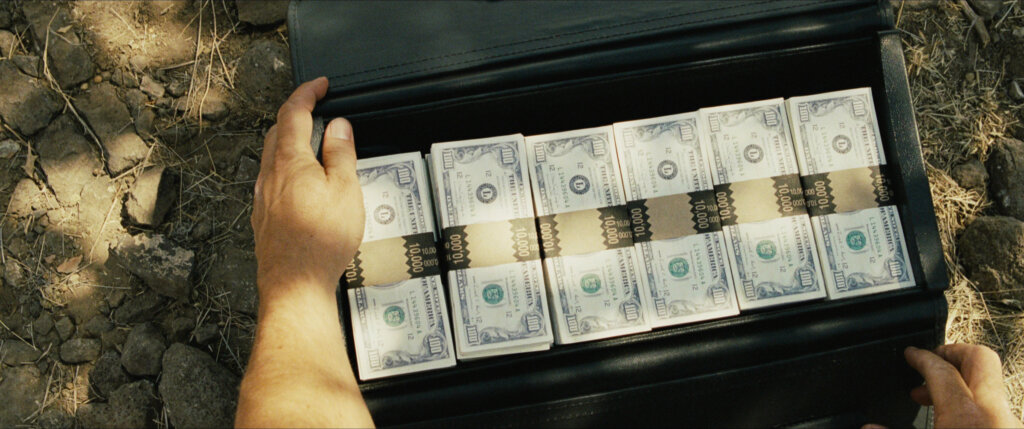
Moss has his own story about control. He is observant, technically capable, and good at improvising under pressure. Watching him work through motel rooms, locks, and lines of sight encourages us to imagine that ingenuity might beat whatever is following him. His mistake is not merely taking the case. He begins to treat a widening network of other people’s choices as a problem he alone can solve. Carla Jean, in particular, has to live with dangers she did not choose because Moss believes he can keep moving one step ahead of them.
The film then removes him from the story with startling abruptness. Bell arrives after Moss has been killed by others, and the confrontation we have been trained to expect never takes place. This refusal of a heroic showdown gives the film’s question about chance a formal shape. We cannot rely on dramatic convention to protect the person we have followed most closely. At the same time, Moss’s death does not turn every prior decision into an illusion. He chose to take the money, to return with the water, and to keep pursuing an escape. He could not choose how every other person would respond.
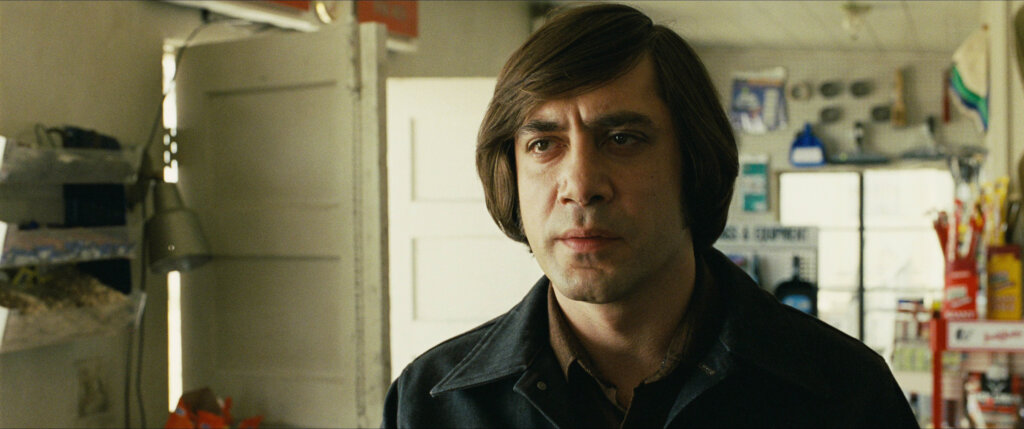
Chigurh’s meeting with Carla Jean is the point at which the film states its moral objection most plainly. He arrives after Moss’s death because he had promised to kill her if Moss failed to deliver the money. He presents that promise as a binding principle and offers a coin toss as though it were the fairest remaining option. Carla Jean refuses to call it. She tells him, in effect, that the coin cannot decide anything: the choice belongs to him (Coen & Coen, 2007).
Her refusal does not stop Chigurh. The film leaves her death offscreen, but he checks the soles of his boots as he exits her house, recalling his earlier care to avoid blood. Carla Jean is not granted safety for recognizing the truth. She is the person with the least power in the room, yet she identifies the moral fact Chigurh has arranged his life to evade. The outcome may be beyond her control. His conduct is still his own.
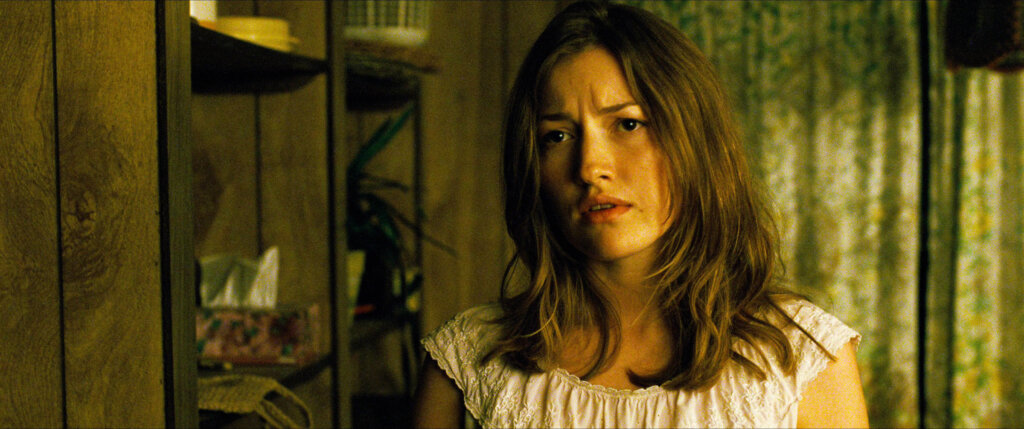
The Coens’ presentation of Chigurh resists a simple equation between a character and an abstract principle. Ethan Coen described him, in relation to McCarthy’s novel, as a personification of a capricious, unforgiving world rather than an ordinary contest between good and evil (Coen, 2007). That account helps explain why he can feel less like a psychologically familiar killer than a force advancing across the landscape. It does not require us to adopt Chigurh’s understanding of himself. Onscreen, the personification also talks, threatens, calculates, makes promises, and chooses how to use his weapon. Carla Jean addresses the man within the symbol.
The car crash immediately after he leaves her house pushes this contradiction further. Chigurh has a green light. Another driver strikes his vehicle without warning, leaving him badly injured. At last, he confronts chance as something that happens to him. The accident neither punishes him proportionately nor vindicates him. He survives through the help of two boys who do not know whom they are helping, pays for a shirt to bind his injuries, and walks away. Their small act of assistance enters the same world as his violence without becoming an endorsement of it. Fortune distributes injury and survival at random. Moral judgment still has to distinguish the people involved.
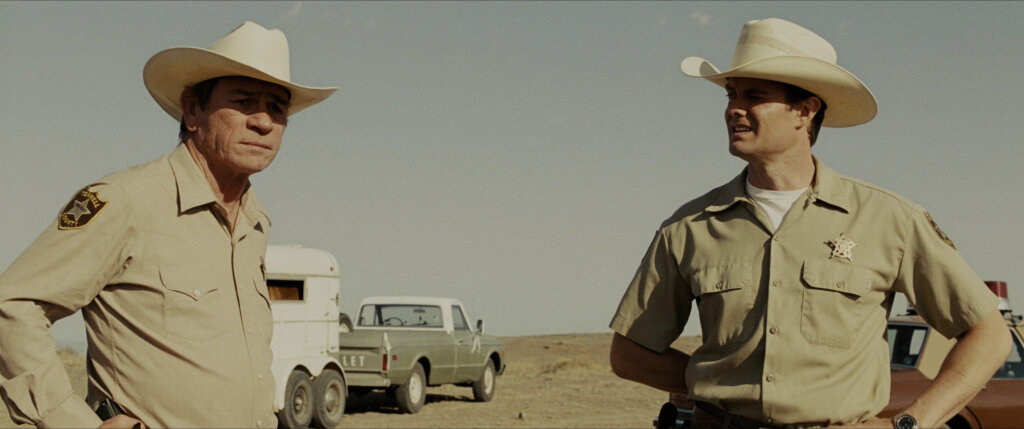
Bell faces that task from another direction. His voice opens the film with a memory of lawmen who worked without carrying guns. Each crime scene seems to confirm that he has outlived the moral order he knew. If Chigurh imagines himself the instrument of fate, Bell fears that history has become a force against which his own choices no longer matter. That fear helps explain his retirement, but it may also conceal a comforting story about the past. When Bell visits Ellis, the older man recalls a lawman murdered decades earlier. The violence Bell finds unbearable did not begin with this case. Ellis challenges both Bell’s nostalgia and the thought that stopping all of it was ever his personal responsibility (Coen & Coen, 2007).
Bell’s final dream offers no solution to the crimes he could not prevent. His father rides ahead through a cold darkness carrying fire and intending to make a place for him. Bell wakes before he reaches it. The image may suggest faith, inherited duty, or a longing for care. It does not promise that good people will prevail, and the film ends before the dream can be turned into proof of anything. Bell’s task, like the viewer’s, is to live without guarantees that the world will reward his understanding of it.
This is why No Country for Old Men reaches beyond the familiar question of whether Chigurh represents fate. The film repeatedly shows how readily people turn uncertainty into a story that serves them. Moss trusts his skill; Bell imagines a lost age of order; Chigurh uses a coin to convert his own brutality into an apparent law of the universe. These beliefs are not morally equivalent. Moss can care for a stranger, and Bell can grieve for people he failed to save. Chigurh’s story has a victim standing directly in front of him. His ritual asks that victim to participate in disguising his choice.
Chance may determine which life meets which threat. It cannot make the threat innocent. By refusing to call the coin, Carla Jean does something the film’s armed men struggle to do: she separates the limits of human control from the surrender of human responsibility. No one can promise her a different outcome. She can still name the person who brought it about.
References
Coen, E. (2007). Interview with the Coen brothers on No Country for Old Men. CHUD.
Coen, J., & Coen, E. (Directors). (2007). No Country for Old Men [Film]. Miramax. Official film page.
Nelkin, D. K. (2025). Moral luck. In E. N. Zalta & U. Nodelman (Eds.), The Stanford Encyclopedia of Philosophy.
Talbert, M. (2024). Moral responsibility. In E. N. Zalta & U. Nodelman (Eds.), The Stanford Encyclopedia of Philosophy.
Discover more from Philosophy in Film
Subscribe to get the latest posts sent to your email.
