10 Films About Free Will and Determinism
Every film is predetermined. Once it has been completed, every image and line is fixed. A character may hesitate between two possibilities, but each screening will reproduce the same choice. Cinema nevertheless depends upon our belief that the character is deciding—that the reasons, fears, and desires represented on screen help explain what happens next.
That tension makes film particularly well suited to the problem of free will. Human beings experience themselves as agents capable of considering alternatives and acting for reasons. At the same time, every choice emerges from conditions the person did not choose: biology, upbringing, social pressure, prior experience, and the physical state of the world. Films about free will and determinism make those pressures visible. They turn causation into behavioral conditioning, prophecy, time loops, simulated worlds, alternate timelines, and institutions capable of predicting the future.
The central philosophical conflict is not simply between freedom and fate. Causal determinism holds that the state of the world at one time, together with the laws of nature, determines what follows. If the conditions were exactly the same, no different future could occur (Hoefer, 2023). Fatalism makes a different claim: a particular outcome will occur regardless of what anyone does (Rice, 2023). Under determinism, a person’s reasoning and actions can still be essential parts of the causal chain. Under fatalism, the destination arrives by any available route.
Philosophers also disagree about what freedom would require. Libertarian accounts generally maintain that genuine free will is incompatible with determinism and that at least some human choices are not causally determined. Hard determinists and other free-will skeptics deny that people possess the kind of control required for ultimate moral responsibility. Compatibilists argue that freedom can exist within a determined world when actions proceed from a person’s own values, reasoning, and desires rather than coercion or compulsion (McKenna & Coates, 2024; O’Connor & Franklin, 2022).
None of these positions can be settled merely by adding randomness. An action caused by an unpredictable quantum event would not necessarily belong to an agent any more fully than an action fixed by prior causes. The important questions concern control, understanding, and ownership. Could the person have acted differently? Did the action express who they were? Were their desires manipulated? Can someone be responsible for an event that another person predicted or arranged?
These questions also connect free will to the concerns found in existential films. Existentialism emphasizes the role of choice in creating a life, but the philosophical problem begins one step earlier: what would make a choice genuinely ours? My essay on Donnie Darko and the meaning of sacrifice examines that question through a character whose apparent act of self-sacrifice may also be the result of a carefully constructed trap.
The ten films below approach free will through different mechanisms, rather than offering ten versions of the same argument. They are arranged chronologically, and their numbers do not represent quality. Major spoilers follow.
10 Films About Free Will and Determinism
10. A Clockwork Orange (Stanley Kubrick, 1971)
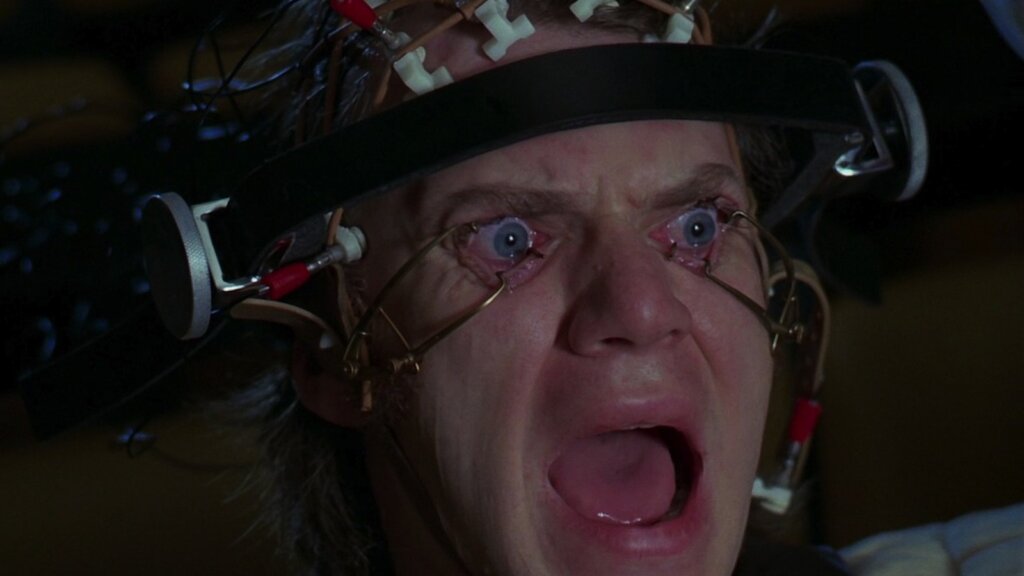
Can someone be good without the ability to choose evil?
Alex does not begin A Clockwork Orange as an innocent person whose freedom is threatened by an oppressive government. He is a sadist, rapist, and murderer who takes pleasure in dominating others. The Ludovico Technique appears attractive because it promises to stop him from causing further harm. Through drugs and forced exposure to violent images, the state conditions his body to respond to aggression and sexual desire with incapacitating nausea.
The treatment changes Alex’s behavior without changing his moral commitments. He does not reject violence after recognizing the humanity of his victims. His body simply makes violence unbearable. In this context, an action can conform to a moral rule without expressing moral understanding. A machine that cannot injure anyone is safe, but it is not virtuous.
The prison chaplain voices the film’s central objection when he argues that goodness must be chosen. Yet Kubrick does not allow that principle to function as an easy defense of Alex. Restoring his freedom also restores his capacity to brutalize other people. The film therefore places two genuine values in conflict: public safety and moral agency. A society has strong reasons to prevent violence, but it dehumanizes Alex when it treats his will as a mechanism to be reprogrammed.
Even a compatibilist account of freedom can object to the Ludovico Technique. The problem is not just that prior causes shape Alex, since prior causes shape everyone. The treatment deliberately bypasses his capacity to evaluate reasons. It produces obedience through an involuntary physical response. Alex becomes, as the title suggests, something organic forced to operate like clockwork.
The government later reverses the treatment when Alex becomes politically inconvenient. That decision confirms that neither his punishment nor his cure was primarily concerned with moral development. His agency is first removed and then restored according to the needs of power. A Clockwork Orange refuses the comforting conclusion that freedom makes people good. It argues instead that without some meaningful freedom, goodness itself loses its moral content.
9. The Truman Show (Peter Weir, 1998)
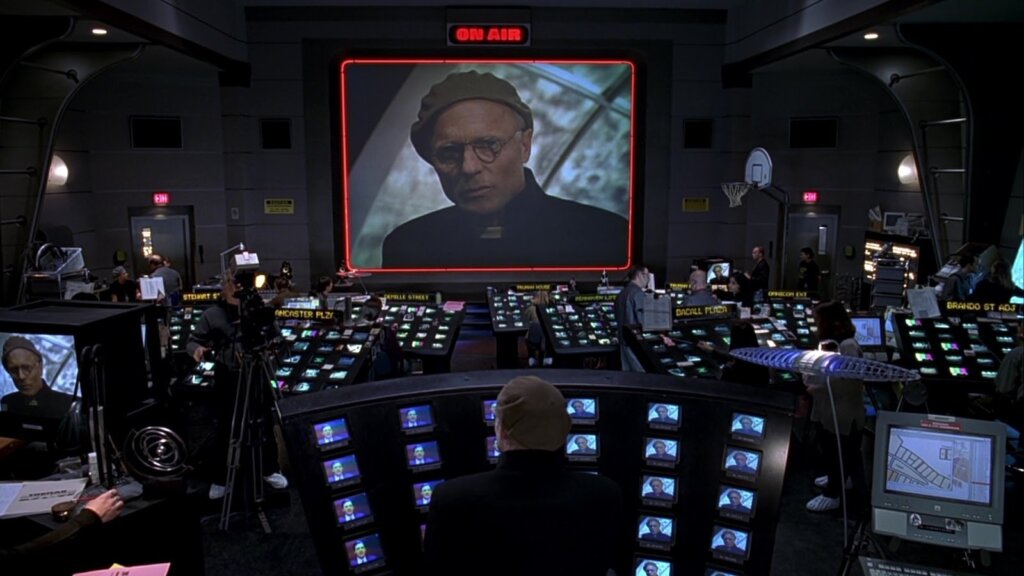
Can a choice be free when someone else has designed the world in which it is made?
Truman Burbank lives inside a television production without knowing it. Christof cannot control Truman’s mind directly, but he controls almost everything that supplies the mind with reasons: family, friendship, employment, news, geography, and fear. Truman has been conditioned to avoid the water through the staged death of his father, preventing him from sailing beyond the limits of Seahaven.
The film presents a social version of the manipulation problem. Truman appears to act voluntarily. He goes to work, speaks affectionately to his wife, and abandons plans to travel. Yet those choices depend upon false beliefs deliberately created by another person. The absence of visible force does not make the environment free. Control can operate most effectively when its subject experiences a designed decision as common sense.
This distinguishes freedom from simply doing what one wants. Truman’s desires have been cultivated to keep him manageable, while incompatible desires—his attraction to Sylvia, curiosity about Fiji, and suspicion that the world is repeating itself—are suppressed or redirected. If freedom requires only action consistent with a person’s strongest desire, Christof can claim that Truman has always been free. If it requires informed self-direction, Seahaven is a prison, with or without Truman realizing it.
Truman’s escape does not require an action without causes. His decision grows from evidence, memory, dissatisfaction, and attachment to someone missing from his world. What changes is his ability to evaluate those causes. He notices patterns that the production wants him to ignore and revises beliefs that other people have treated as permanent.
Truman approaches the final door knowingly. Christof still tries to define him, insisting that the constructed world is safer than the one outside. Truman cannot know what his life will become after he exits. He can only reject another person’s authority to decide that life for him. Like the films in my list about personal identity, The Truman Show connects freedom to authorship: a person begins to recover a self by challenging the story others have imposed upon it.
8. Run Lola Run (Tom Tykwer, 1998)
Would the same person make a different choice if the world began again?
Lola has twenty minutes to obtain 100,000 Deutschmarks and save her boyfriend, Manni. The film runs through this crisis three times. Small differences in timing produce radically different encounters, and brief flash-forward sequences reveal entire futures created by momentary contact with strangers.
The repeated structure appears to provide exactly what ordinary life withholds: the opportunity to replay a decision under slightly altered conditions. Yet the variations do not isolate a pure, uncaused will. A delayed staircase, a barking dog, an approaching car, or a few seconds of hesitation changes what Lola sees and what becomes possible. Her choices are embedded in a network of causes extending beyond her knowledge.
This resembles the sensitivity to initial conditions commonly associated with chaos. A causal system can be deterministic while remaining practically unpredictable because tiny differences expand into enormous consequences. Determinism does not imply that a person could calculate the future. Nor does unpredictability establish freedom. The stranger whose life changes after crossing Lola’s path is not more autonomous because the audience could not foresee the result.
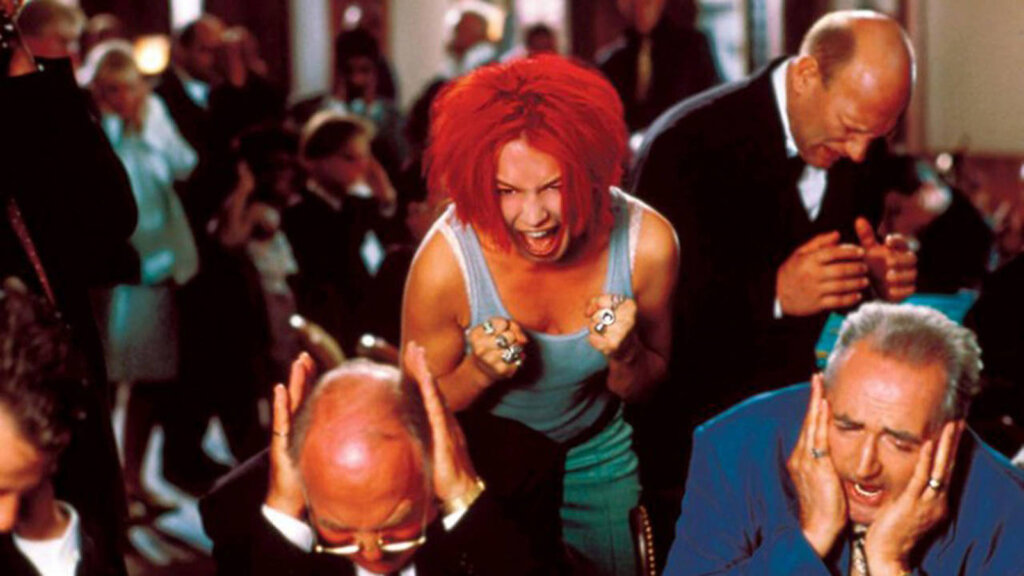
Lola nevertheless appears to retain something across the repetitions. Her responses become increasingly deliberate, and each run permits her to test the limits that defeated her before. The roulette scene pushes this development toward the miraculous. Her sustained scream seems to force chance into alignment with her will, although the film never explains whether she controls the result or finally receives the luck previously denied to her.
Run Lola Run‘s energy comes from holding causation and agency together. Lola cannot choose the world from which she begins, but she changes her relationship to it through attention, persistence, and movement. Freedom appears as the ability to act within a causal network that no individual can fully understand.
7. The Matrix (Lana and Lilly Wachowski, 1999)
Does foreknowledge destroy choice, or does it merely reveal what someone will choose?
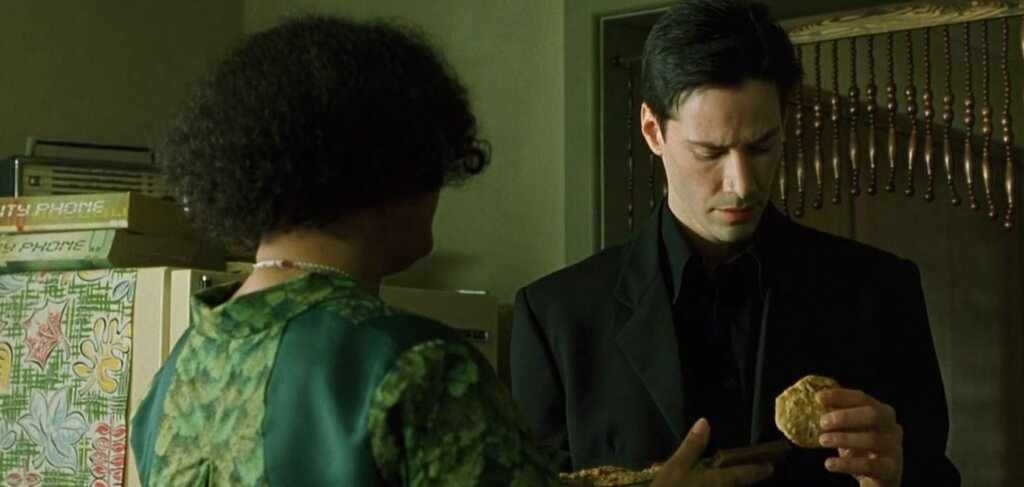
Neo’s first major act of apparent freedom is choosing the red pill. The decision seems to divide passive illusion from active knowledge. It is also carefully staged by Morpheus, who already believes that Neo is the One and presents the alternatives through a persuasive narrative. Neo chooses, but he does not choose from a neutral position.
The Oracle complicates the problem further. She tells Neo that he is not the One and predicts that he will have to decide between his own life and Morpheus’s. Her statements influence the actions they describe. Neo returns to rescue Morpheus partly because he believes the prophecy requires his sacrifice, while that rescue becomes part of the process through which he recognizes his abilities.
Prediction is not the same as causation. Knowing that Neo will act does not necessarily force him to act. The deeper problem is that the Oracle participates in the causal chain. She does not watch the future from outside it; she provides information that helps bring the future about. The prophecy resembles a map handed to someone whose response to the map has already been included in the route.
This structure supports a compatibilist reading. Neo’s actions can be fixed and still express his commitments. He risks his life because of loyalty, love, and a refusal to accept the limits imposed upon him. The fact that the Oracle anticipated those reasons would not make them cease to be his. Her guidance becomes a threat to freedom only if it manipulates him in a way that bypasses his judgment.
The simulated world links this ethical question to the concerns of metaphysical films. Neo must determine not only what to choose but which reality gives his choices meaning. The Matrix treats freedom as intellectual and political before it becomes supernatural. The first liberation is learning that the apparent necessities of one’s world were constructed.
6. Minority Report (Steven Spielberg, 2002)
Can someone be guilty of an act that the future says they will commit?
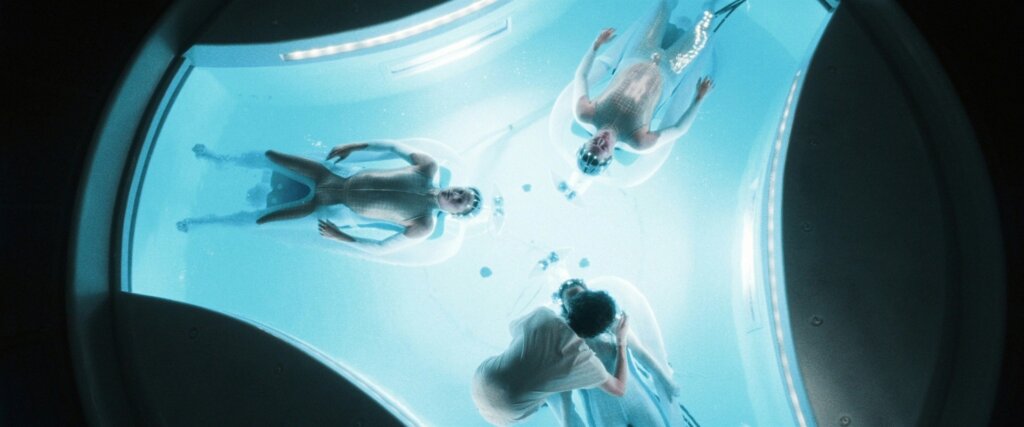
Precrime arrests people before they commit murder. Its legitimacy depends upon two claims that the film’s society treats as one: the precogs see a future event, and that event would occur unless the police intervened. If the prediction can be prevented, however, then the recorded murder is not an unavoidable future in the ordinary sense. It is a conditional possibility that acquires institutional authority.
John Anderton accepts this contradiction while he controls the system. He describes the predicted murder as certain and then prevents it from taking place. The system preserves its credibility by treating intervention as confirmation: the absence of the crime proves that Precrime worked, never that the future remained open.
The moral problem becomes unavoidable when Anderton sees himself killing Leo Crow. Knowledge of the prediction changes the conditions under which the predicted act would occur. He enters the room expecting manipulation, recognizes the staged evidence, and has a reason to resist the future precisely because he has seen it. A prediction about a reflective agent can become one of the causes the agent considers.
The existence of minority reports reveals that the precogs do not always agree. Instead of interpreting disagreement as evidence that more than one future is possible, Precrime hides it to preserve the appearance of certainty. The institution needs determinism because its power depends upon converting probability into guilt.
Harry Frankfurt famously challenged the claim that moral responsibility always requires the ability to do otherwise. A person might act from their own reasons even when an observer stands ready to prevent any alternative, and the observer’s unused power need not explain the action (Frankfurt, 1969). Minority Report presents almost the reverse case. The state punishes people without allowing their reasons to become actions at all. It replaces moral responsibility with a forecast and then denies the accused the moment in which resistance, consent, or reconsideration could occur.
5. Mr. Nobody (Jaco Van Dormael, 2009)
If every possible life exists, what makes any particular choice meaningful?
Nemo Nobody, the last mortal person in a future society, recounts several incompatible versions of his life. The possibilities branch from decisions involving his parents, romantic partners, and the paths produced by apparently minor events. The film does not identify one account as a simple factual history. Each life develops with the emotion of something experienced.
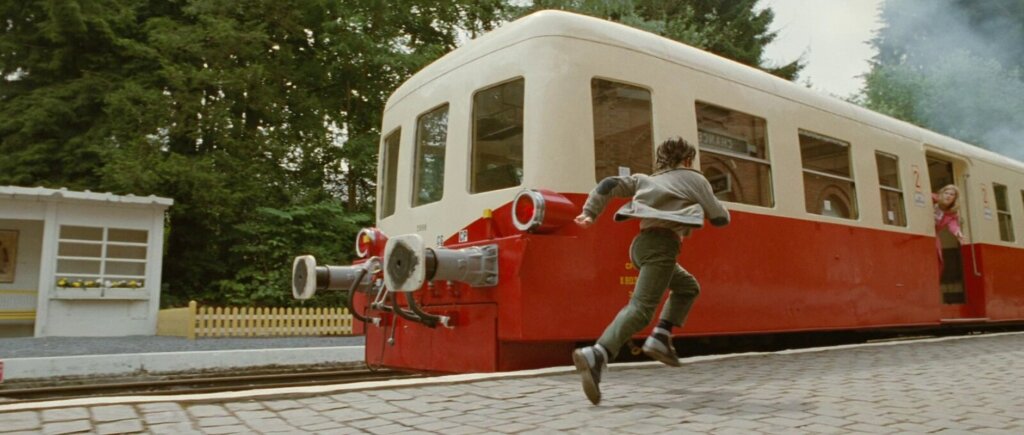
The decisive childhood scene places Nemo between his departing mother and the father remaining behind. Choosing either parent appears to determine everything that follows. Faced with consequences too large to understand, he imagines both routes and the branches within them. Freedom becomes paralyzing because choice excludes entire futures.
Possible alternatives are often treated as the foundation of free will. Mr. Nobody makes their abundance frightening. A person able to see every consequence would not necessarily become more capable of choosing. Complete information could make commitment impossible, since every life contains losses visible from the perspective of another.
The film also challenges the fantasy of a perfect choice. Nemo’s possible lives cannot be ranked according to a single measure of success. Love, safety, intensity, regret, and chance are distributed differently across them. The search for the one correct path mistakes uncertainty for an error that sufficient knowledge could remove.
This connects free will to the question of what gives a life meaning. A life acquires shape partly because alternatives become unavailable. Commitment would mean very little if every excluded possibility remained fully accessible. Mr. Nobody suggests that finitude restricts freedom, but it is also what gives freedom its importance.
4. The Adjustment Bureau (George Nolfi, 2011)
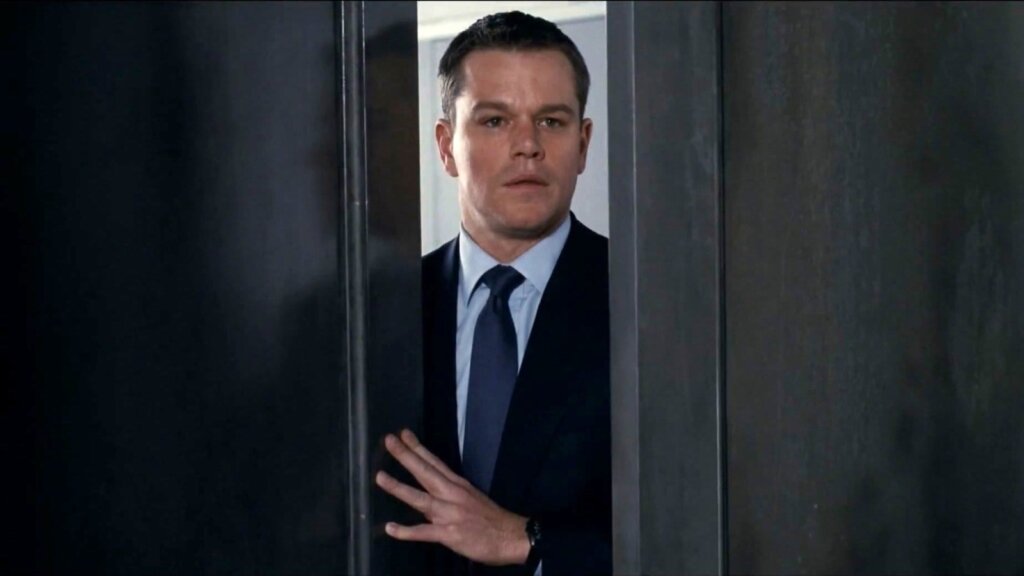
Is a life freely chosen when a higher power has already written the plan?
David Norris meets Elise Sellas because a member of the Adjustment Bureau fails to prevent their encounter. Their attraction conflicts with a plan maintained by agents who alter circumstances, redirect attention, and remove memories. Fate appears not as an impersonal law but as an administrative system in The Adjustment Bureau.
The Bureau does not ordinarily force people through direct violence. It adjusts the environment until the desired decision seems natural. A spilled drink, missed bus, or interrupted conversation guides a person back toward the approved path. Its control therefore resembles the manipulation in The Truman Show, but its scale is theological. The Chairman occupies the place of providence, while the caseworkers interpret and enforce a design they did not create.
The agents insist that human beings proved incapable of managing history when given unrestricted freedom. Their argument is paternalistic: control is justified by the disasters people would otherwise cause. David and Elise are permitted ordinary choices only when those choices do not threaten the larger arrangement. The Bureau calls that limited space free will because the boundaries remain mostly invisible.
The distinction between determinism and fatalism clarifies their rebellion. If their separation were determined by every prior condition, their efforts to remain together would be part of the process producing the outcome. The Bureau instead behaves as though separation must occur despite their efforts, repeatedly changing the route whenever they resist. The plan is closer to fate maintained through intervention than to an impersonal chain of natural causes.
When persistence finally leads the Chairman to revise the plan, the ending seems to celebrate self-determination. It also leaves an uncomfortable qualification. David and Elise become free because a superior authority recognizes the sincerity of their resistance. Their victory demonstrates meaningful agency, but it does not abolish the hierarchy that made permission necessary.
3. Predestination (Michael and Peter Spierig, 2014)
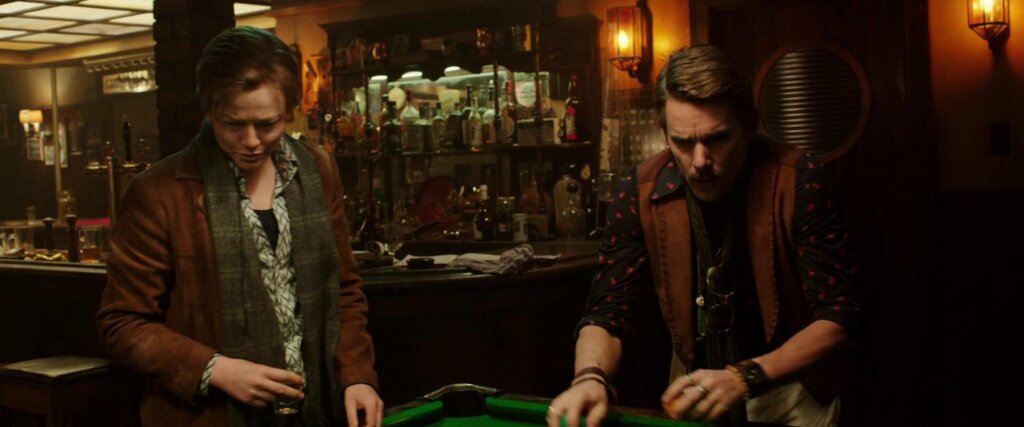
Can anyone be the author of a life with no beginning outside itself?
The temporal structure of Predestination closes almost every apparent opening. Jane becomes John, John travels into the past and fathers Jane with an earlier version of himself, and the child is returned to become Jane. The temporal agent who recruits John is his older self, while the criminal he hunts is another stage of the same life.
This is a causal loop without an identifiable first source. Jane’s existence, recruitment, and transformation do not begin in a past independent of time travel. Each event causes another event that eventually causes the first. The loop may be logically consistent, but consistency does not explain where the information and identity within it originate.
The film’s title offers a fatalistic interpretation. Every attempt to prevent the Fizzle Bomber helps complete the history in which the bomber exists. Yet the characters do not remain passive. Each version of the protagonist acts for recognizable reasons: love, abandonment, duty, resentment, and the desire to prevent suffering. The fixed loop includes deliberation.
That makes the film a severe test for compatibilism. If freedom consists in acting from one’s own motives, many actions within the loop may qualify. The difficulty is determining which motives are truly the protagonist’s when older versions repeatedly manipulate younger ones. The agent supplies John with selected information, uses his pain to secure cooperation, and places him on the path the agent has already traveled.
Personal identity becomes inseparable from causal responsibility. The same person is victim, lover, parent, recruiter, and enemy. Blaming one stage means blaming someone shaped by harms inflicted by another stage of the same life. Predestination turns self-creation into self-entrapment: the protagonist causes who he becomes but never occupies a position outside the loop from which to choose that identity as a whole.
2. Arrival (Denis Villeneuve, 2016)
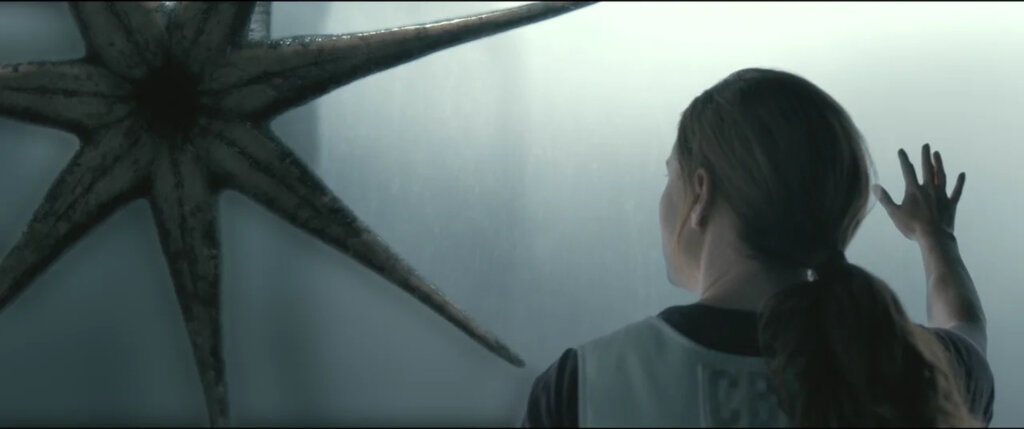
Can someone choose a future they already remember?
As Louise Banks learns the heptapods’ written language, she begins experiencing future events with the immediacy of memory. The film gradually reveals that the scenes involving her daughter are not recollections of a past loss. They belong to a life Louise has not yet lived.
Her altered perception resembles a block universe in which past, present, and future are equally real. From that perspective, time does not come into existence one undecided moment after another. Louise’s future is available to consciousness because it already occupies part of the complete temporal structure.
Foreknowledge alone does not logically cause an event. Seeing that Louise will make a decision is different from forcing her to make it (Hunt & Zagzebski, 2026). The problem is whether infallible knowledge leaves room for a different action. If Louise could refuse the relationship and prevent her daughter’s birth, then what she experienced was not knowledge of the actual future. If the vision cannot be mistaken, her apparent alternative may never be genuinely possible.
A compatibilist can still describe Louise as free. She does not experience the future as an alien command. Her actions express love and a willingness to accept joy that she knows will end in grief. Knowledge changes the meaning of her choice, but it does not obviously replace her reasons with someone else’s.
The film should not make this acceptance too easy. Louise’s knowledge also concerns Ian, who does not initially share it. Choosing a relationship while withholding its known future raises a problem of consent. Her embrace of a finite life may be courageous, but her authority to make that decision for another person is less certain. Like the argument that human beings give life meaning through their choices, Arrival finds value in impermanence. Its account of freedom remains moving because it never completely separates love from the burden of knowing what love will cost.
1. The Laplace’s Demon (Giordano Giulivi, 2017)
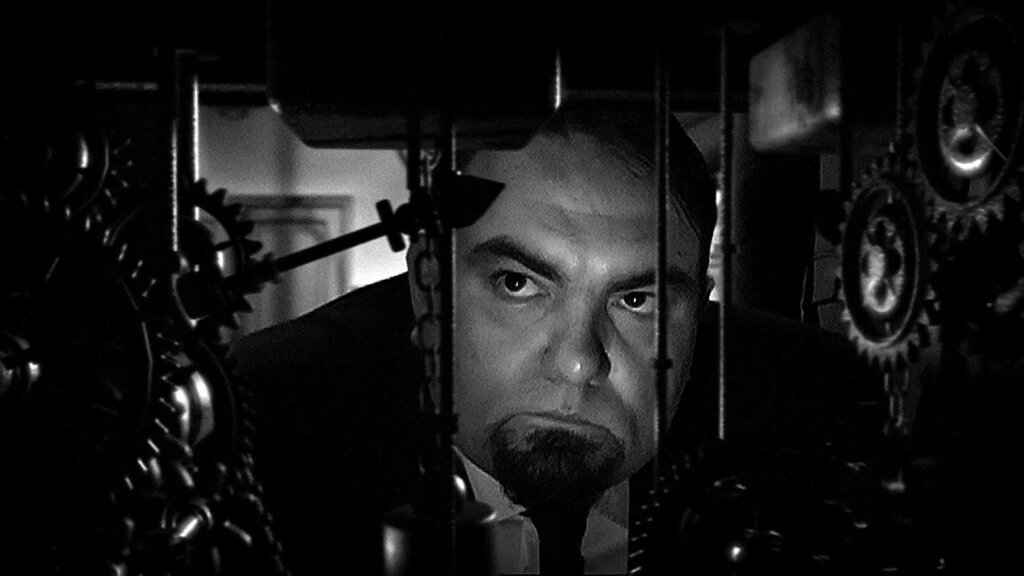
Would perfect prediction turn human beings into objects?
A group of researchers develops a method of predicting how many fragments will result when a glass falls and breaks. They are invited to an isolated mansion, where a mechanical model represents them as pawns moving through rooms. The model appears to anticipate not only their movements but their attempts to resist what it predicts.
The title refers to the intelligence imagined by Pierre-Simon Laplace. If such an intellect knew every force and the position of every particle at a given moment, and possessed sufficient power of calculation, it could comprehend the past and future within a single formula (Laplace, 1814/1902). The thought experiment presents perfect prediction as the ultimate expression of a law-governed universe.
Determinism does not ordinarily imply predictability. A system may be fully caused while remaining too complex for any human observer to calculate. Imperfect information, computational limits, and sensitivity to small differences can make the future inaccessible even if only one future is physically possible. The Laplace’s Demon removes that practical protection by giving prediction a visible form.
The model also creates a self-reference problem. Once the researchers see what their pieces are expected to do, the prediction becomes part of the situation being predicted. They can decide to resist it, but that resistance may already be represented by the next movement. Every attempt to prove the model wrong produces further evidence of its accuracy.
This does not automatically show that the researchers lack free will. A perfect observer might predict an action because it understands the person’s reasons rather than because it overrides them. Yet the mansion reduces the group to objects viewed from above. Their fear comes partly from seeing human deliberation translated into mechanics. What feels like an open decision from inside the room appears as the movement of a pawn from outside it.
Can Free Will Exist in a Determined World?
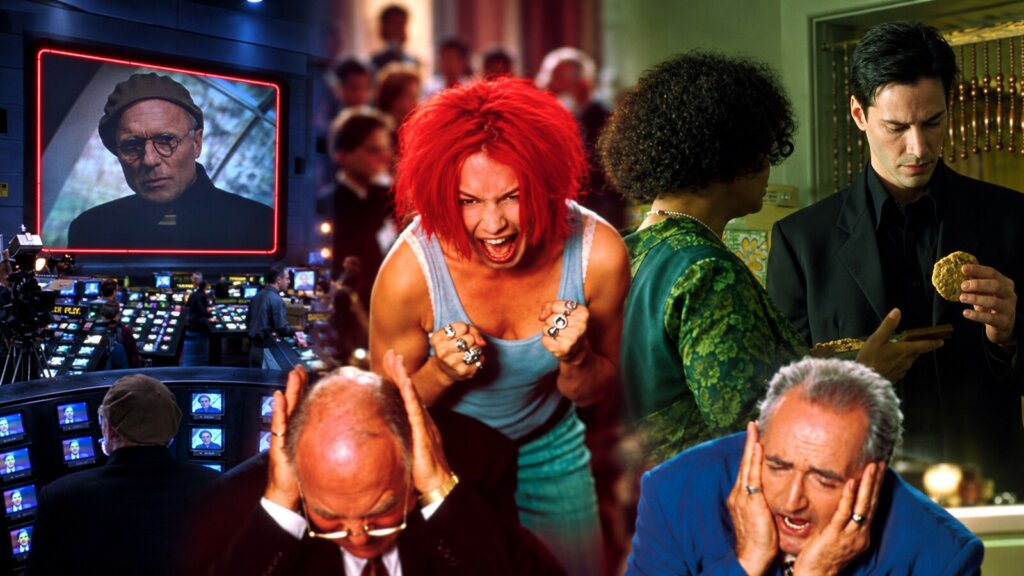
These films do not test only one definition of freedom. A Clockwork Orange asks whether morality survives when the capacity for wrongdoing is removed. The Truman Show and The Adjustment Bureau examine choices produced inside manipulated environments. Minority Report and Arrival separate knowledge of an action from the causes of that action. Predestination and The Laplace’s Demon imagine causal structures from which no external point of origin appears available.
The differences arise because “I could not have done otherwise” can describe very different conditions. A person might be physically restrained, psychologically compelled, deceived, causally determined, trapped in a time loop, or simply unwilling to betray a deeply held value. Treating these situations as equivalent obscures the features of agency that moral judgment is supposed to recognize.
The libertarian intuition remains powerful throughout the list. Freedom seems to require a genuinely open future in which more than one action is possible. Run Lola Run and Mr. Nobody visualize that intuition by allowing alternatives to appear on screen. They also reveal its limits. More possibilities do not automatically produce greater control. Chance can redirect a life without becoming a choice, while complete awareness of every branch can make commitment impossible.
Compatibilism offers a different standard. An action can belong to a person when it proceeds through their capacity to understand reasons and regulate behavior, even if that capacity has prior causes. This explains why Neo and Louise may be agents despite prophecy or foreknowledge. Their decisions still express commitments with which they identify.
Manipulation presents the most persistent objection. Christof, the Bureau, the Oracle, and the temporal agent all arrange conditions under which another person chooses. If an authority can manufacture beliefs and desires while leaving the final act apparently voluntary, then consistency with one’s motives may not be enough. Freedom may also require an appropriate history: the person must be able to examine, revise, and claim the motives guiding the action.
This is where cinema’s own determinism is philosophically useful. A character’s actions cannot change between screenings, yet audiences still distinguish decisions from accidents, coercion from consent, and betrayal from sacrifice. We ask what the character knew, which reasons moved them, and whether another power used them as an instrument. The outcome’s fixed place in the film does not eliminate those distinctions.
Free will may therefore involve less independence from causation than independence from the wrong kinds of control. These films do not prove that determinism and freedom are compatible. They show why the debate cannot be resolved by asking only whether the future is fixed. The more difficult question is whether an action can still belong to someone whose life, character, and reasons were never created from nothing.
References
Frankfurt, H. G. (1969). Alternate possibilities and moral responsibility. The Journal of Philosophy, 66(23), 829–839.
Hoefer, C. (2023). Causal determinism. In E. N. Zalta & U. Nodelman (Eds.), The Stanford Encyclopedia of Philosophy.
Hunt, D. P., & Zagzebski, L. (2026). Foreknowledge and free will. In E. N. Zalta & U. Nodelman (Eds.), The Stanford Encyclopedia of Philosophy.
Laplace, P.-S. (1902). A philosophical essay on probabilities (F. W. Truscott & F. L. Emory, Trans.). John Wiley & Sons. (Original work published 1814)
McKenna, M., & Coates, D. J. (2024). Compatibilism. In E. N. Zalta & U. Nodelman (Eds.), The Stanford Encyclopedia of Philosophy.
O’Connor, T., & Franklin, C. (2022). Free will. In E. N. Zalta & U. Nodelman (Eds.), The Stanford Encyclopedia of Philosophy.
Rice, H. (2023). Fatalism. In E. N. Zalta & U. Nodelman (Eds.), The Stanford Encyclopedia of Philosophy.
Discover more from Philosophy in Film
Subscribe to get the latest posts sent to your email.
