Butterfly on a Wheel (2007) Review: Why Its Revenge Twist Fails
Updated October 9, 2026
Thrillers are not generally my favorite kind of film, but I can enjoy an elaborate revenge plot when I believe somebody could actually carry it out. Park Chan-wook’s Oldboy (2003) pushes its plan to an extreme and makes that excess disturbing. Mike Barker’s Butterfly on a Wheel (2007), released in the U.S. as Shattered, has a smaller, more familiar premise. Unfortunately, its twists require more belief than the film actually deserves.
Stream, rent, or purchase Butterfly on a Wheel on Amazon.
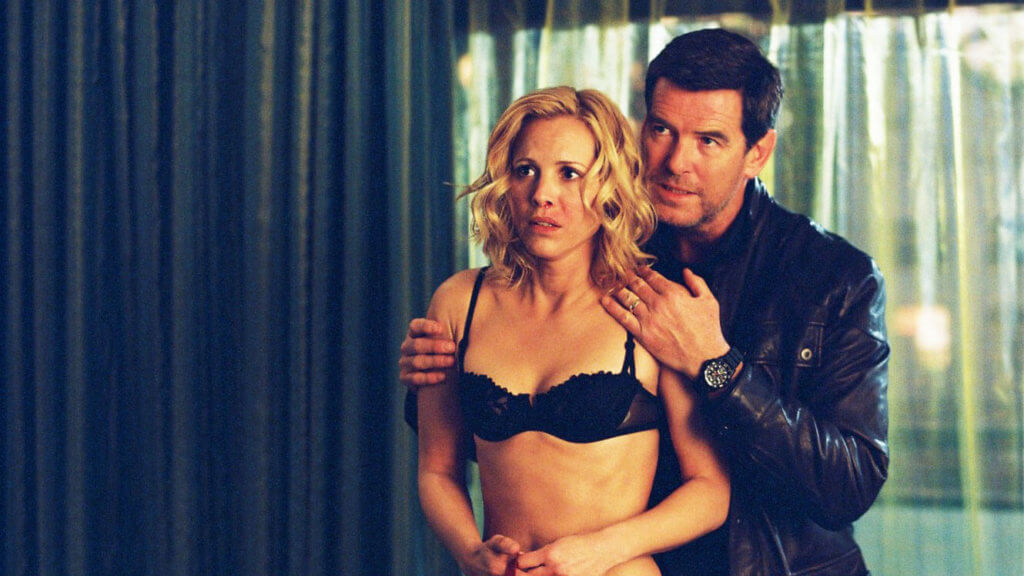
Neil (Gerard Butler) and Abby Randall (Maria Bello) appear to have a lovely marriage and a happy life with their young daughter, Sophie. Then Tom Ryan (Pierce Brosnan) claims to have kidnapped Sophie. He takes control of the couple for the next twenty-four hours, making them complete a series of increasingly cruel tasks while threatening Sophie’s life if they refuse.
Neil and Abby have no practical way to test Tom’s claims, and the thought of their daughter in danger makes even his most irrational demands difficult to ignore. For a while, the film can generate tension simply by asking what he will force them to do next.
I will start with the positives, as they are few and far between. If you’re willing to turn your brain off and ignore the glaring issues, Butterfly on a Wheel can be entertaining. Some of its plot turns are effective in the moment, and Brosnan is well suited to the role of a man who seems to know more about his victims than they know about him. The premise works to ratchet up the emotion, even when the photography leans heavily on the dreary gray and blue filters that seemed obligatory in thrillers of the period.
The trouble is that each new test makes Tom’s control harder to believe. He appears able to anticipate where Neil and Abby will go, how strangers will behave, and what the couple will be willing to sacrifice. I don’t need a thriller to function like a documentary. I do need its surprises to seem possible within the story it has established. Here, the machinery becomes so conspicuous that I spent more time thinking about the planning than worrying about Sophie.
I had a similar response to The Number 23: a premise that initially caught my attention gradually lost me through its dependence on coincidence and contrivance. Butterfly on a Wheel is more focused, but its characters still follow a route that seems designed for the eventual reveal rather than one they might plausibly choose for themselves.
The dialogue doesn’t help. People explain themselves at moments when fear, anger, or exhaustion ought to make them less articulate. Butler, Bello, and Brosnan all have scenes pitched at a breakneck intensity. My impression is that the three principal actors seem to be phoning it in. At the same time, I think the script gives them little room to behave like people who don’t know what comes next.
Spoilers for the ending of Butterfly on a Wheel follow.

Tom is Judy’s husband, and Judy is the woman with whom Neil has been having an affair. The supposed kidnapping was staged. Sophie has been safe at home, and Abby has been working with Tom to make Neil experience the fear and betrayal that his affair caused them. The money apparently destroyed and the documents apparently delivered to ruin his career are also part of the deception.
The reveal explains why Tom seemed to control every stage of the day. It doesn’t make the preceding ordeal any more convincing. Tom and Abby coordinated an extraordinary number of movements, reactions, and risks to produce a lesson for Neil. Once the film shows us how much was arranged in advance, its suspense begins to look less like the result of a clever plan than the result of a screenplay refusing to let anything go wrong with one.
The most telling moment comes when Tom orders Neil to shoot Judy to save Sophie. Neil pulls the trigger, unaware that the gun will not fire. His choice reveals something ugly about him, and it gives Tom a terrible form of satisfaction. But it also exposes the imbalance in the film’s moral logic. Neil has betrayed Abby. Tom and Abby respond by convincing him that their child may die and manipulating him into an apparent attempt to kill another person. Infidelity is a serious betrayal; it does not make these acts equivalent.
That imbalance is almost contained in the title. Alexander Pope’s “Epistle to Dr. Arbuthnot” asks, “Who breaks a butterfly upon a wheel?” The image raises the question of punishment wildly out of proportion to its object. Butterfly on a Wheel could have used its ending to ask whether Tom and Abby have become frighteningly cruel in their pursuit of justice. Instead, it seems impressed by the intricacy of their revenge.
I wanted more from Abby in particular. Discovering that she helped construct Neil’s nightmare ought to complicate the earlier scenes in which she appears terrified for Sophie. She has a reason to be angry, but the film leaves too little space to consider what joining Tom’s plan has done to her. She becomes the mechanism of a twist when she could have been its most troubling character.
My review of The Best Offer raises a related problem: a carefully arranged deception can explain what happened without making the people behind it persuasive. By contrast, the elaborate role-play in Shutter Island leaves a difficult question about guilt and the power to control someone else’s reality. Butterfly on a Wheel treats control chiefly as evidence that its final trick worked.
Not every thriller needs to be revolutionary. Some just need to entertain us, and I can see why the reveal might work for someone seeing the film for the first time. But the more I considered what Tom and Abby had done, the less interested I became in admiring their ingenuity. The film has an intriguing premise and a few decent twists. It also has unnatural dialogue, overworked performances, and an unwarranted confidence that an elaborate plan automatically makes an intelligent story.
Butterfly on a Wheel (2007) Rating: ★½ out of 5
In case you are still interested in watching it, you can stream, rent, or purchase Butterfly on a Wheel via Amazon.
Discover more from Philosophy in Film
Subscribe to get the latest posts sent to your email.
