Sherlock Jr. (1924) Review: Buster Keaton and the Dream of Cinema
Silent films don’t always work for me. I can admire their historical importance while feeling that I am completing an assignment rather than watching something entertaining. Sherlock Jr. (1924) is different. Buster Keaton’s comedy remains remarkably effective because its central fantasy is still one of cinema’s most powerful: what if the person watching the film could enter the screen and become someone else?
Stream, rent, or purchase Sherlock Jr. on Amazon.
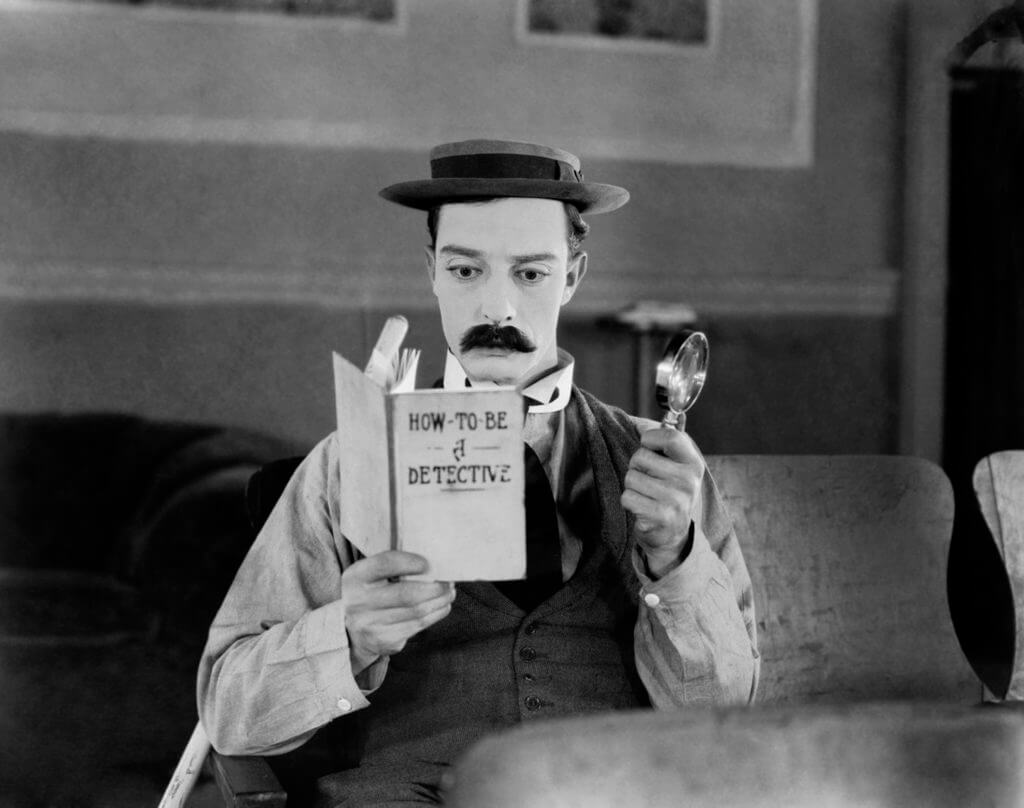
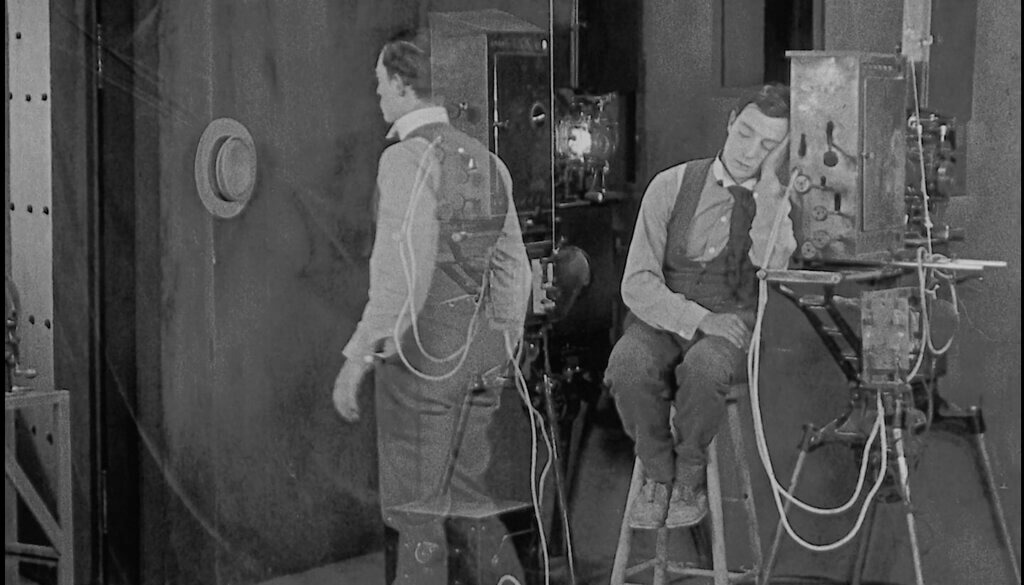
Keaton plays a projectionist who also cleans the theater, studies detective manuals, and hopes to marry a young woman played by Kathryn McGuire. When a rival frames him for stealing her father’s pocket watch, he falls asleep in the projection booth. His dream-self then leaves his body, walks down the theater aisle, and enters the film playing on the screen. Inside that film, he becomes the sophisticated detective Sherlock Jr. and receives the competence, authority, and romantic confidence that his waking life has denied him.
But Sherlock Jr. is much more interesting than its plot summary suggests. The projectionist is not merely a poor man who wants to become a detective. He is someone whose entire social position is defined by making other people’s fantasies possible while remaining invisible himself.
He operates the projector, cleans up after the audience, and watches stories in which other people possess the confidence and agency he lacks. The theater is therefore both his workplace and his imagined escape route. When he enters the screen, he is not just entering a fictional world. He is crossing from the position of spectator and servant into the position of protagonist.
That shift gives the film a surprisingly sharp class dimension. Sherlock Jr. commands attention because the dream temporarily removes the conditions that made the projectionist seem insignificant. He has the right clothes, the right posture, and the right narrative. The film does not suggest that he has discovered a hidden heroic essence. It suggests that heroism is partly a costume supplied by a social and cinematic system.
Keaton’s body makes this argument more clearly than any intertitle could. His famous deadpan expression is not an absence of emotion. It’s a refusal to tell us how we are supposed to interpret the disaster unfolding around him. His body stays precise while the world becomes impossible. He is thrown from one location to another, stuck in elaborate physical traps, and placed in danger by cuts that transform space before he has time to understand it.
The result is funny because Keaton does not perform surprise in the usual comic manner. He treats each impossible event as a practical problem. If the scene changes, he adjusts. If a bomb is hidden inside a billiard ball, he clears the table without striking it. If the film suddenly relocates him from a rocky landscape to a snowy one, he continues moving as though the universe has merely made an administrative error.

The sequence in which Keaton enters the film remains its great formal achievement. A projectionist walks toward the screen, and editing turns the screen into a doorway. He is suddenly surrounded by new settings, new dangers, and new narrative rules. The trick is technically ingenious, but its philosophical force comes from how casually Keaton presents it.
This is why Sherlock Jr. still belongs in conversations about self-reflexive and postmodern cinema, even though applying the word “postmodern” to a 1924 comedy is not all that precise. The film draws attention to its own construction, exposes the artificiality of editing, and makes the act of spectatorship part of the story. I have written about those qualities in my list of lesser-known postmodern films, but Keaton’s achievement is more than a demonstration of cinematic cleverness. The film’s formal experimentation expresses an emotional need.
Buster does not enter the screen because he wants to lecture us about film grammar. He enters because ordinary life has made him feel powerless. The dream gives him a version of himself who can interpret clues, defeat criminals, and win the approval of the woman he loves. His fantasy is built from the conventions of Classical Hollywood: a clear villain, a threatened woman, a sequence of escalating obstacles, and a hero whose competence restores romantic order.
That structure is both the joke and the limitation. Sherlock Jr. becomes powerful only after the film supplies him with a role that already knows what a hero is supposed to do. He does not create a new identity from nothing. He borrows the gestures of detective fiction and allows the genre to organize his behavior for him.
The waking world is not transformed by the dream. The rival is still a rival, the misunderstanding still exists, and Buster is still the theater employee who was mistaken for a thief. His fantasy provides emotional knowledge, not political liberation. It shows him how to act, but it does not change the conditions that made him want to escape.

The ending makes that distinction especially clear. After waking, Buster imitates the romantic behavior he observed in the film playing on the screen. Cinema is now his instruction manual. He cannot simply transfer the dream into reality, but he can borrow its gestures and adapt them to his own life. The final joke punctures the fantasy of perfect imitation, reminding us that real intimacy is more awkward than a scripted romance.
This is also where the film’s famous self-reference becomes more than a prediction of later self-reflexive cinema. Sherlock Jr. understands that films do not merely entertain us. They teach us how to move, how to desire, how to imagine success, and sometimes how to perform identities that our ordinary circumstances do not permit. Buster is not liberated from fiction. He survives by learning how to use fiction without confusing it with reality.
I would not call the film flawless. The waking-world romance is thin, and McGuire’s character is given little opportunity to exist outside the role of the girl Buster wants to impress. The rival is more of a plot mechanism than a person, and the dream narrative sometimes feels like a sequence of brilliant comic ideas searching for a story capable of containing them. At roughly forty-five minutes, Sherlock Jr. is short enough that its episodic structure never becomes exhausting, but it also leaves the real-world conflict underdeveloped.
Those limitations caught my attention because the film’s dream is so much richer than its romance. I remember the projection booth, the screen, the astonishing changes of location, and the geometry of Keaton’s body more vividly than I remember the supposed love triangle. The film’s emotional center is not really whether Buster gets the girl. It’s the moment when a person who has spent his life maintaining someone else’s fantasy briefly discovers that he can occupy one himself.
That discovery is still exhilarating. Keaton’s stunts are impressive, but the film’s deeper achievement is the way it connects physical comedy to an idea about identity. A person can be pushed around by social circumstances and still possess the ability to imagine another way of moving through the world. The imagination may not be enough to change reality, but it can reveal which parts of reality have been accepted merely because they were presented as natural.
This is why Sherlock Jr. continues to feel alive rather than merely important. Its technical innovations are no longer mysterious to viewers who have grown up with digital effects and rapid editing. Yet the emotional fantasy remains familiar. Most of us have imagined becoming more capable, more attractive, more decisive, or more deserving of attention. Keaton turns that private wish into a literal cinematic gag: the spectator steps into the story and discovers that the story has its own rules.
Sherlock Jr. is therefore both a love letter to cinema and a gentle warning about its power. The screen can offer freedom, but it offers freedom in pre-existing forms. It can help us imagine a different self, but it cannot decide whether that self will survive outside the theater. Keaton understands both sides of the fantasy, which is why his film remains funny, formally astonishing, and unexpectedly moving a century later.
Sherlock Jr. (1924) Film Rating: ★★★★½ out of 5
If you’d like to watch Sherlock Jr. (1924), it’s currently available to stream, rent, or purchase via Amazon.
For more on silent cinema, read my list of the 10 Best Silent Films for Philosophy Students.
Discover more from Philosophy in Film
Subscribe to get the latest posts sent to your email.
