
Nebraska and Happy People: A Year in the Taiga—Escaping Modernity
Originally published June 2, 2016. Updated August 26, 2026. This essay contains spoilers.
Few films appear less comparable than Alexander Payne’s Nebraska (2013) and Werner Herzog and Dmitry Vasyukov’s Happy People: A Year in the Taiga (2010). Nebraska is a black-and-white fiction film about an aging father and his son crossing the American Midwest. Happy People is a documentary assembled from Vasyukov’s footage of trappers living in and around Bakhta, a remote village in the Siberian taiga.
What connects the films is not their plot or form, but their use of landscape. Both take place far from the economic and political centers of contemporary life. Yet their landscapes carry opposite meanings. Nebraska depicts communities that remain entangled with consumer capitalism but have largely been abandoned by its promises. Happy People presents craftsmanship, self-reliance, and geographic isolation as possible sources of freedom.
Neither film depicts a literal escape from modernity. Woody Grant’s journey begins with a mass-mailed fantasy of wealth, while the Siberian trappers use manufactured tools and sell furs through a market economy. Still, both films suggest that happiness might become more attainable when dependence on money, bureaucracy, and consumer aspiration begins to loosen. Through their contrasting landscapes, Nebraska and Happy People ask whether modern life has made people freer—or simply more dependent.
What Modernity Means in These Films
For the purposes of this essay, modernity does not simply mean anything recent. It describes a social order increasingly organized through markets, industrial production, bureaucracy, communication networks, and dependence on distant institutions. Its promises include convenience, mobility, abundance, and greater control over the world. Its costs may include impersonality, consumer dependency, and the loss of practical self-sufficiency.
This understanding is loosely related to Max Weber’s account of modern rationalization, which emphasizes the growing influence of calculation, bureaucracy, capitalism, and technological control.
Neither Nebraska nor Happy People is a theoretical work, however. The films dramatize two different positions within modernity: people who have been left behind by its promises, and people who appear capable of living at its margins.
Nebraska: Consumerism and a Landscape Left Behind
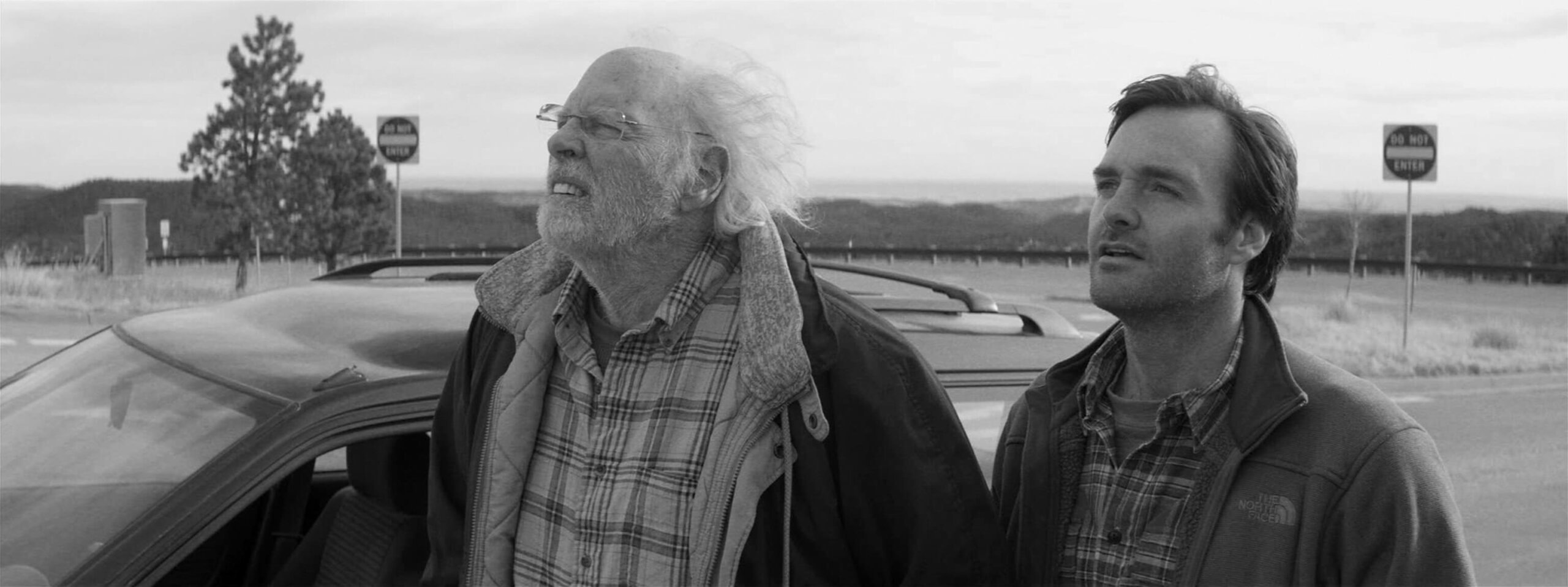
In Alexander Payne’s Nebraska, Woody Grant (Bruce Dern) is found walking along a Montana highway. He believes that a sweepstakes letter has awarded him one million dollars and intends to travel to Lincoln, Nebraska, to collect it. His son David (Will Forte) understands that the letter is a marketing scam, but after repeatedly failing to dissuade his father, he agrees to drive him there.
Their journey takes them through Woody’s hometown of Hawthorne, Nebraska. What begins as a darkly comic road trip gradually becomes a return to a community organized around memories of land, work, debt, resentment, and missed opportunity. As in many road films, the scenery is not merely decorative. Payne mixes wide expanses of farmland with empty main streets, aging buildings, and bars whose occupants seem to exist outside the normal movement of time.
Payne grew up in Nebraska and has repeatedly returned to the state in films including Citizen Ruth, Election, and About Schmidt. For Nebraska, he and cinematographer Phedon Papamichael used black and white to give the landscape a weathered, almost historical quality. Payne has said that the screenplay itself seemed to demand black and white, while Papamichael described the landscapes as reflections of the characters’ psychological journey in an interview with Filmmaker Magazine.
Hawthorne is not presented as a place simply destroyed by technology or industrialization. It is a place bypassed by economic change. Its residents remain surrounded by the promises of prosperity, but few appear to have benefited from them. Older characters retreat into memories, younger characters appear stalled, and entire conversations unfold among people who have nowhere else to go. People simply are. They exist, and that is enough.
The sweepstakes letter condenses the promise of consumer capitalism into a single piece of direct mail: money will repair age, humiliation, family conflict, and lost status. Woody says he wants a new truck and an air compressor, but the objects represent more than practical purchases. They would provide visible proof that his life amounted to something. Once news of the supposed fortune reaches Hawthorne, relatives and former acquaintances suddenly believe that they deserve a portion of it.
The ending complicates a simple rejection of material possessions. David uses his own money to buy Woody the truck and air compressor, allowing his father to drive through Hawthorne and briefly command the respect he had been denied. The objects still matter, but not because they deliver the happiness promised by the sweepstakes letter. They become a means through which David restores a measure of dignity to his father. Modern consumer goods are not rejected so much as separated from the fantasy that wealth alone can repair a life.
Happy People: Self-Reliance in the Siberian Taiga
Happy People: A Year in the Taiga was created from Russian filmmaker Dmitry Vasyukov’s four-part television documentary about life in the Siberian taiga. Werner Herzog condensed and reshaped that material for an international audience, adding his own narration. The finished film follows the residents of Bakhta through four seasons, paying particular attention to trappers such as Gennady Soloviev and Nikolay Siniaev.
The taiga is a vast boreal forest, not a tundra. Bakhta lies along the Yenisei River and can ordinarily be reached only by boat or helicopter. Its isolation requires its residents to possess skills that most people in industrialized societies have outsourced to specialists, manufacturers, and public infrastructure.
The trappers build and maintain cabins, carve wooden skis, construct traps, repair equipment, prepare food, and produce mosquito repellent from boiled tree bark. Their work is dangerous and physically exhausting, but the film presents their practical knowledge as a form of autonomy. They do not merely consume finished products; they understand the tools and materials upon which their survival depends.
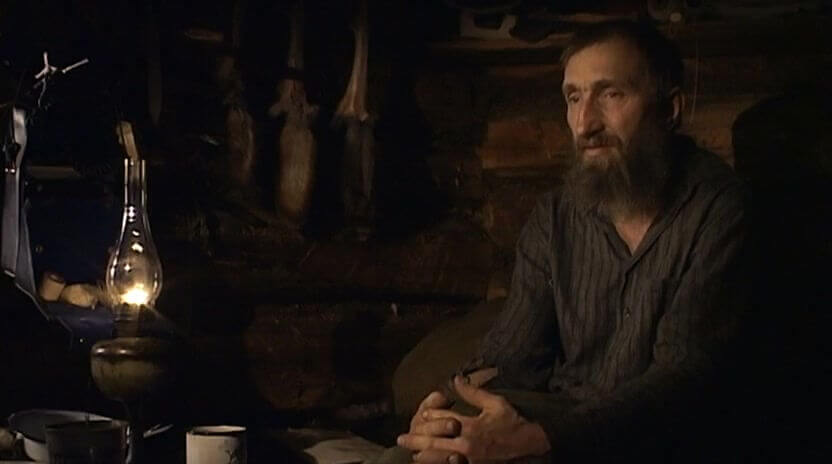
Nikolay explains that material possessions can be taken from a person, “but you cannot take away his craftsman skill.” The distinction is central to the film’s understanding of freedom. Possessions create comfort, but knowledge creates resilience. A person who knows how to make, repair, hunt, and build retains something that cannot be lost through unemployment, inflation, or the failure of an institution.
The handmade skis offer the film’s clearest example. Nikolay argues that factory-made skis are poorly suited to the region, while the skis he makes himself reflect generations of accumulated knowledge. His independence does not come from rejecting every tool associated with modern life. It comes from understanding his environment well enough to decide which tools are useful and which are inadequate.
My review of Home (2008) examines the opposite situation: modern infrastructure arrives at an isolated household and destroys the separation that once sustained it. In Happy People, isolation remains difficult but productive. It forces the trappers to maintain skills that industrialized societies have allowed to disappear.
This does not mean that the trappers “live off the land and nothing else.” They use firearms, snowmobiles, chainsaws, outboard motors, and factory-made clothing. They also sell furs through a larger market. As Steven Boone observes, much of their technology is manufactured even when their shelters, skis, traps, and other equipment are built by hand.
Herzog nevertheless pushes their autonomy into explicitly political language. When the trappers leave the village, he calls them “happy people” and emphasizes the absence of “rules,” “taxes,” “government,” “bureaucracy,” and modern communications. His narration transforms practical self-reliance into a romantic vision of freedom.
That vision should not be accepted without qualification. The trappers remain connected to families, markets, laws, and manufactured technology, while the film devotes far more attention to male independence than to the work performed by the women who remain in the village. Their freedom is therefore partial and, to some degree, shaped by Herzog’s selective narration. What the film depicts most convincingly is not an existence outside modernity, but an existence less dependent on its daily systems.
Can Anyone Really Escape Modernity?
The people of Bakhta do not describe themselves as unfortunate outsiders waiting to be rescued by modern development. When Gennady Soloviev learned that Herzog’s version of the documentary would be released internationally, he reportedly asked the director to ensure that audiences did not pity the community’s poverty and understood that the people of Bakhta were happy.
That statement supports Herzog’s interpretation, but it does not prove that Bakhta exists outside modernity. The trappers sell what they catch, use manufactured equipment, and rely on the village and their families. The cameras recording their lives, and the international distribution of the resulting film, connect them to the same global networks from which they initially appear separate.
Their remoteness nevertheless changes the character of that connection. Modern institutions remain present, but they do not organize every part of the trappers’ daily existence. A broken tool can often be repaired rather than replaced. Survival depends upon direct knowledge of forests, rivers, weather, and animals. Work may be relentless, but its purpose and consequences remain visible.
This is where Happy People most clearly diverges from Nebraska. Hawthorne is geographically accessible but economically stranded. It receives modernity’s promises—wealth, mobility, consumption—more reliably than it receives their benefits. Bakhta is geographically isolated, yet the documentary presents its residents as capable, purposeful, and deeply connected to their surroundings.
The distinction also explains the different emotional effects of the films’ landscapes. Nebraska uses empty roads, deteriorating buildings, and flat horizons to suggest exhaustion and suspended possibility. Happy People presents an even harsher environment, but fills it with purposeful activity. One landscape appears to have been drained by promises originating elsewhere; the other acquires meaning through the work performed within it.
Neither film proves that simplicity automatically produces happiness. Life in Bakhta involves danger, isolation, physical hardship, and long separations from family. Nor does Nebraska suggest that consumer goods are inherently corrupting. David’s gift to Woody demonstrates that material objects can express love and restore dignity. The problem is the belief that wealth can substitute for those things.
My analysis of Villa Amalia considers a more deliberate attempt to abandon the obligations and comforts of modern life. In all three films, escape is less a geographic destination than an effort to reduce the systems, expectations, and possessions that have come to define a person’s identity.
Both Nebraska and Happy People: A Year in the Taiga ultimately turn landscape into a moral argument. Nebraska shows the promise of wealth reaching people more effectively than prosperity itself. Happy People imagines freedom as practical competence, meaningful work, and reduced dependence on bureaucracy. Neither film offers a complete escape from modernity, but both ask whether convenience and abundance have made people happier—or merely less capable of living without them.
Sources
“Max Weber.” Stanford Encyclopedia of Philosophy.
Boone, Steven. “Happy People: A Year in the Taiga.” RogerEbert.com, January 23, 2013.
Gilbey, Ryan. “Nebraska—Road to Nowhere in America’s Midwest.” The Guardian, December 1, 2013.
Payne, Alexander. “‘It Found Its Way to Me Exclusively Because of the Title’: Alexander Payne on Nebraska.” Filmmaker Magazine, November 2013.
Sharkey, Betsy. “Happy People: A Year in the Taiga Shows Culture Frozen in Time.” Los Angeles Times, February 14, 2013.
“Happy People: A Year in the Taiga.” Music Box Films.
Discover more from Philosophy in Film
Subscribe to get the latest posts sent to your email.
