Chronicles of the Ghostly Tribe (2015) Review: A Beautiful Mess
Updated September 14, 2026. This review contains spoilers.
Chronicles of the Ghostly Tribe is visually impressive and occasionally thrilling, but its chaotic plot and baffling mythology make it a beautiful mess. Director Lu Chuan throws ancient aliens, demonic blue bats, giant monsters, a secret government agency, romance, reincarnation, and a portal to another dimension into one fantasy adventure. I wanted to enjoy the excess. Instead, I spent much of the film wondering which of its many half-developed stories I was supposed to care about.
The frustrating part is that there’s a fun monster movie buried somewhere inside it. The art design is frequently beautiful, the creatures are imaginative, and the story moves quickly enough to remain entertaining. Unfortunately, every new revelation makes the narrative less coherent rather than bringing its mysteries into focus.
Stream, rent, or purchase Chronicles of the Ghostly Tribe on Amazon.
Chronicles of the Ghostly Tribe is a Chinese fantasy-adventure film directed by Lu Chuan and loosely based on the popular Chinese fantasy novel series, Ghost Blows Out the Light by Zhang Muye. The story takes place in China throughout the late 1970’s and 1980’s, beginning with a large-scale excavation of mysterious caves hidden away in a snowy mountain range. A sudden and mysterious explosion halts the workers’ progress, and a small expedition sets out to investigate the source of the blast.
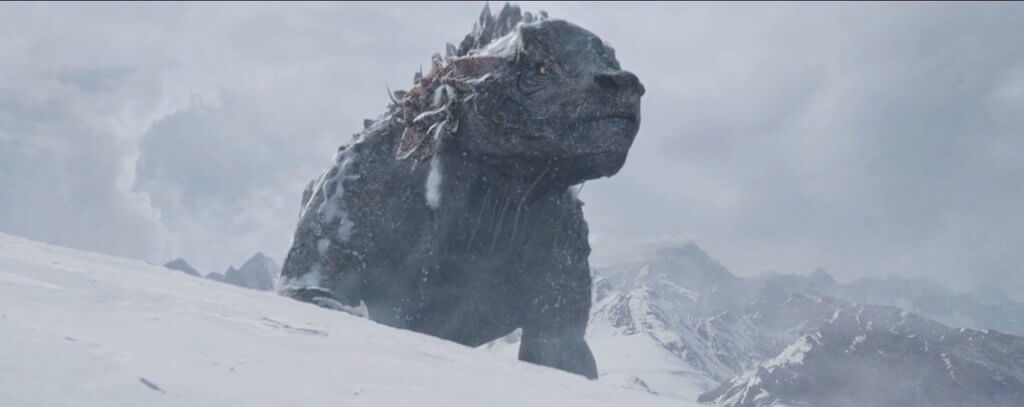
The group is led by a scientist named Professor Yang (Wang Qingxiang), his daughter, Yang Ping (Yao Chen), and the worker who has fallen in love with her, Hu Bayi (Mark Chao). Inside the cave, the group discovers strange fossils of large, dragon-like beasts (and evidence that some of these monsters are still living), as well as swarms of tiny, blue, bat-like creatures that incinerate anyone who touches them. While following the tracks of one of the giant beasts, the group finds a “Demon Pagoda” carved out of stone. Professor Yang manages to open a portal in the structure, releasing thousands of ghosts into the cavern. Fearing for their lives, one of the workers closes the portal, causing the cavern to collapse and swarms of blue bats to descend on the group. They attempt to escape, only to encounter the large creature that they had been pursuing, which takes Yang Ping in its jaws. Hu Bayi is the only one of the group to return to the excavation site, and he spends the following years trying to unlock the mystery of the ghostly tribe and bring back his lost love.
If the plot to Chronicles of the Ghostly Tribe sounds confusing, that’s because it is; and the above synopsis only covers the first 30 minutes of a nearly 2 hour film. Besides being confusing, one of the central issues is that the filmmakers clearly bit off way more than they could chew when developing the story. It’s as if they couldn’t decide which elements from the novels were the most pertinent, so they just jammed as many different plot lines in as possible; sort of a “quantity over quality” approach to storytelling. Instead of following a single thread from start to finish, the plot branches off in various different directions, none of which is ever fully realized to anyone’s satisfaction. The characters offer some rather uninteresting exposition to explain events from the beginning of the film, but none of them make all that much sense, and most of the questions the plot raises are explained away with the nonsensical “magic” of the Demon Pagoda. Hu Bayi and Yang Ping, as it turns out, are of vital importance to the mystery of the Ghostly Tribe, but there is no logical reason given for their status as “the chosen ones.”
The problem is not simply that the film contains too much information. Some fantasy worlds become more compelling as their rules accumulate. Here, each explanation replaces one mystery with several unrelated rules. Characters disappear, timelines jump forward, identities change, and new organizations arrive carrying information that the audience needed much earlier.
The film rarely allows Hu Bayi to discover anything through his own decisions. Other characters explain the mythology to him, send him toward another location, or reveal that he possesses an importance he never earned through action. A much simpler creature feature such as Howl creates more tension because its characters and audience learn the danger together. Chronicles of the Ghostly Tribe repeatedly interrupts danger so someone can deliver another piece of mythology.
This brings us to the titular “Ghostly Tribe,” which is hardly even present in the majority of the film, and for some reason this group is lumped together with the monsters that occupy the same cave. They both exist within the same realm, and pose some kind of existential threat to mankind, but we never really learn anything compelling or worthwhile about them. What we do learn is that the tribe is an ancient race that used to live on Earth, but has been relegated to some other dimension, along with the giant dragon creatures and the small blue bats. It’s implied that their release from the Demon Pagoda would be disastrous to the human race, but we never really see the damage they are theoretically capable of; we only see the monsters that accompany them.
The Ghostly Tribe is eventually identified as an ancient extraterrestrial race that once threatened humanity before being forced into another dimension. That explanation does not make the title any less misleading. The tribe remains more of a collection of ideas than a tangible presence, while the monsters receive most of the screen time.
The film briefly approaches the unease found in cosmic horror films: human history turns out to be one small part of a much older, nonhuman conflict. Yet the discovery never changes Hu Bayi’s understanding of humanity or his place within it. What might have become a confrontation with human insignificance becomes another reason to stage a monster fight.
The uncertainty surrounding the creatures could also have been interesting. They occupy an unstable space between ghosts, demons, prehistoric animals, and extraterrestrial beings. Rather than turning that inability to categorize them into a source of horror, however, the film treats every category as interchangeable. The mystery expands, but it never deepens.
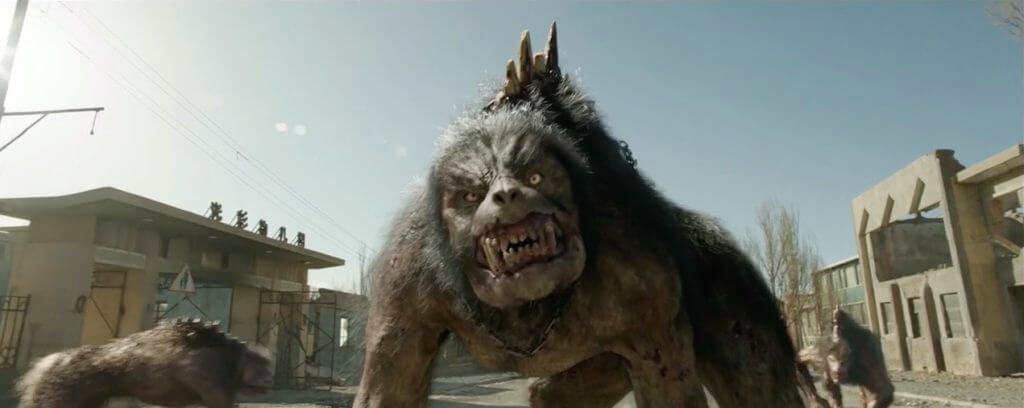
Large segments of the film are just dedicated to fights between the groups of adventurers and the large dragon creatures, but these sequences are really nothing more than CGI spectacles. And even though the visuals are generally well-executed, occasionally the special effects are subpar, particularly during some of the more complexly choreographed scenes. The film clearly had a large budget, but some of the fight scenes between live humans and CGI monsters just feel awkward and poorly produced.
But as needlessly complicated as the fantasy elements of the film are, the love story is equally confusing. Hu Bayi quickly falls in love with Yang Ping, who then gets taken by the monster. He later meets someone named Shirley, who looks exactly like Yang Ping, with the difference that she seems to have evil intentions. However, there still seems to be some kind of love connection, and through inane Demon Pagoda magic, Hu Bayi might be able to save Yang Ping, even though she is now evil and possibly part of the Ghostly Tribe, or maybe not. Who knows. I’m not even sure the screenwriters know, and they clearly had no intention of explaining things clearly for the audience.
As far as the performances go, the actors seem to do the best they can with the script they were given. Mark Chao gives Hu Bayi enough sincerity to remain likable, even when the character is being carried from one revelation to another. Yao Chen has the more difficult task. She must represent Hu Bayi’s lost love, a potentially dangerous double, and a living connection to the Ghostly Tribe without receiving enough coherent material to unite those roles.
The performances consequently mimic the shallow tone of the material. These characters rarely exist beyond exposition, destiny, romantic longing, and reaction shots. Their emotional responses tell us that a revelation matters, but the screenplay has not always done enough to make it matter to us.
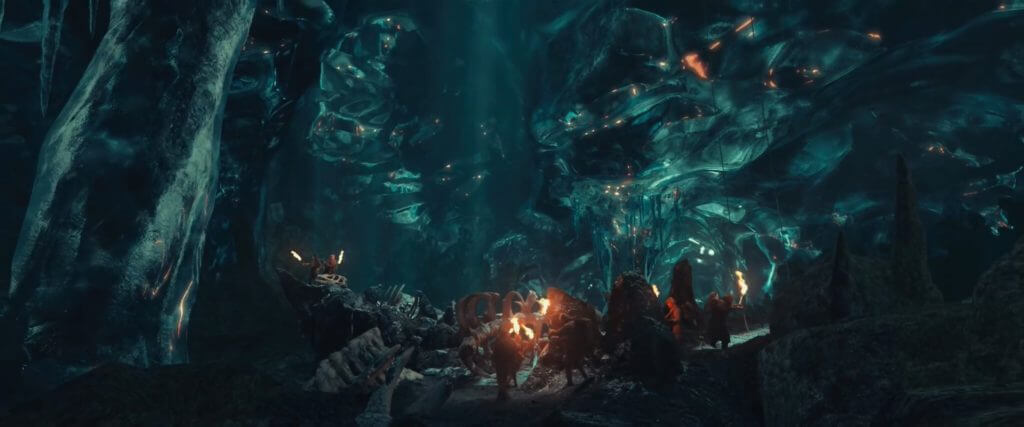
The monsters and environments are much more memorable. The Demon Pagoda, underground caverns, flaming blue bats, and abandoned settlements give the film an impressive visual scale. Like the beautiful but hollow spectacle of Ghost in the Shell, however, Chronicles of the Ghostly Tribe demonstrates that visual polish cannot supply emotional depth that the screenplay has neglected to create.
By the final act, the film has identified the Ghostly Tribe as an ancient alien race, connected Hu Bayi to Prince Yi—the human leader who once defeated it—and treated Shirley as the transformed or recovered Yang Ping. These revelations are supposed to unite the expedition, the Demon Pagoda, Hu Bayi’s survival, and Shirley’s supernatural abilities.
Instead, they function like a glossary delivered after the audience has already needed the definitions. Learning that Hu Bayi possesses a special ancestry does not explain why the film withheld that information for so long, and learning more about Shirley does not give their love story the emotional development it lacks. The ending provides information without producing clarity.
That is why the conclusion feels strangely overexplained and unfinished at the same time. It answers factual questions about the mythology while leaving the more important narrative questions unresolved: who these people have become, what their experiences mean to them, and why the audience should feel invested in whatever happens next.
You might think that I’m being overly critical. After all, many fantasy-adventure films are over-the-top with their ambitions, and offer very little in the way of a logical or grounded narrative structure. But Chronicles of the Ghostly Tribe takes things a step further and gets absolutely ridiculous in the final act. With all of its many faults, the ending is perhaps the most disappointing part of the entire film. The explanation for the events of the first half of the film is only revealed in the last few minutes, but there are still questions left unanswered. It seems as though the filmmakers wanted to leave open the possibility of a sequel, but if this was the case, it was not executed in an artful way. Instead, they end by answering all the questions we didn’t want answered, and none of the ones we did.
Though the plot is a mess and the end is frustrating for the audience, Chronicles of the Ghostly Tribe is still pretty entertaining. It’s mindless entertainment, but it’s entertainment nonetheless. The story, with all its strange turns and half-baked ideas, moves along at a steady pace, and the action sequences are adequately thrilling. So, if you’re looking to turn your brain off and just watch a fun movie for a few hours, The Chronicles of the Ghostly Tribe might just be the one for you.
Chronicles of the Ghostly Tribe (2015) Rating: ★½ out of 5
If you’d still like to watch the full movie, Chronicles of the Ghostly Tribe is available to stream, rent, or purchase via Amazon.
Discover more from Philosophy in Film
Subscribe to get the latest posts sent to your email.
