
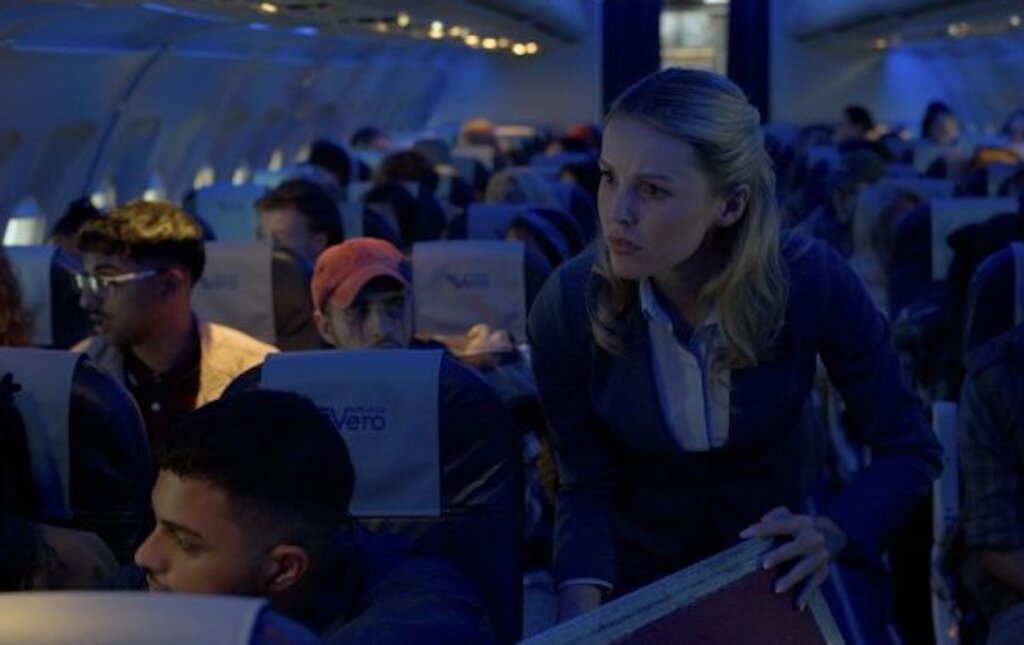
Black Box (2026) Review: Aliens on a Plane Can’t Escape the Formula
Black Box sells itself well: it’s aliens on a plane. Put a group of strangers inside a sealed metal tube, introduce something violent and not of this world, and let panic take care of the rest. I’m usually an easy audience for this kind of contained genre film. Unfortunately, Black Box spends most of its brief runtime demonstrating that a good elevator pitch still needs characters, coherent rules, and decent dialogue.
Rent, buy, or stream Black Box on Amazon.
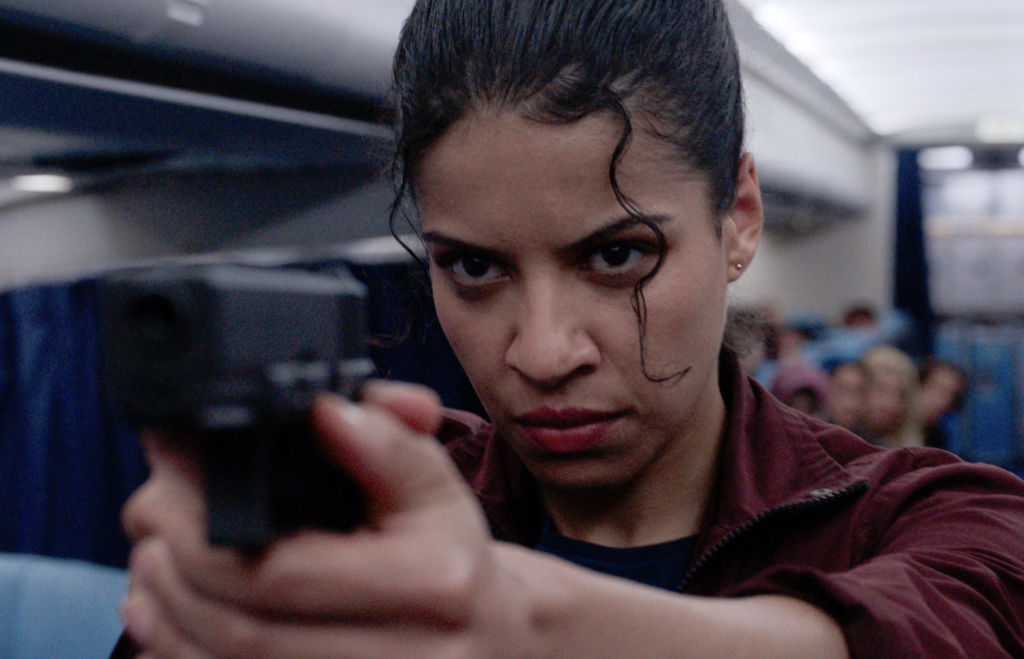
Directed by Steven Quale and written by Stephen Susco, the film follows Jeremy (Tom Brittney), a grieving man escorting his girlfriend’s body home after her death during a hiking trip. Before the flight has even taken off, an elderly passenger starts coughing, retreats to the lavatory, and emerges bleeding. Then the plane takes off anyway, because why not, and then passes through a strange cloud. Lights appear outside the windows, and the passengers discover that whatever has found them is not limited to the exterior of the aircraft.
The official trailer understands the appeal perfectly. This is “aliens on a plane,” delivered with the blunt efficiency of a straight-to-streaming creature feature. I wish the finished film had trusted that simplicity. Instead, it keeps reaching for the scale of a much more expensive alien-invasion thriller while relying on the most familiar pieces of the old Airport disaster formula.
You can practically identify every character’s function as soon as they appear. Jeremy is the decent, emotionally damaged protagonist who will eventually have to become heroic. There is a capable flight attendant, an air marshal, a frightened child, a conspiracy-minded passenger, and an aggressively selfish wealthy man in first class. The rich passenger is especially broad. He treats cooperation as an inconvenience and other people as disposable almost immediately, because the screenplay needs us to recognize the group’s designated coward as soon as possible.
These aren’t necessarily bad ingredients. Disaster films have always depended on recognizable social types. Part of the pleasure comes from watching people with different backgrounds and priorities become a temporary community under pressure. The problem is that Black Box rarely gives its passengers anything beyond those assigned functions. They don’t gradually reveal who they are. They announce it, usually through awkward exposition, and then behave exactly as the formula requires.
Jeremy is bland but functional at the center of it. His girlfriend’s death is meant to give the flight more meaning, particularly because her body is being transported in the cargo hold. That’s a grim and potentially effective detail. The film could have used the bizarre crisis to force Jeremy into a confrontation with grief, denial, or the physical fact of death. Instead, the subplot mostly supplies him with a tragic backstory and gives later scenes a convenient emotional pressure point.
I never felt that I knew the relationship he’d lost. We are told enough to understand why he’s sad, but not enough to make the grief meaningful. The script treats bereavement as a shortcut to depth, and Brittney is then asked to carry emotional beats that the writing never established. His performance isn’t the film’s worst problem, but he never turns Jeremy into someone more memorable than “the heroic passenger.”
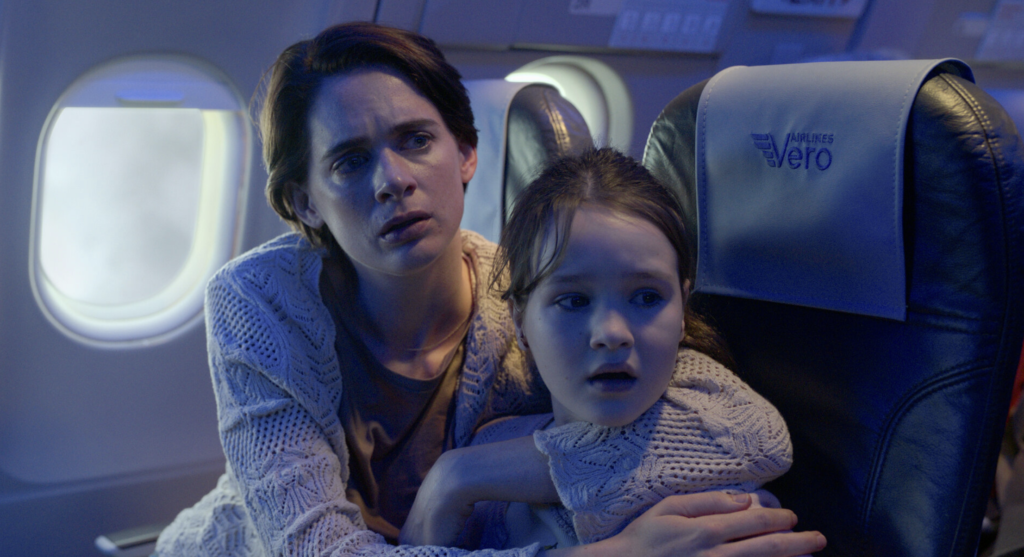
The supporting cast faces an even harder task. Much of the dialogue exists to explain the danger, challenge an obvious course of action, or remind us which passenger is selfish, frightened, competent, suspicious, and so on. Several performances feel shaky at best, but I’m not sure stronger actors could have made some of these exchanges sound natural. When characters exist primarily to resist Jeremy, believe Jeremy, or die near Jeremy, there’s only so much personality a performer can invent.
The production does get one important thing right: the airplane set is pretty convincing. The narrow aisles, low ceiling, divided cabins, lavatories, galley, and cargo area create a believable physical space. Even before the aliens attack, the setting produces useful tension. Everyone is trapped, movement is difficult, and any conflict can block the only route from one end of the cabin to the other.
The early sequence involving the sick passenger makes good use of that confinement. A man coughing behind a locked lavatory door works because there’s nowhere else for the crew or passengers to go. They cannot create a safe perimeter or simply leave the building. Whatever is happening is already sharing their air.
The film’s strongest stretch arrives when the aliens finally attack the cabin. Lights flicker, bodies are thrown through a cramped space, and panic travels fast. The tight geography helps disguise some of the budget limitations, and the sequence has a scrappy energy that much of the rest of the film lacks. For a few minutes, Black Box becomes the lean, nasty B-film promised by its premise.
That attack also highlights how much better the film works when it stops explaining itself. We don’t need another speech about who Jeremy used to be or another argument with the passenger in first class. An inhuman threat has entered a sealed cabin. The aisle is too narrow to escape it. That’s more than enough.
This is where I kept thinking about Sweetheart, another modestly budgeted monster film focused on a restricted location. Sweetheart understands that limited resources can become a style: keep the creature frightening, give the protagonist clear physical problems to solve, and use the environment as part of the threat. Black Box has the right environment but keeps trying to make the story larger than the production can support.
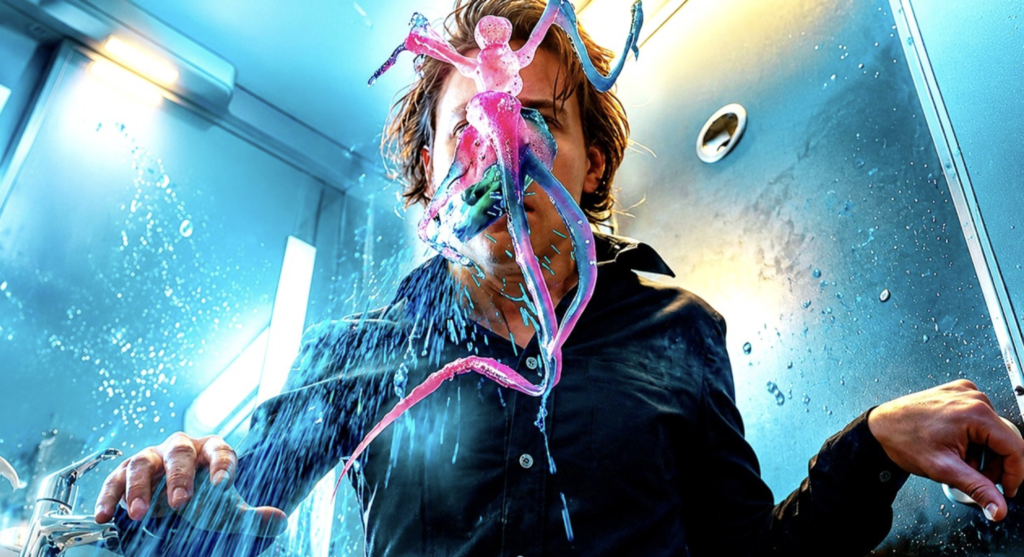
There’s nothing inherently wrong with inexpensive effects. Some of my favorite genre films reveal very little and allow sound, framing, or reaction shots to do the frightening work. Black Box, however, repeatedly asks its visual effects to sell phenomena they cannot convincingly realize. Exterior shots, strange skies, creature movements, and some of the more elaborate alien imagery make the production’s limitations hard to ignore.
The difference is not simply money. It’s judgment. A lower-budget film has to decide what it can show persuasively and build its suspense around those choices. Here, the filmmakers seem to be imagining the visual scale of a studio alien thriller while shooting a contained cabin film.
The creature effects also suffer from inconsistent presentation. The aliens are sometimes physical attackers, sometimes an invasive presence, and sometimes part of a larger form of manipulation that the film deliberately withholds. Ambiguity could have made them disturbing. Instead, their abilities and limitations seem to change according to what a scene needs.
At various points, I found myself asking basic practical questions: What can the creatures sense? What prevents them from attacking? How does their influence work? Why is one passenger vulnerable while another is not? A film doesn’t have to provide a technical manual for its monster, but it does need enough internal logic for survival decisions to matter.
That problem drains tension from several later scenes. If I cannot anticipate what the threat might do, I also cannot appreciate a character finding an intelligent way around it. Survival becomes a series of arbitrary reversals rather than a contest between human ingenuity and an alien predator.
I had a similar frustration with Devil’s Gate, which assembles recognizable alien-horror ingredients without finding a strong enough identity of its own. Black Box moves faster, and the plane is a better central location, but both films mistake accumulated genre signals for a fully developed world.
Without giving away the final turn, Black Box eventually hints that the incident aboard the plane belongs to something wider and more socially embedded than a random attack. The last few minutes introduce a faint echo of John Carpenter’s They Live: ordinary reality may be concealing a system of alien control that most people cannot—or will not—recognize. It’s easily the film’s most interesting idea. It’s also underdeveloped.
In They Live, the revelation reorganizes everything. The aliens are not simply monsters hiding among people; they embody exploitation and conformity. Black Box gestures toward a comparable possibility, but only after spending most of its runtime as a routine survival thriller. The ending feels less like the completion of an argument than a teaser for the more ambitious film this one might have been.
I think a lighter version of that idea could have strengthened the entire story. The passengers already represent a miniature social order: wealth in first class, workers responsible for everyone’s safety, official authority carried by the air marshal, and vulnerable people dependent on strangers. An alien threat that exploited those divisions would have given the stock characters a purpose. Instead, selfishness and cooperation mostly function as familiar disaster-film beats.
I can forgive a creature feature for being derivative when it is tense, funny, inventive, or enjoyably nasty. Black Box is rarely enough of any of those things. It borrows the passenger manifest from an airport film, the threat from an alien-possession story, and a final suggestion from They Live, but it never turns those borrowed pieces into a distinctive experience.
“Aliens on a plane” should have been the beginning of the fun. Here, it’s also the most complete description of what the film can offer.
Black Box (2026) Film Rating: ★½ out of 5
If you’d like to watch Black Box (2026), it’s currently available to stream, rent, or purchase via Amazon.
Discover more from Philosophy in Film
Subscribe to get the latest posts sent to your email.
