

The Filthiest Person Alive: Taste, Power, and the Right to Be Vile in John Waters’ Golden Era
John Waters has been called the “Pope of Trash” so often that the title may feel like a substitute for true analysis of his films. It gets at something real, of course. Few directors have devoted as much energy to dog feces, sexual deviance, bad mothers, criminal behavior, religious blasphemy, and people screaming obscenities at one another. Still, describing Waters as a filmmaker of bad taste does not tell us how bad taste actually functions in his work.
If shock were the only goal, the films would become more effective as they became more explicit. A bigger budget would give Waters more freedom to show things that earlier productions could only suggest. Yet the opposite happened. The five features Waters made between Multiple Maniacs (1970) and Polyester (1981) remain more dangerous than the better-funded films that followed. Their power does not come exclusively from what Waters puts on-screen. It comes from the way he turns taste into a contest over who deserves to be seen, admired, feared, or allowed to exist.
Between Multiple Maniacs and Polyester, Waters used bad taste to expose taste as a system of social and moral power. Bourgeois culture treats cleanliness, beauty, restraint, and respectability as signs that certain people deserve recognition. Waters responds with queer figures, criminals, bad mothers, sexual outsiders, and social rejects who demand visibility without first proving that they are sympathetic or morally admirable. However, his films do not present transgression as automatically liberating. His outsiders repeatedly reconstruct hierarchy around filth, beauty, celebrity, and political authority. Waters’ golden era therefore defends the right to be vile while showing that counterculture can reproduce the same competitions and exclusions it claims to oppose.
Pierre Bourdieu argues in Distinction that taste is never as private or innocent as it appears. People use cultural preferences to place themselves within social hierarchies. What we call refined, vulgar, beautiful, or tacky says something about the object being judged, but it also identifies the social position of the person making the judgment. Taste separates those who supposedly know better from those who do not. It converts familiarity with certain clothing, food, music, and art into cultural capital, allowing class distinctions to present themselves as natural differences in judgment rather than products of education and access (Bourdieu, 1984).
Waters understood this process instinctively. His films collapse the boundaries between high and low culture, but they do not pretend those boundaries have disappeared. The Dreamlanders wear cheap clothing as if it were couture. Amateur performances imitate the exaggerated behavior of Hollywood stars. Exploitation, melodrama, pornography, horror, and European art cinema exist alongside one another without being placed in their usual order of importance. As Emanuel Levy argues, Waters’ use of camp and trash directly opposes the standards of bourgeois taste that determine which forms of cinema can be taken seriously (Levy, 2015). His films do not ask permission to enter respectable culture. They build their own culture out of everything respectable audiences have already thrown away.

This resistance also has a moral dimension. Respectability politics generally describes the attempt by members of marginalized groups to improve their social position by demonstrating their ability to conform to dominant standards. It is an understandable strategy, particularly when exclusion carries serious material consequences. Yet it also accepts that the dominant culture has the right to decide which behaviors make someone worthy of protection or inclusion. Marginalized people may be accepted, but only after proving that they are polite, productive, sexually restrained, and otherwise inoffensive. Margot Dazey describes respectability politics as an inherently ambivalent strategy, since it can resist oppression while simultaneously accommodating the norms that sustain it (Dazey, 2021).
Waters refuses that bargain. His characters do not insist that queer people, drag performers, sex workers, criminals, or social outcasts are secretly just like everyone else. They are frequently selfish, cruel, ridiculous, and dangerous. This does not mean that Waters believes violence and abuse should be accepted without consequence. The right to be vile is not a legal right to harm other people. It is a representational and political claim: recognition cannot be conditional on moral perfection. If marginalized characters can only appear as victims, saints, or harmless eccentrics, their visibility remains controlled by the same people who excluded them in the first place.
Gayle Rubin’s “Thinking Sex” helps explain why this refusal worked as a foundation of Waters’ films. Rubin argues that societies organize sexual behavior into moral hierarchies. Certain forms of sex are treated as healthy, natural, and respectable, while others are associated with danger, sickness, or criminality. These categories are neither neutral nor permanent. They reflect the power to determine which pleasures can be publicly acknowledged and which people must remain hidden (Rubin, 2011). Waters does not respond by moving his characters from the disreputable side of the hierarchy to the respectable one. He questions why the hierarchy should exist at all.
Multiple Maniacs begins with the Cavalcade of Perversion, a traveling attraction operated by Lady Divine and Mr. David. The public is invited to stare at people presented as sexual and biological curiosities. The arrangement seems to confirm the normal audience’s superiority. They can enter the tent, observe the “perverts,” and leave with their identities intact. The spectators are supposedly respectable because they remain on the correct side of the display.
Waters immediately destroys that division. Lady Divine and her associates rob the audience at gunpoint, turning spectatorship into a trap. The paying public does not control the spectacle after all. The people placed on display seize control of the space and punish those who came to judge them. Linda Yablonsky describes Multiple Maniacs as the raw material Waters would later refine in Pink Flamingos, but she also notes that indignation, rather than obscenity alone, grounds his filmmaking (Yablonsky, 2017). The Cavalcade is funny because it reverses the expected relationship between observer and object. Those who came to confirm their normalcy discover that normalcy offers no protection.

Lady Divine does not become a conventional revolutionary in the process. She is a diva, murderer, cannibal, and jealous lover whose authority depends on the spectacle she creates. She refuses respectable society, but she still wants status. Her criminality becomes a kind of performance, and her violent behavior increases her power within the world of the film. Even at this early stage, Waters recognizes that rejecting one hierarchy does not prevent another from taking its place.
Pink Flamingos develops this idea into a complete social system. Divine, living under the name Babs Johnson, has been declared the “filthiest person alive” by a tabloid. The title gives her public recognition, but it also attracts Connie and Raymond Marble, who believe that they are more deserving of it. The resulting conflict is structured like a competition for wealth, beauty, or professional prestige. Its participants simply use filth as their chosen currency.
The Marbles are not rebels escaping capitalist society. They are entrepreneurs. They kidnap women, force them to give birth, and sell the babies. Their behavior is shocking, but it is also organized around production and profit. Divine’s family appears more communal by comparison, though it is hardly a model of ethical living. Babs responds to challenges against her reputation with murder, cannibalism, and public execution. She condemns the Marbles according to her own moral code, but that code exists primarily to protect her status.
The genius of Pink Flamingos is that filth never becomes egalitarian. One person must be the filthiest, which means everyone else must occupy a lower position. Babs does not want to eliminate the standards through which people are ranked. She wants to sit at the top. The film inverts bourgeois distinction without escaping its basic structure. Instead of competing over education, property, or refined cultural preferences, its characters compete over their willingness to violate social taboos.
This is where the right to be vile becomes more difficult than a simple celebration of nonconformity. Babs does not ask for empathy. Anna Breckon argues that Pink Flamingos replaces empathy with disgust as a possible basis for political and social relation. Disgust would normally allow the respectable viewer to reject what is seen. Waters instead makes disgust the very thing connecting the viewer to the film. We may recoil, but we remain fascinated. We keep watching (Breckon, 2013).

The infamous final scene completes this relationship. Divine does not merely simulate the consumption of dog feces. The act is real, and Waters makes certain that the audience knows it. The distinction between character and performer temporarily collapses. Divine proves not only that Babs is the filthiest person alive, but that the performer is willing to cross a boundary that the audience assumed would remain intact. The scene is not philosophically significant because eating feces is inherently radical. It matters because the viewer loses the ability to contain filth within fiction. The film forces us to recognize that our disgust is part of the spectacle and, consequently, part of the social hierarchy Waters has created.
Female Trouble replaces the competition over filth with a competition over beauty and fame. Dawn Davenport begins the film as a teenager furious that her parents have not bought her the cha-cha heels she wanted for Christmas. The gift has value because it represents the kind of person Dawn believes herself to be. She wants recognition of her glamour, maturity, and difference from the ordinary family surrounding her.
After leaving home, Dawn moves through prostitution, motherhood, robbery, modeling, and murder. Her life becomes a series of performances through which she attempts to acquire an audience. Donald and Donna Dasher finally provide one. They believe that beauty and crime are inseparable, photographing Dawn as she commits increasingly violent acts. When her face is disfigured with acid, the Dashers do not consider her ruined. Her physical transformation makes her more valuable because it brings her appearance closer to their anti-aesthetic ideal.
Ed Halter argues that Female Trouble collapses the distinction between beauty and ugliness while presenting crime as an alternative artistic value (Halter, 2018). However, the film does not simply declare Dawn beautiful and leave it at that. Her beauty depends on the Dashers’ approval. She has exchanged one group of cultural authorities for another. They turn her body and crimes into art, then use that art to establish their own superiority over conventional society.

Dawn eventually becomes a celebrity, but celebrity does not free her. During her nightclub performance, she asks who is willing to die for art before firing into the audience. The moment brings together everything she has learned about beauty, violence, and recognition. If art requires sacrifice, Dawn is happy to provide victims. Her subsequent trial and execution only give her a larger stage. She delivers her final speech as if accepting an award, grateful that her crimes have finally made her important.
Dawn’s trajectory resembles the conventional pursuit of fame, stripped of its respectable language. She seeks mentors, develops an image, cultivates an audience, and transforms personal suffering into publicity. Waters makes the process grotesque, but its underlying logic remains familiar. Dawn’s countercultural celebrity reproduces the same dependence on spectators, gatekeepers, and public approval that governs mainstream stardom.
Desperate Living pushes the argument beyond individual recognition and into political organization. Mortville initially appears to offer an escape from respectable society. It is a community of criminals, social rejects, and people who have nowhere else to go. If any place could exist beyond bourgeois morality, Mortville should be it.
Instead, the town is ruled by Queen Carlotta, an authoritarian monarch who maintains power through police violence and arbitrary punishment. The people living outside conventional society have constructed a miniature version of the system that rejected them. Mortville has its own ruling class, its own laws, and its own standards for determining who can exercise authority. The setting turns counterculture into a literal political order, revealing that marginalization does not automatically produce solidarity.

Peggy Gravel makes this problem even clearer. She arrives in Mortville after killing her husband with the help of her maid, Grizelda. Despite being treated as an outsider by conventional society, Peggy remains committed to class hierarchy and authoritarian control. She does not object to oppression as long as she can position herself near the people administering it. Her attraction to Carlotta’s rule demonstrates that rebellion against one social order can coexist with a desire to dominate others.
The people of Mortville eventually revolt, but Waters refuses to present their revolution as clean or morally uplifting. Carlotta is overthrown and cooked as part of a celebratory feast. The image is liberating, disgusting, and funny at the same time. Fascism has been defeated, but the new community expresses its freedom through cannibalism. Waters does not allow the revolution to become respectable enough for uncomplicated approval.
In Desperate Living, Waters grants outsiders political agency without granting them moral purity. Some organize against authoritarianism. Others support it. Some form genuine relationships, while others reproduce the violence they have experienced. Their marginal position does not make them inherently virtuous, but their lack of virtue does not justify their exclusion. They possess the same capacity for solidarity, selfishness, courage, and cruelty as anyone else.
Polyester brings the argument back to suburbia. By 1981, Waters had moved away from the rough 16mm appearance of his earlier films and toward a more polished production modeled partly on the melodramas of Douglas Sirk. Elena Gorfinkel describes the film as a departure from the low-rent style of the Trash Trilogy, though its criticism of social propriety remains firmly in place (Gorfinkel, 2019). The setting looks more conventional, but the Fishpaw household is no more ethical than Divine’s criminal family in Pink Flamingos.
Francine Fishpaw desperately attempts to preserve the appearance of a normal middle-class life. Her husband operates a porn theater and openly cheats on her. Her son attacks women’s feet. Her daughter becomes pregnant, and her mother exploits Francine’s misery whenever possible. The family maintains the physical structure of suburban respectability while abandoning almost every moral value that structure is supposed to represent.

The contrast exposes respectability as an aesthetic performance. The Fishpaws have a house, a family unit, and a recognizable place within suburban society. None of this makes them good. Their conventional appearance simply allows their cruelty and dysfunction to remain legible as family life. Waters’ earlier characters are treated as dangerous because they look and behave improperly. The Fishpaws demonstrate that proper appearances can conceal behavior that is just as destructive.
Odorama turns this criticism into a physical experience. Theatrical viewers were given cards containing scents that ranged from flowers and pizza to flatulence, gasoline, and dirty shoes. When a number appeared on-screen, the audience scratched the corresponding space and smelled along with Francine. Ido Rosen argues that Odorama should not be dismissed as a promotional gimmick. It carries the film’s subversive ideas beyond the image and into the viewer’s body (Rosen, 2022).
It also makes the politics of taste strangely literal. Pleasant and unpleasant odors occupy the same card. Roses do not possess a higher cinematic status than flatulence. The audience may continue to rank the smells, but the film forces them to experience each one through the same process. Polyester does not eliminate distinction. It reveals how quickly sensation becomes judgment and how easily judgment becomes a claim about what belongs in art.
This makes Polyester an appropriate ending to Waters’ golden era. It does not abandon the attack on respectable culture. It disguises that attack within a recognizable form. The film looks closer to a mainstream melodrama, but it still asks the audience to pay for the privilege of smelling dirty shoes and flatulence. Waters brings filth into suburbia without allowing suburbia to remain clean.
Seven years later, Hairspray (1988) completed Waters’ movement into more accessible filmmaking. It is arguably his most celebrated film, and certainly the one that has traveled furthest into popular culture. It inspired a Broadway musical and a large-scale Hollywood adaptation, while Waters’ original has received extensive critical and institutional recognition. The Criterion Collection describes it as the point where his subversive sensibility merged with a new “bubblegum sweetness.”
Hairspray remains politically subversive in important ways. It places Divine in a loving heterosexual marriage, celebrates a fat teenage heroine, and attacks racial segregation. Yet its outsiders are easier to accept because they are fundamentally good people. Tracy Turnblad is courageous, optimistic, and morally correct. Her opponents are bigots whose cruelty makes the distinction between right and wrong perfectly clear.
This does not make Hairspray a failure. Its accessibility is one of its greatest strengths. Still, it operates according to a different political logic than Waters’ earlier films. Tracy deserves inclusion because she is kinder and more open-minded than the people excluding her. The film asks the mainstream audience to recognize the humanity of an outsider who has demonstrated that she is worthy of recognition.
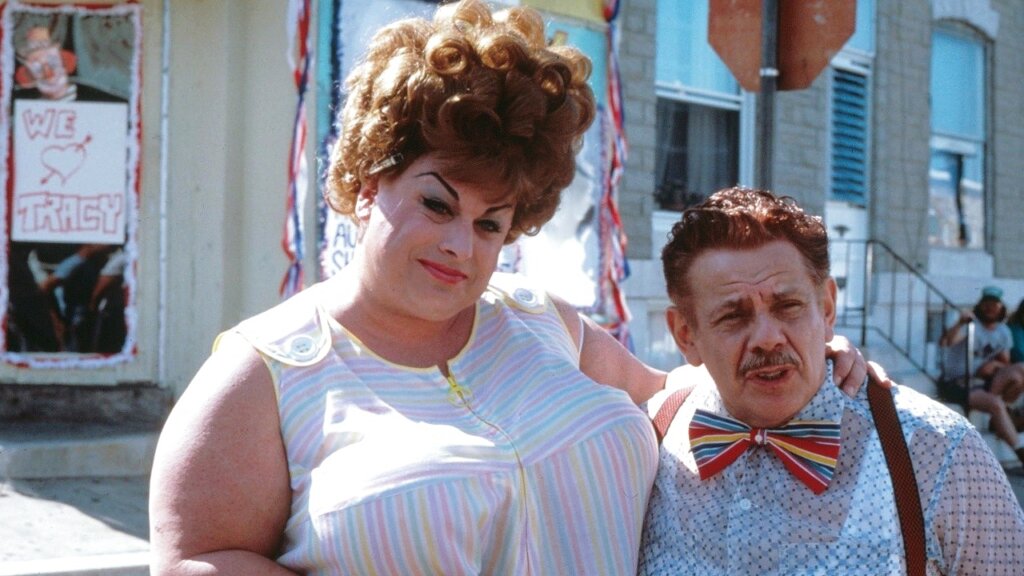
Babs Johnson never makes that demonstration. Neither does Dawn Davenport. Lady Divine would probably shoot anyone who asked. Waters’ golden-era films refuse to make social acceptance dependent on good behavior. Hairspray successfully brings outsiders into the mainstream, but it does so by making them respectable enough to enter.
Waters continued this strange new relationship with mainstream sensibilities throughout the 1990s and early 2000s, until A Dirty Shame in 2004. The film divides Baltimore between puritanical “neuters” and sexual “perverts,” seemingly returning Waters to the territory of his earlier work. Yet the filth has become curiously safe. Characters explain sexual terminology, trade juvenile innuendos, and perform a version of transgression that rarely becomes threatening, erotic, or especially funny.
As I argued in my review of A Dirty Shame, Waters pushed further with the $12,000 Pink Flamingos than he managed with a budget of roughly $15 million in 2004. The problem is not simply that money made him less creative. By that point, “John Waters” had become an established cultural brand. Filth could be reproduced with professional lighting, recognizable actors, controlled sets, and studio financing. It could receive an NC-17 rating while remaining far less confrontational than the films Waters made without a rating at all.
A Dirty Shame performs bad taste without challenging the power behind taste. Its perverts are harmless comic eccentrics, while its neuters are obvious hypocrites. The film tells us exactly whom to support and assures us that sexual deviance is nothing to fear. That message is agreeable, but it lacks the discomfort of Waters’ earlier demand. We are no longer asked to recognize people who may be selfish, cruel, or impossible to defend. We are asked to laugh at a collection of sanitized sexual references.
Taken together, Hairspray and A Dirty Shame are two opposing but equally effective examples of what made the period from 1970 to 1981 distinctive. Hairspray makes Waters’ outsiders respectable enough to enter the mainstream. A Dirty Shame makes transgression harmless enough to be sold by it. The golden-era films do something more difficult. They question why anyone should have to become respectable before being granted the right to exist.
Waters’ early films are not politically valuable because filth is inherently revolutionary. Pink Flamingos shows filth becoming a status symbol. Female Trouble turns crime into celebrity. Desperate Living allows an outsider community to reproduce authoritarian power. Transgression can become another form of cultural capital, complete with its own gatekeepers and hierarchies. There is no guarantee that people rejected by one social order will build a better one.
That uncertainty is precisely what gives the films their power. Waters does not offer positive representation in the conventional sense. He offers unconditional representation. His characters do not need to be admirable before they can command the screen. They can be glamorous and repulsive, oppressed and oppressive, ridiculous and frightening. They are permitted the full moral range generally reserved for respectable people.
Waters’ golden-era films remain offensive because they reject a bargain that much of progressive cinema continues to make: behave properly, demonstrate the correct values, and prove that you are just like everyone else, and perhaps you will be admitted. Waters’ reply is much ruder and philosophically harder. Admission means very little if the same gatekeepers still possess the authority to decide who deserves it.
Sources
Bourdieu, Pierre. Distinction: A Social Critique of the Judgement of Taste. Translated by Richard Nice, Harvard University Press, 1984. Harvard University Press
Breckon, Anna. “The Erotic Politics of Disgust: Pink Flamingos as Queer Political Cinema.” Screen, vol. 54, no. 4, 2013, pp. 514–533. Oxford Academic
Dazey, Margot. “Rethinking Respectability Politics.” The British Journal of Sociology, vol. 72, 2021, pp. 580–593. Wiley Online Library
Gorfinkel, Elena. “Polyester: The Perils of Francine.” The Criterion Collection, 17 September 2019. The Criterion Collection
Halter, Ed. “Female Trouble: Spare Me Your Morals.” The Criterion Collection, 26 June 2018. The Criterion Collection
Levy, Emanuel. “John Waters: Queer as Trash and Camp.” Gay Directors, Gay Films? Pedro Almodóvar, Terence Davies, Todd Haynes, Gus Van Sant, John Waters. Columbia University Press, 2015. Oxford Academic
Rosen, Ido. “Divine Smells: Odorama, Melodrama, and the Body in John Waters’ Polyester.” Open Screens, vol. 5, no. 1, 2022. Open Screens
Rubin, Gayle S. “Thinking Sex: Notes for a Radical Theory of the Politics of Sexuality.” Deviations: A Gayle Rubin Reader. Duke University Press, 2011, pp. 137–181. Duke University Press
The Criterion Collection. “Hairspray.” The Criterion Collection
Yablonsky, Linda. “Multiple Maniacs: Genuine Trash.” The Criterion Collection, 21 March 2017. The Criterion Collection
Discover more from Philosophy in Film
Subscribe to get the latest posts sent to your email.
