
Stoicism in Changing Lanes: Anger, Control, and Rational Choice
Originally published July 6, 2016. Substantially updated August 31, 2026.
A traffic accident lasts only a few seconds in Changing Lanes (2002). Everything that follows happens because two men cannot stop reacting to it.
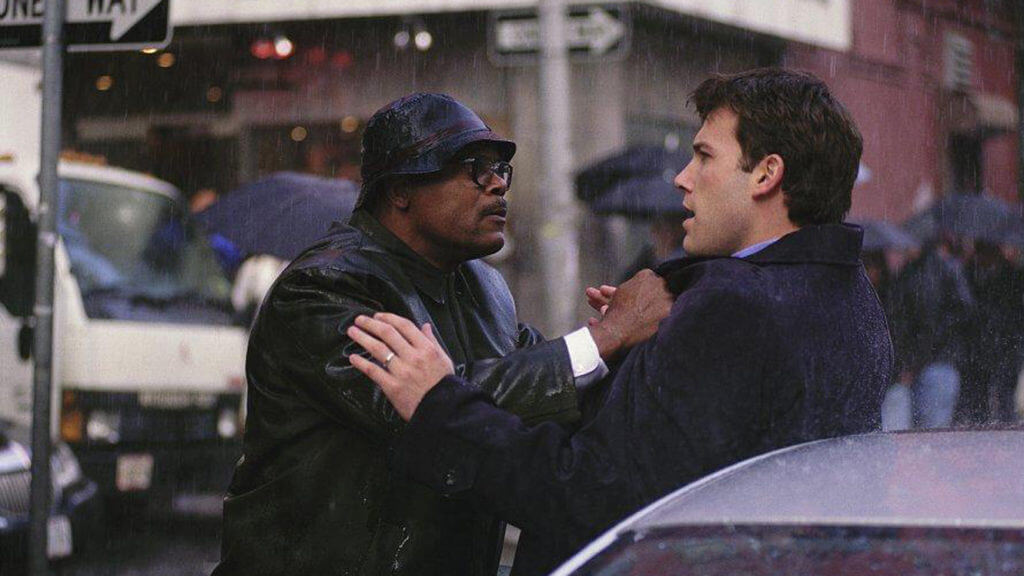
Gavin Banek (Ben Affleck) and Doyle Gipson (Samuel L. Jackson) begin as strangers rushing toward separate court hearings. Their collision is inconvenient but relatively minor. What transforms it into something destructive is the series of judgments, resentments, and retaliations that follow. Each man becomes convinced that the other has wronged him, and each responds by causing a greater wrong.
That makes Changing Lanes an unusually useful film through which to examine Stoic philosophy. Its central conflict is not really between two drivers. It is between external events and the judgments people make about them.
Stoicism is sometimes reduced to the idea that people should suppress their emotions. That description is misleading. Ancient Stoics were particularly concerned with pathê, usually translated as “passions”: excessive impulses connected to mistaken judgments about what is genuinely good or bad. According to the Stanford Encyclopedia of Philosophy, Stoic passions involve judgments that assign inappropriate value to things outside ourselves.
The difference matters. Changing Lanes is not Stoic because its characters eventually stop feeling anything. They remain angry, frightened, ashamed, and frustrated. Their transformation occurs when they stop allowing those feelings to determine what they believe they should do.
Stoicism therefore provides a surprisingly precise framework for understanding the film. Gavin and Doyle spend most of the story trying to control circumstances and one another. They become happier only when they begin exercising control over their own decisions.
Gavin is a successful young attorney working for a powerful New York law firm. Doyle is a recovering alcoholic desperately trying to regain some stability in his life and maintain a relationship with his children. Both are traveling to court when their cars collide.
Doyle wants to exchange insurance information and handle the accident properly. Gavin, worried that he will be late, offers him money instead. When Doyle refuses, Gavin leaves him stranded on the highway.
The immediate consequences are enormous.
Doyle arrives late to family court and loses an opportunity to argue for custody of his children. Gavin reaches his own hearing but discovers that an important legal document has been left behind at the accident scene. Doyle has found it.
What began as an ordinary collision now gives each man something the other desperately needs.
Their reasonable options disappear almost immediately beneath anger.
Doyle refuses to return Gavin’s file. Gavin retaliates by arranging for Doyle’s credit to be destroyed, threatening the house Doyle hoped to purchase for his family. Doyle responds with increasingly dangerous acts of his own. Each retaliation produces another retaliation until neither man is trying to solve his original problem anymore.
Both are simply trying to make the other suffer.
By the end of the day, however, Gavin and Doyle recognize what they have become. Doyle returns the file. Gavin offers to represent him and attempts to repair some of the damage he has caused. Gavin also uses the document to confront corruption within his own law firm.
The accident has not been undone. Doyle cannot simply recover the lost custody hearing. Gavin cannot erase the things he has done. What changes is their relationship to those events.
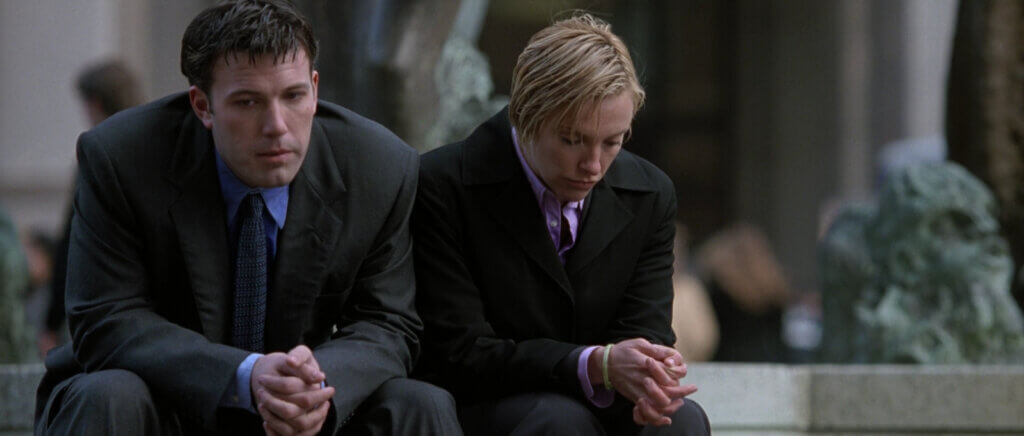
This progression closely resembles the Stoic account of passion and judgment.
For the Stoics, an external event does not automatically determine whether someone lives well. Wealth, reputation, physical comfort, professional success and many other circumstances belong to what Stoic philosophers called “indifferents.” Some are obviously preferable to others, but they do not possess the power to make someone virtuous or vicious on their own.
Our judgments about those circumstances are another matter.
Doyle losing his court hearing is a genuine misfortune in the ordinary sense of the word. Gavin losing his legal document is similarly serious. Stoicism does not require pretending that neither situation matters.
The problem begins when each man treats his misfortune as justification for abandoning reason.
Doyle’s anger at Gavin is understandable. But anger gradually turns into a belief that hurting Gavin will somehow repair what Gavin has done to him. Gavin makes the same mistake from the opposite direction. Recovering his document becomes so important that he convinces himself he is entitled to destroy Doyle’s financial life to obtain it.
Their passions do not merely accompany their actions. They distort their judgments.
This is where Changing Lanes becomes particularly effective as a film about Stoicism. The retaliation creates the conditions for further retaliation. Every attempt to regain control actually gives the other man greater influence over his life.
Gavin is furious because Doyle possesses the document he needs. Doyle is furious because Gavin has damaged his financial future. Each man therefore allows the behavior of someone he despises to determine his own behavior.
From a Stoic perspective, that is almost a perfect definition of surrendering one’s freedom.
The ancient Stoics argued that human flourishing comes from “living in agreement with nature,” which included bringing human reason into harmony with the rational order they believed structured the world. As the Stanford Encyclopedia of Philosophy explains, virtue was not simply one ingredient in a good life for the Stoics. Virtue was sufficient for happiness. Prudence, justice, courage and moderation were expressions of a rational character rather than rewards granted by favorable circumstances.
This idea produces one of the more difficult questions raised by Changing Lanes: Can someone really be happy when another person’s actions have materially damaged their life?
Doyle appears to demonstrate the problem.
At one point, he considers returning Gavin’s document. Before he can follow through, he discovers that Gavin has destroyed his credit. Doyle’s attempt to behave reasonably has seemingly accomplished nothing. Another person’s selfishness has intervened.
That seems like a strong objection to the Stoic position. Circumstances do matter. Poverty matters. Losing access to one’s children matters. A powerful attorney can harm someone in ways that positive thinking cannot magically reverse.
Yet Stoicism does not actually require Doyle to believe otherwise.
The distinction is between what Doyle can reasonably attempt to change and what he allows to govern his character.
He should fight for his children. He should try to repair his credit. He should hold Gavin responsible. Stoicism does not demand passivity in the face of injustice.
What it challenges is Doyle’s belief that revenge will restore what he has lost.
Once he begins retaliating, Gavin effectively controls him. Gavin does something cruel, Doyle responds cruelly, Gavin retaliates again, and Doyle reacts again. Doyle may feel that he is asserting himself, but his actions are increasingly being dictated by someone else.
The same is true of Gavin.
He is wealthy, professionally successful and surrounded by people willing to solve problems for him. Yet he is no more internally free than Doyle. The missing file takes control of his day because Gavin decides that preserving his professional position is worth almost anything.
This distinction between external circumstances and individual judgment is one reason Stoicism remains relevant to modern discussions of happiness. It also separates Stoicism from other philosophical traditions represented elsewhere on the site. My collection of films about the meaning of life asks what might make a life meaningful, while my guide to existential films places greater emphasis on freedom, choice and responsibility. Stoicism approaches the problem differently: the quality of a life depends primarily on the quality of one’s judgments and actions.
That also distinguishes Stoic happiness from the consequentialist account of happiness I discuss in my essay on John Stuart Mill and the Principle of Utility. Mill asks us to evaluate actions largely through the happiness and suffering they produce. Stoicism places far more weight on the rational and virtuous condition of the person acting.
Changing Lanes ultimately sides strongly with the Stoic view.
Gavin and Doyle do not achieve peace because their external problems disappear. Doyle’s family situation remains painful. Gavin still has to confront the corruption surrounding his career. Neither man can undo the damage of the previous several hours.
Instead, they stop treating revenge as something valuable.
Doyle returns the document even though doing so cannot restore everything he has lost. Gavin begins using his position to help Doyle rather than manipulate him. Most importantly, Gavin finally confronts the unethical behavior within his law firm instead of simply protecting his own status.
Their final actions reflect several of the traditional Stoic virtues at once: wisdom in recognizing their earlier mistakes, moderation in ending the cycle of retaliation, courage in accepting the consequences of their decisions and justice in attempting to repair the harm they caused.
The film’s version of Stoicism is not perfect. Changing Lanes sometimes comes close to suggesting that rational behavior will eventually produce a fair outcome, while real life offers no such guarantee. A person can act wisely and still lose. Someone can behave justly and still be treated unjustly.
The Stoic response is more demanding than the film’s relatively hopeful conclusion.
Virtue is valuable precisely because the world does not guarantee that it will be rewarded.
That idea gives Changing Lanes its philosophical weight. Gavin and Doyle initially believe happiness depends on forcing the world back into the shape they want. If Gavin gets his document, he will be fine. If Doyle gets revenge, justice will somehow be restored.
Neither belief survives the day.
What they can control is much smaller, but ultimately more important: whether the next decision reproduces the anger of the previous one.
The accident is outside them. The court hearings are outside them. Much of the damage they suffer is caused by circumstances they cannot completely control.
Their response belongs to them.
That is where Changing Lanes finds its strongest connection to Stoicism. The film does not show two men learning to feel nothing. It shows them learning that anger becomes most destructive when it is mistaken for a reason to act.
Sources
Stanford Encyclopedia of Philosophy. “Stoicism.” Stanford University. https://plato.stanford.edu/entries/stoicism/
Changing Lanes. Directed by Roger Michell, performances by Ben Affleck and Samuel L. Jackson, Paramount Pictures, 2002.
Discover more from Philosophy in Film
Subscribe to get the latest posts sent to your email.
