


This review contains some spoilers of the film’s ending.
I wanted to follow The Uprising into a dangerous, rebellious space. A film about the Peasants’ Revolt, released at a time in history when a handful of people control more wealth and tech than entire countries, has a lot to work with. It could make us feel the exhaustion of people who’ve been told to endure another tax, another demand, another indignity. It could ask what finally makes obedience impossible to bear.
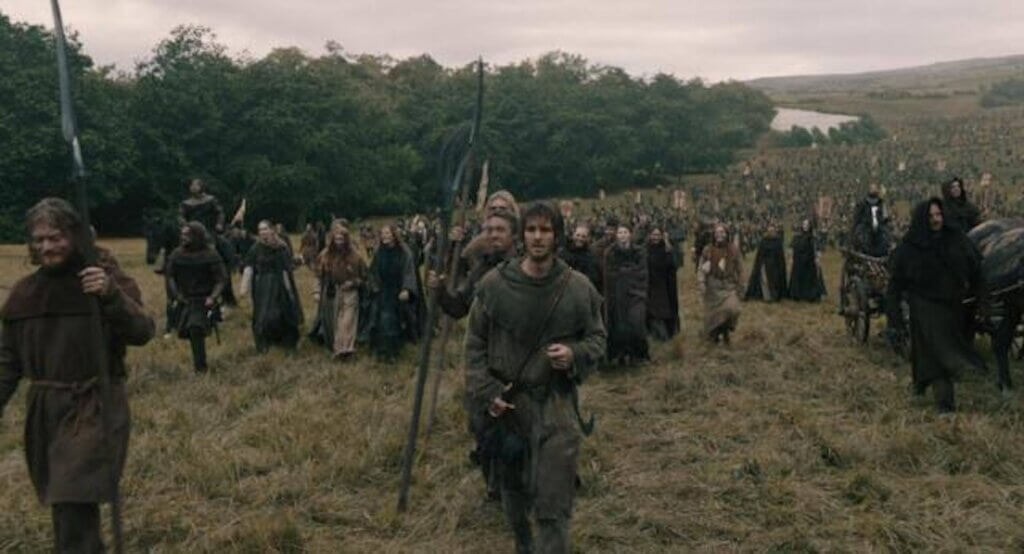
For a while, Paul Greengrass’s film looks as though it might do exactly that. Its crowds swell with violence and unrestrained rage. Then the march starts to feel endless. After two hours of bloody encounters and increasingly familiar showdowns, the film switches to something else: Robin Hood nonsense, offered as though a legend were the same as political change.
Check prices to stream, rent, or purchase The Uprising on Amazon.

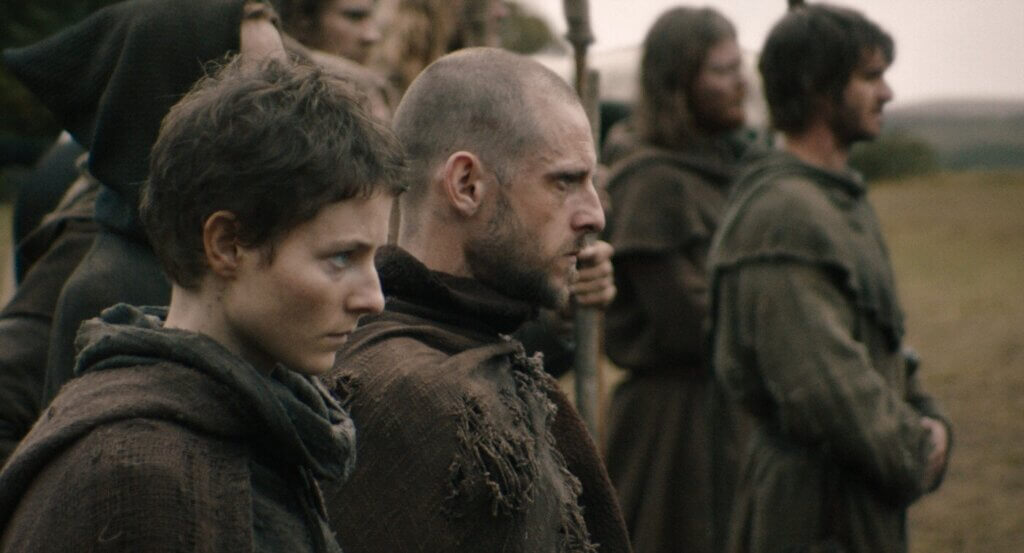
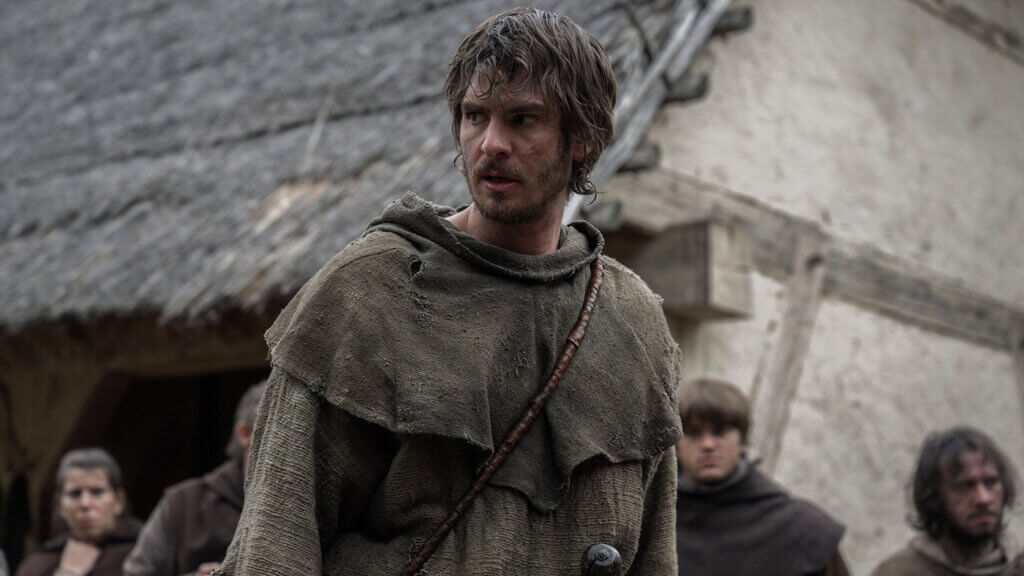
Andrew Garfield plays a ploughman drawn into rebellion against the rule of Richard II. Cosmo Jarvis plays Wat Tyler and Jamie Bell plays the radical preacher John Ball. Greengrass throws us among bodies rather than asking us to admire history from a safe distance. Dirt, noise, movement, and the sheer difficulty of coordinating a crowd give the uprising a sense of realism. I could feel why people might join even when they know they could die. There are moments when the action works, and the production makes the period feel rough and ugly. I kept hoping the film would turn that energy and atmosphere into an idea.
It has a remarkable historical one available. The National Archives’ material on Richard II describes peasants and craftsmen rebelling against the government in 1381. The presence of craftsmen alongside peasants points to something larger than one heroic man’s grievance. People with different lives could recognize the same structure above them. A film about that realization could show how collective action begins, how it changes its participants, and why those in power fear it. The Uprising gives us the scale and tumult of a movement, but the longer it runs, the more its politics narrow to the fate of a few individuals.
At first I accepted the repetition as part of the point. A revolt would be messy and exhausting. Plans would fail. Greengrass’s restless camera and the punishing succession of confrontations can make the viewer feel trapped inside that uncertainty. But eventually every encounter seemed to build toward another familiar and pointless showdown. More bodies gathered, and the film pushed forward without making me understand the people or their demands any better. The runtime is just over two hours. I felt every minute of it.
That’s a different failure from simply being too slow. Here, the length creates the expectation that the rebellion’s contradictions will get sharper: who gets to speak for it, what its members actually want, and whether they can challenge a system effectively. Instead, the violence serves as a way to postpone those questions. The film moves from confrontation to confrontation until movement itself begins to pass for development. Whenever I thought we had reached the moment when the poor would face the people who benefit from their suffering, attention shifted back to the damage done among those with the least power.


I’m not asking the film to pretend that popular violence is pure. Any serious account of rebellion should show how anger can be indiscriminate, how a crowd can harm people who never chose the policies it hates. Yet The Uprising seems much more frightened of what the rebels might do than of the conditions that made them rebel. It watches the poor and working class tear each other apart, then handles those at the top with a strange delicacy. The people who hold power remain the least exposed to the film’s harshest moral scrutiny. We are invited to recoil from rebellion as uncontrollable while the system it challenges slips away from judgment.
That imbalance is especially frustrating because Greengrass knows how to make the clashes frightening. The action can be convincing, and the physical production occasionally cuts through the tedium. But craft cannot supply a political point of view by itself. Strike (1925), which I reviewed, finds ways to make workers visible as a collective force even when state violence tries to reduce them to disposable bodies. And that came out over a century ago! Greengrass can put a great many people in the frame. Too often he uses their numbers to make the danger look bigger rather than to make their shared interests clearer.
Garfield’s ploughman gives the story someone to hold on to, and I understand the instinct. A huge political event can feel remote if no single person pulls us through it. Yet the film grows less interesting as it asks one man to carry more of the rebellion’s meaning. Wat Tyler and John Ball suggest conflicting ways of leading and imagining change, but I wanted more from the relationships among the people who follow them. What does a farmer risk that a craftsman does not? What would a victory change the day after the fighting stops? Those questions might sound less cinematic, but they’re the questions that could at least make the violence count for something.
The film’s retreat also blunts its connection to our own moment. Medieval taxes and present-day tech companies are not the same institutions. Still, the old story could speak directly to a world in which a small class accumulates extraordinary control while ordinary people are told that the arrangement is inevitable. The issue is not whether Greengrass should have inserted a speech about inequality. He had a setting in which people could recognize that the wealth above them rests on their labor below it. He could have followed that recognition without turning every expression of class anger into a warning about the mob. I kept waiting for the film to look upward with the same intensity it directs at the rebels.

Instead, the shift to Robin Hood lore gives that anger an escape route. The legend of a figure who steals from the rich and gives to the poor sounds rebellious, and I might have enjoyed it in a film that had promised a folk adventure from the beginning. Here it makes the uprising feel like a long prelude to a more familiar story. An entire class struggle shrinks to a recognizable outlaw fantasy. Redistribution becomes the noble work of an exceptional individual, and the question of who governs, owns, taxes, and commands everyone else can be left where it was. After making us sit through the cost of collective revolt, the film offers a hero we can applaud without having to trust the crowd. Greengrass literally turns the film away from collectivism and toward rugged individualism in the last few minutes, with a “hero” who’d prefer to live out in the woods by his own rules and let everyone else slave away in a broken system.
That choice changes what the preceding two hours mean. The rebels’ excesses are made vivid enough to justify the film’s anxiety about them, while their demands never gain comparable force. It’s a remarkably cautious conclusion for a film that spends so much time staging defiance. In my list of Marxist films, what interests me is how cinema can make class conflict visible in the way people live and act together. The Uprising has the conflict as its subject and still seems reluctant to imagine the poor as agents of lasting change. It gives them the right to be angry, then flinches when they try to use that anger.
I thought of Concrete Utopia, which is willing to examine how a desperate group’s solidarity can become cruel without pretending that scarcity just happens out of nowhere. That kind of discomfort is what I wanted here. The rebels could have done terrible things and still made a compelling case against their rulers. The film could have held both thoughts at once. Instead, it spends its strongest images on the danger posed by people at the bottom and saves its gentlest political imagination for a legend that leaves the hierarchy intact.
I came away from The Uprising tired and irritated. Some revolutions fail; some are betrayed; some destroy people they meant to free. My problem is that The Uprising keeps approaching a harder, more timely argument and then backs away. Its view of rebellion feels afraid of the very people who make rebellion possible. We need to eat the rich; this film clutches its pearls at the prospect, faints, and wakes up inside a Robin Hood story.
The Uprising (2026) Rating: ★★☆☆☆ (2/5)
If you’d like to watch The Uprising (2026), it will be available to stream, rent, or purchase via Amazon.