


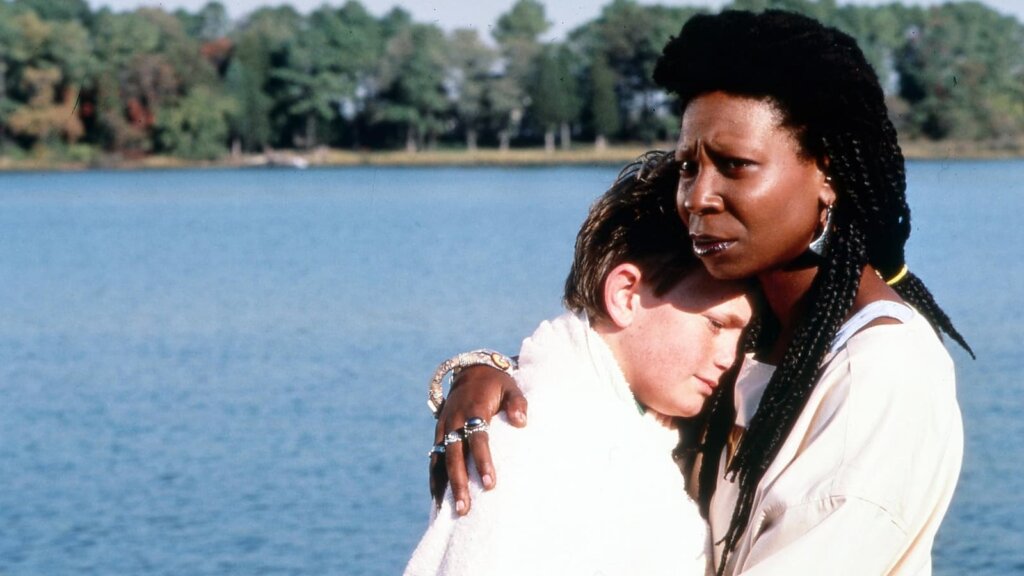
Some bad films disappear from my memory almost immediately. Clara’s Heart is likely to stay in my mind for a while, whether I like it or not. I’m not sure I could recommend it in any conventional way, but I also can’t deny that its choices have been rattling around in my head. This is a film in which a Jamaican housekeeper tells an adolescent boy about rape, incest, and suicide; he responds soon afterward by calling her the N-word; and the story then ushers them back toward reconciliation as though we have witnessed an ordinary argument between friends. Watching it feels less like discovering an artifact from an alternate universe.
If that description inspires morbid curiosity, you can stream, rent, or purchase Clara’s Heart on Amazon and experience its bewildering emotional decisions for yourself.
Directed by Robert Mulligan and adapted by Mark Medoff from Joseph Olshan’s novel, Clara’s Heart begins with the death of an infant. Leona and Bill Hart (Kathleen Quinlan and Michael Ontkean) have lost their daughter, and their marriage is collapsing beneath the grief. Leona travels alone to Jamaica, leaving Bill and their surviving child, David (Neil Patrick Harris), at home. At the resort, she meets Clara Mayfield (Whoopi Goldberg), a hotel maid whose blunt advice cuts through Leona’s despair. Leona is so taken with her that she brings Clara back to Maryland as the family’s housekeeper.


The premise offers several directions a thoughtful film might take. Grief has isolated every member of the Hart family. David lost a sister and, in practical terms, both of his parents. Leona and Bill are absorbed in their separate crises, new relationships, and private attempts at reinvention. Clara enters a wealthy white household as an employee, yet gradually assumes the emotional labor the parents abandoned. There’s plenty here about race, class, domestic work, surrogate parenthood, and the way adults force children to carry pain they don’t understand. Unfortunately, Clara’s Heart approaches all of this with the zero subtlety or sense.
David resents Clara’s presence, at first. He’s angry, lonely, and surrounded by adults who treat him as an inconvenience attached to their failed marriage. Neil Patrick Harris was making his screen debut, and his later confidence isn’t fully visible yet. He has moments of recognizable adolescent bitterness, but the performance often feels quite uneven. One moment he’s withdrawn, the next he’s theatrically furious, and before long he’s attempting a Jamaican accent that lands about as well as you would expect.
The accent imitation may be intended to show that David has absorbed Clara’s rhythms and feels close enough to play with them. On screen, it adds another strange racial layer to a relationship the film has no idea how to examine. Clara is already written as an almost mystical source of hard-earned wisdom, imported from Jamaica to repair a rich white family. David copying her speech only makes the film’s construction of Clara even more artificial.
Goldberg commits to the role, but I found the performance overly sentimental, as I often do. To add insult to injury, the fake Jamaican accent is very distracting, and the screenplay gives Clara so many aphorisms, knowing looks, and perfectly timed interventions that she rarely gets to exist without serving someone else’s emotional development. Clara supposedly built an inner life beyond the Hart family, but the film keeps turning that life into material for David.
That problem resembles the racial comfort offered by Victoria & Abdul. In both films, a privileged white character is redeemed through intimacy with a person of color whose suffering becomes evidence of exceptional wisdom. The friendship is presented as proof of mutual humanity, yet one person does most of the teaching, forgiving, and healing. Clara’s Heart acknowledges class difference and racism, but it arranges them around David’s maturation rather than Clara’s autonomy.
Leona and Bill make this imbalance worse because they’re written as thin, self-absorbed emotional obstacles. Their grief could have made them complicated. Instead, the film repeatedly emphasizes their failures until Clara appears to be the only adult capable of recognizing that David needs care. Leona pursues a relationship with self-help personality Peter Epstein (Spalding Gray), while Bill begins rebuilding his own life. The parents’ selfishness is less a psychological portrait than a mechanism designed to push David toward Clara.

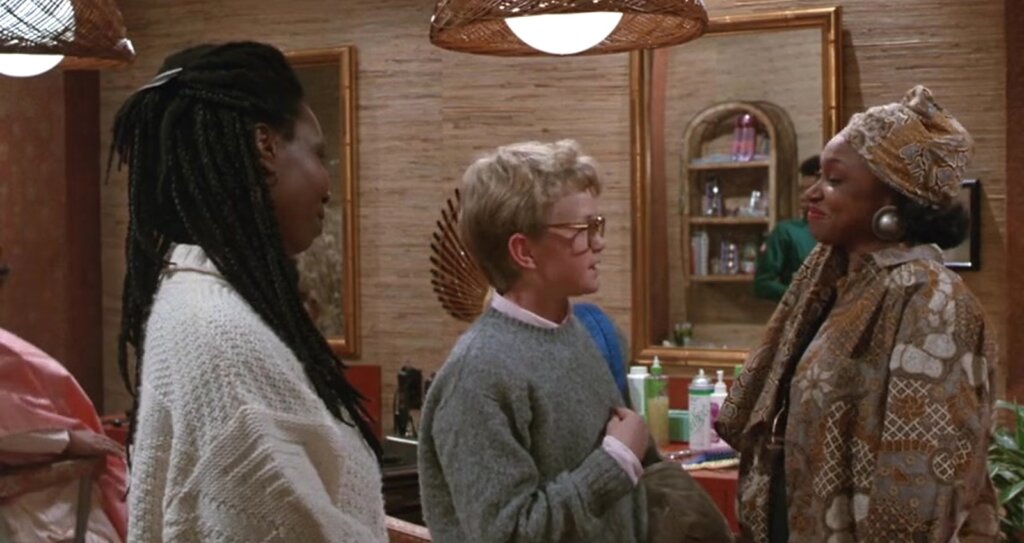
Mulligan directed To Kill a Mockingbird, so he certainly knew how to build a drama around childhood perception and adult moral failure. Here, however, the emotional machinery is always visible. A buoy in the water is a painfully obvious symbol of David’s fear and eventual growth. Family conversations are designed to deliver maximum hurt. The music swells so we know exactly when and how to feel. Rather than letting grief distort the household gradually, the film moves from one demonstration of neglect to another.
I kept thinking about Nobody Knows, another film about children abandoned by adults who remain absorbed in their own desires. Hirokazu Kore-eda understands that neglect accumulates through routines and small disappointments. The tragedy emerges from daily life. Clara’s Heart has too little patience for accumulation. It wants every emotional development to arrive as a major event.
The film’s most astonishing sequence begins when David discovers letters connected to Clara’s dead son, Ralphie. After invading her privacy, he pressures her until she reveals the truth. Ralphie raped a girl, then raped Clara when she confronted him, and later died by suicide. This confession is so severe that it seems to rupture the film around it. Rape, incest, maternal guilt, and suicide enter a glossy family melodrama all at once. Then the screenplay just keeps on moving.
Within about five minutes of screen time, David lashes out and calls Clara the N-word. It should permanently change the emotional terms of their relationship. At minimum, the scene requires the film to confront what David has learned from the world around him and why racial violence becomes the weapon he reaches for when he wants to hurt her. Instead, the slur functions like the most extreme line available in a melodramatic argument. The film uses racism to raise the temperature, then relies on affection and regret to lower it again.
That’s where Clara’s Heart loses any remaining claim to emotional honesty. David’s grief and youth can explain cruelty, but that doesn’t repair anything on its own. Clara’s history makes his attack particularly vicious: after disclosing the worst violence of her life, she’s immediately reduced to a racial category by the child she has protected. The film seems to understand the scene as evidence that hurt people hurt people. I think it reveals something uglier in the screenplay. Clara is expected to absorb one more wound so David can learn one more lesson.
The reconciliation is a typical melodramatic contrivance. Their bond is too central to the film’s desired conclusion, so the story restores it whether or not the characters have done the work. A similarly patronizing fantasy weakens 10 Jours en or, which also treats affection across racial difference as inherently profound while leaving the actual difference thinly examined. These films assume that placing a white character and a black character in the same frame is enough. It isn’t.


Roger Ebert argued in his original review of Clara’s Heart that Goldberg created a great character who seemed to have fallen into a bad film. I’m less enthusiastic about the performance than Ebert was, but his description of the mismatch is accurate. Clara’s past belongs to a harsher, more psychologically demanding story. The Hart family belongs to a polished domestic melodrama. David belongs to a coming-of-age film. Peter seems to have wandered in from a satire the filmmakers were afraid to make. None of these pieces settle into the same reality.
By comparison, Shoplifters moves between damaged parent figures, vulnerable children, crime, affection, and social inequality without turning its characters into moral exhibits. The people in that film hurt one another, and love doesn’t erase the consequences. Their beautiful memories remain real precisely because the film refuses to declare them sufficient. Clara’s Heart keeps insisting that feeling deeply is the same as understanding deeply.
Spoilers follow.
Clara eventually recognizes that David has become too dependent on her and leaves the household. This is one of the film’s more defensible decisions. She cannot remain the permanent replacement for parents who refuse to parent, and David cannot build his entire emotional life around an employee who was brought into his home to stabilize everyone else. Yet even this separation is staged as another opportunity to uplift.
David finds Clara working at a hospital and apologizes. She tells him that he will always remain in her heart. The moment is supposed to confirm that their friendship has survived loss, racism, violated privacy, and abandonment. For me, it confirms the film’s refusal to distinguish forgiveness from resolution. Clara once again provides the wisdom, and David once again receives what he needs.
That ending completes the film’s central fantasy: an endlessly resilient black woman enters a broken white household, takes on its neglected child, shares her trauma, withstands his racism, and leaves him stronger. Her reward is the knowledge that she helped. The film gives Clara a tragic history, but it grants David the emotional future.
Perhaps that’s why Clara’s Heart remains oddly watchable. I was rarely convinced, often uncomfortable, and occasionally stunned that someone had approved the next scene. Yet boredom wasn’t the problem. The film is too bizarre for that. It keeps finding new ways to confuse and surprise.
Neil Patrick Harris would soon become Doogie Howser, M.D., and his debut has historical curiosity even if it isn’t a good performance. Goldberg works hard, Freddie Francis gives the Maryland estate a handsome melancholy, and the premise contains the raw material for something challenging. Almost every promising element is defeated by wild tonal shifts, racial simplification, thin characterization, and a screenplay determined to squeeze tears from every possible situation, however absurd.
Clara’s Heart is a choice. As a drama, it barely works. As an object of pure curiosity—a major star trying a shaky Jamaican accent, a future television icon making his debut, and a family film suddenly detonating a confession about rape and incest—it has a strange pull. Sometimes bad films are more memorable than competent films. This is certainly one of them.
Clara’s Heart (1988) Film Rating: ★½ out of 5
Watch Clara’s Heart: Stream, rent, or purchase the film on Amazon and decide whether its bizarre sincerity makes it fascinating or merely unbearable.