


This review contains major spoilers.
Some families inherit names, houses, even behaviors and mannerisms. The family in Shoplifters assembles itself out of discarded people. They live almost entirely in the present. The future is an approaching debt they’ve collectively decided not to discuss. That should make them reproachable, but, somehow, it doesn’t.
Stream, rent, or purchase Shoplifters on Amazon.

Hirokazu Kore-eda’s Shoplifters (2018) is one of the best slice-of-life films I’ve seen in a long time, maybe ever. It’s sympathetic without becoming saccharine the way Perfect Days does. Shoplifters never tells us when to cry. It simply lets people live together until their ordinary routines make us feel something.
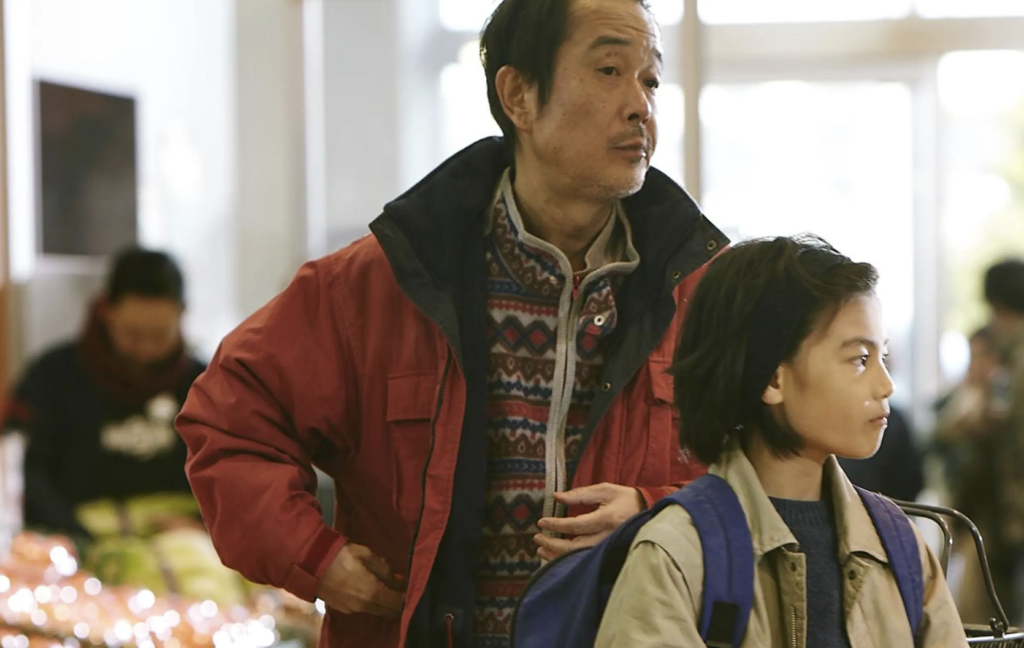
The opening scene shows Osamu Shibata (Lily Franky) and young Shota (Kairi Jō) shoplifting groceries. Their hand signals and coordinated movements suggest a ritual they’ve practiced many times. Osamu creates a distraction. Shota slips food into his backpack. That’s just how they get their dinner.
On the walk home, they notice a little girl, Yuri (Miyu Sasaki), sitting alone outside in the cold. They initially intend to give her something to eat and return her. Then they hear her parents fighting. They discover scars on her body. She stays with them overnight, and the overnight stay gradually becomes a place within the family.
The Shibatas don’t rescue Yuri because they have the resources to offer her a secure future. They barely have room for another sleeping body. Their home is cluttered, cramped, and supported by an unstable combination of low-wage work, shoplifting, pension fraud, and secrets. But it’s a place to live with people who care.
The household includes Osamu, Nobuyo (Sakura Ando), Shota, Yuri, the elderly Hatsue (Kirin Kiki), and Aki (Mayu Matsuoka). At first, Kore-eda allows us to assume that we understand how everyone is related. He doesn’t immediately explain the family because families rarely introduce themselves through diagrams. We slowly understand their relations (and lack thereof) through daily habits and snippets of exposition.
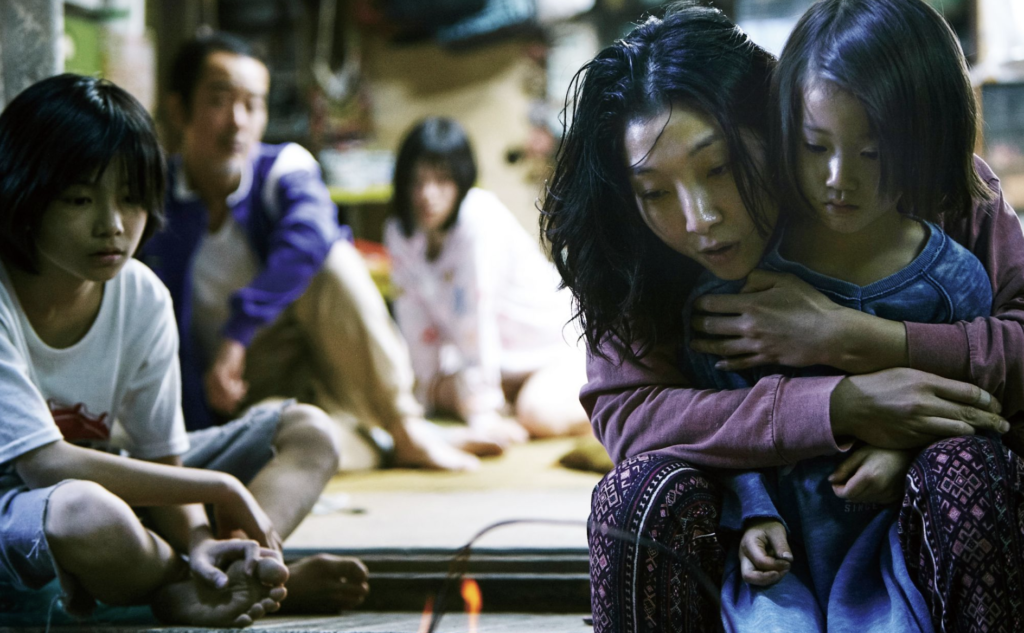
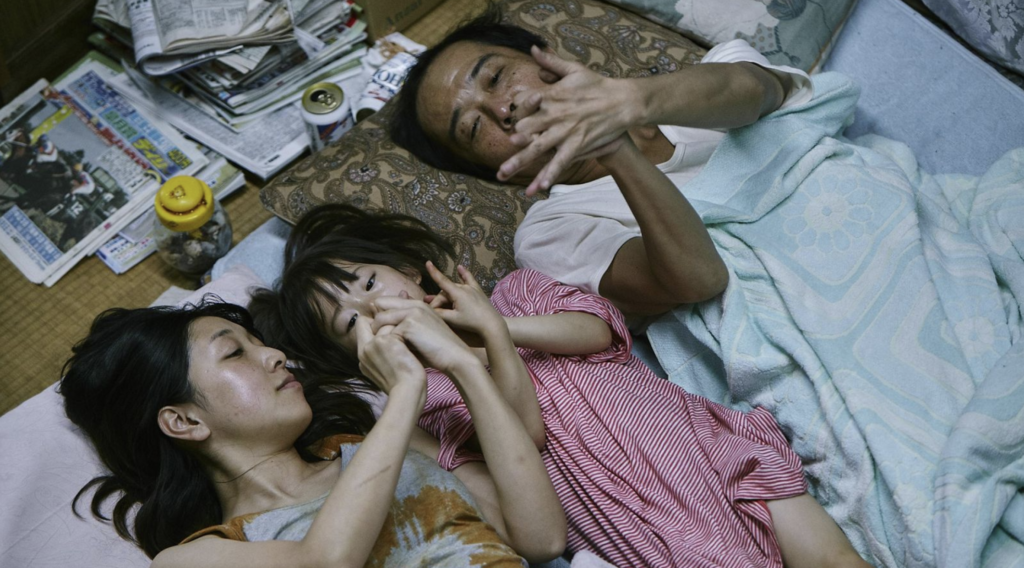
They crowd around the table eating noodles and croquettes. They complain, tease one another, share blankets, and make room where they can. Osamu tries to teach Shota the tricks of shoplifting while secretly hoping the boy will call him “Dad.” Nobuyo bathes with Yuri and notices that they carry similar scars. Aki returns from work and slips back into the household as though the tiny space has been waiting for her. The house is too small for privacy and somehow large enough to become a refuge.

Kore-eda achieves something similarly natural in Nobody Knows, another film about children living beyond the protective reach of ordinary institutions. Both films understand that childhood continues during a crisis. Children still play, sulk, invent games, and become bored. Suffering doesn’t transform them into miniature adults who exist only to illustrate a social problem. I found both films to be extremely powerful without leaning much into sentimentality. Kore-eda has the unique ability to create tragically beautiful setpieces while making us forget we’re actually watching a film, and not just peeking through somebody’s window.
It would be easy to romanticize the Shibatas as lovable outsiders whose crimes don’t matter because society failed them first. Kore-eda is much more honest than that. Osamu and Nobuyo genuinely love the children. They’re also reckless parent figures who teach Shota to steal, conceal Yuri’s identity, bury Hatsue beneath the house after she dies, and continue collecting her pension. They don’t seem to have any meaningful plan for the children’s education, security, or adulthood. Their family survives from one half-assed solution to the next.
Osamu tells Shota that stealing from a store is acceptable because the merchandise doesn’t belong to anyone until it’s purchased. It’s the kind of explanation an adult constructs when he needs a child to accept something the adult already knows is wrong. Later, Shota sees him stealing from a parked car and recognizes that the rules are changing. The moral boundary was never real. It was just convenient.
Shota’s growing discomfort gives the film its momentum. He teaches Yuri the family’s shoplifting routine, but seeing her actually do it forces him to look at his own behavior. What felt like a private game between himself and Osamu now looks like something unpleasant being passed down through the generations.
Eventually, Shota deliberately attracts attention while stealing and jumps from an elevated walkway as he’s pursued. His broken leg brings the authorities into their lives. Somewhere inside, he understands that the family can’t continue indefinitely and that none of the adults will be the one to stop it.
Love and innocence aren’t the same thing. Osamu and Nobuyo can care for Shota more deeply than many biological parents care for their children while still failing him in serious ways. Yuri can be safer with people who technically kidnapped her than with the parents legally entitled to raise her. The Shibatas’ crimes don’t cancel their affection, but their affection doesn’t erase the harm of their choices.

Shoplifters treats family as a practice rather than a biological fact. A family is something people repeatedly do: feeding, protecting, touching, teaching, remembering, and making space.
The most beautiful example is the bath scene between Nobuyo and Yuri. Nobuyo notices the girl’s scars and recognizes a history of abuse similar to her own. Two wounded people sit together in the water, understanding something about each other that the law will never recognize.
Later, Nobuyo holds Yuri and explains that being hit because someone claims to love you isn’t love. Sakura Ando plays this scene with a painful awkwardness, as though Nobuyo is trying to give the child an idea she’s still learning to believe herself.
The biological family has legal authority over Yuri, but it doesn’t provide care. The criminal family provides care but lacks any recognized authority. There’s an uncomfortable class dimension here as well. The Shibatas’ poverty isn’t presented as morally purifying. They lie to one another, exploit loopholes, and sometimes use people. Hatsue’s relationship with Aki involves genuine affection, but it’s also connected to the money she receives from Aki’s parents. Almost every bond in the house contains some mixture of love, need, convenience, and deception.
That mixture is probably more recognizable than we’d like to admit. Most families aren’t held together by one pure substance. Obligation, affection, resentment, economics, memory, and habit become tangled until nobody can say exactly where one ends and another begins.
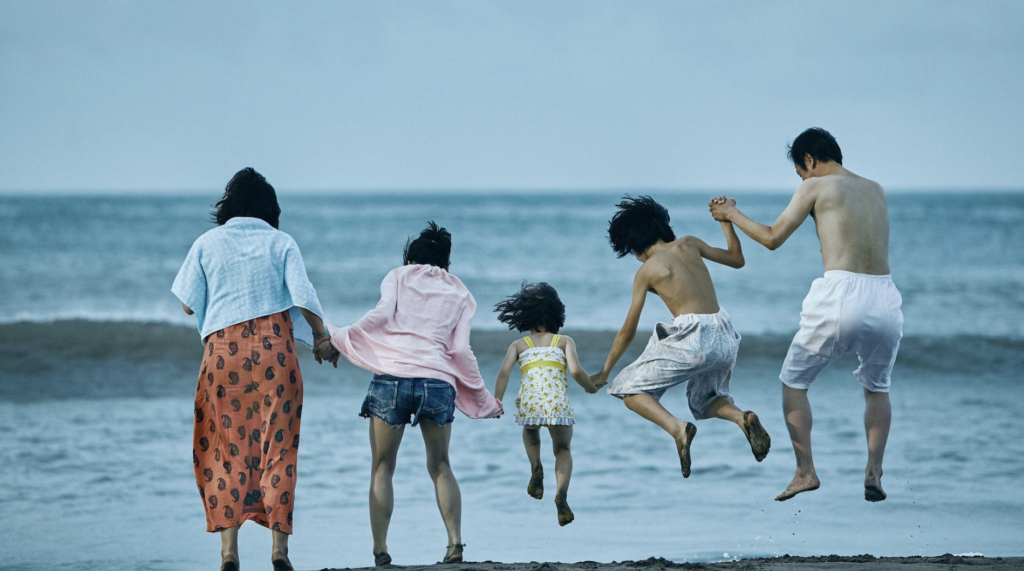
The beach scene is the film at its most beautiful. For once, the family leaves the confined house and enters a landscape wide enough to hold all of them. The children run toward the water. Nobuyo and Osamu watch them. Hatsue sits apart, looking at the family gathered before her. She seems to understand that the day is temporary.
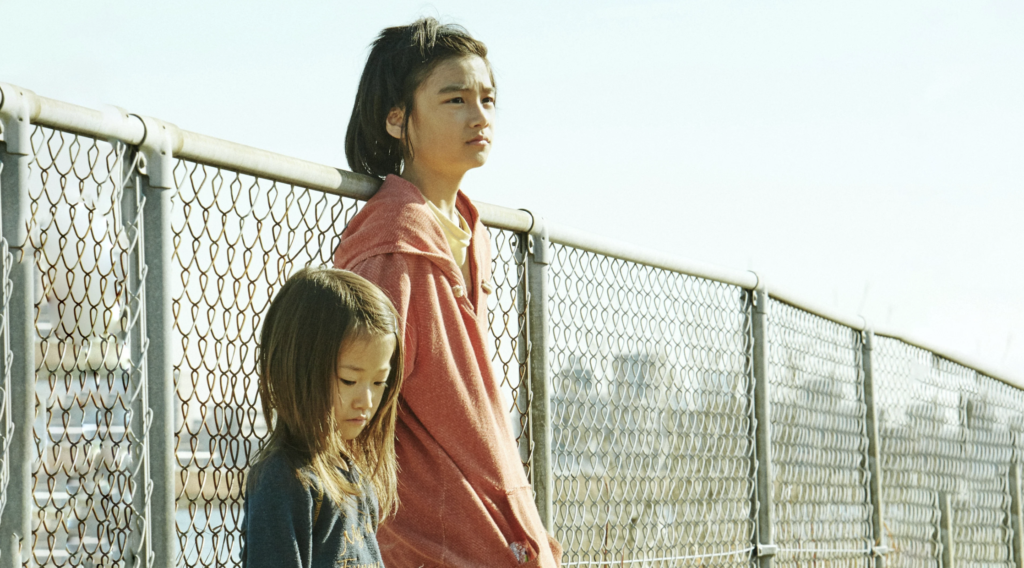
There’s sadness inside the scene. Kore-eda doesn’t interrupt the sunlight with an obvious warning, yet the images already feel like memories. The family is happy, but the film photographs that happiness from the perspective of its eventual loss.
This is where Shoplifters connects beautifully with Kore-eda’s After Life, included in my list of films about the meaning of life. In that film, the dead must select one memory to carry into eternity. The memories people choose are rarely accomplishments. They return to sunlight, weather, food, movement, and brief moments with other people.
The Shibatas have no savings, legal security, or plausible future together. What they accumulate instead are moments: fireworks they can hear but not see, bare feet on sand, food passed across a crowded table, and bodies pressed together inside an overheated house. They’re stealing time as much as groceries.
That time doesn’t suddenly become meaningless when the family collapses. If anything, the collapse reveals how much those ordinary days mattered to each of them. A temporary family can still be a real family, just as a relationship doesn’t become unreal because it ends.
After Shota is hospitalized, the family’s private world is dismantled. The authorities separate everyone and convert their shared history into a list of offenses.
These scenes are cold without making the investigators into villains, though they’re far from sympathetic. Much of what they say is true. Osamu and Nobuyo did take children who weren’t theirs. They concealed Hatsue’s death. They attempted to flee when Shota was injured. The children needed forms of stability that the household couldn’t provide.

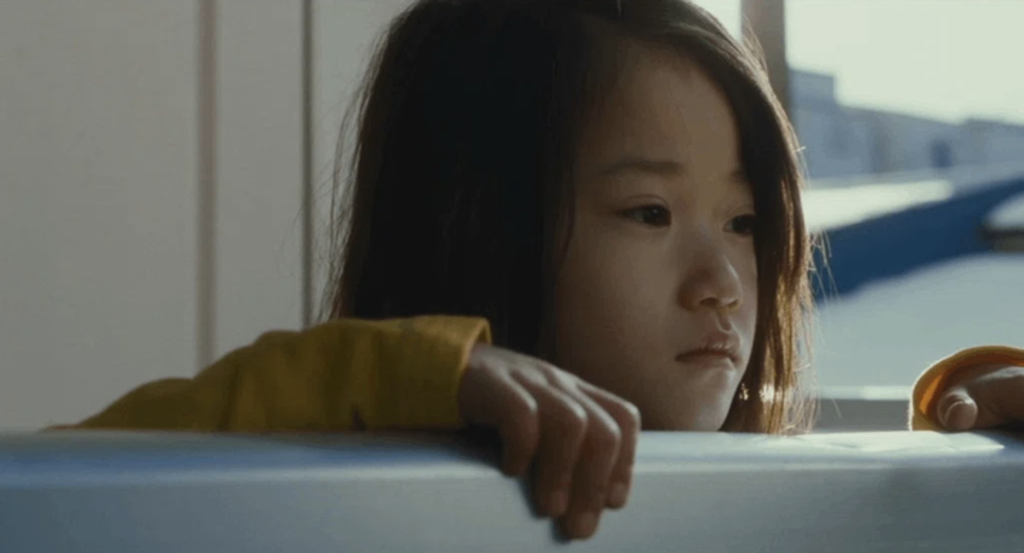
Yet the interrogations also expose the limits of official language. The investigators know how to classify each crime, but their categories flatten the emotional reality we’ve spent the film observing.
When Nobuyo is asked whether the children ever called her their mother, she breaks down. Sakura Ando wipes her tears with both hands. Coming face to face with her life choices is too much to bear.
Nobuyo insists that giving birth doesn’t automatically make someone a mother. The film has already shown us why she believes this. Yuri’s biological mother gave birth to her and then left her outside in the cold. Nobuyo took her without permission but fed her, bathed her, noticed her wounds, and held her when she was frightened. None of that proves that Nobuyo had the right to keep her. It does prove that biology alone can’t explain motherhood.
Osamu faces an equally painful truth. He wanted Shota to call him “Dad,” but fatherhood requires more than affection and imitation. It also requires accepting responsibility for another person’s future, something Osamu has repeatedly avoided.
In a BFI interview about the film, Kore-eda suggests that Osamu may only truly become Shota’s father when he finally lets the boy go. It’s a beautiful contradiction. Osamu is only worthy of the relationship the second he decides to end it.
Nobuyo accepts responsibility and goes to prison. Shota enters an orphanage and begins attending school. Yuri is returned to the home where she was neglected and abused. Society restores the legally recognizable arrangement, but the result isn’t a simple moral correction.
During a prison visit, Nobuyo gives Shota information about the car in which they found him. She’s offering him the possibility of locating his biological parents, even though doing so could weaken his connection to her. It’s one of the few genuinely parental decisions any adult makes about his long-term future.
Later, Shota spends another night with Osamu. They build a snowman. Osamu admits that the family intended to leave him behind after his injury. He also tells Shota that he isn’t his father anymore.
The next morning, Osamu runs after Shota’s departing bus. Shota looks back and silently acknowledges him as his father only when the word can no longer secure anything for either of them. It’s no longer a title Osamu is trying to obtain. It’s something Shota chooses to give.
Then there’s Yuri. Returned to her biological parents, she sits alone outside and repeats a rhyme she learned while living with the Shibatas. The family has disappeared, but traces of it remain.
That ending doesn’t argue that the Shibatas should have been allowed to continue as they were. Their life together was built on too many unstable foundations and deceptions. It was always going to collapse, and the adults’ refusal to think seriously about the future helped ensure that it did.
But the memories remain beautiful. That’s what makes Shoplifters so powerful. It doesn’t ask us to acquit its characters. It asks whether a life can contain genuine love even when the structure supporting that love is dishonest, harmful, and doomed. I think the answer is yes.
Shoplifters (2018) Film Rating: ★★★★½ out of 5
Check the current streaming, rental, or purchase price for Shoplifters on Amazon.