


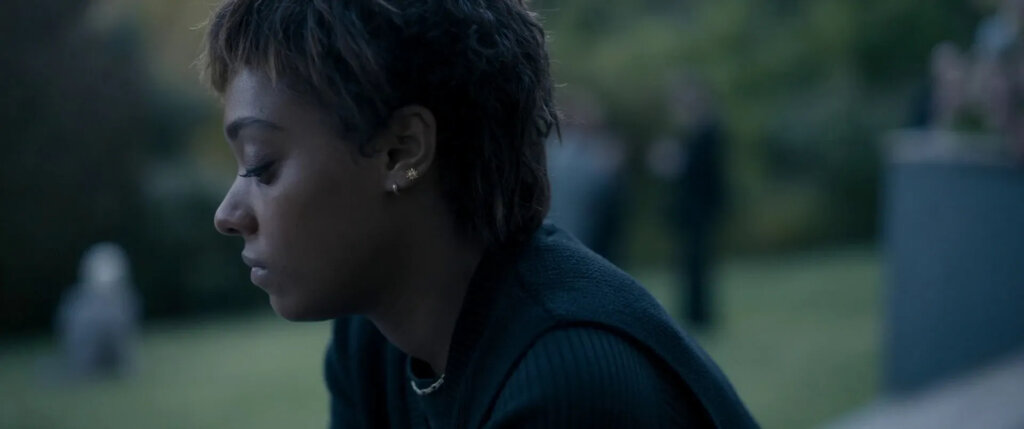
Talk to Me (2022) understands that the most dangerous supernatural object isn’t necessarily one that forces itself on people. Sometimes it’s one they line up to use again and again.
The object in question is an embalmed hand that allows anyone holding it to communicate with the dead. Light a candle, take the hand, and say “Talk to me.” A spirit appears. Say “I let you in,” and it enters your body. The possession must end within 90 seconds, but following that rule becomes increasingly difficult once a group of teenagers discovers that briefly surrendering control is frightening, euphoric, and great for social media.
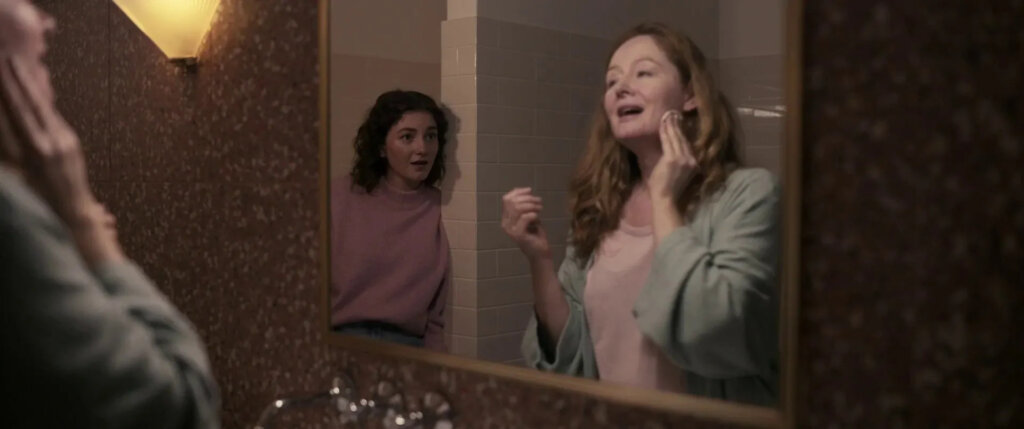
Mia (Sophie Wilde) is initially drawn into the ritual through her friends. Still grieving the death of her mother, she spends much of her time with Jade (Alexandra Jensen) and Jade’s younger brother, Riley (Joe Bird). Their home gives her an escape from her strained relationship with her father, who refuses to speak openly about her mother’s death.
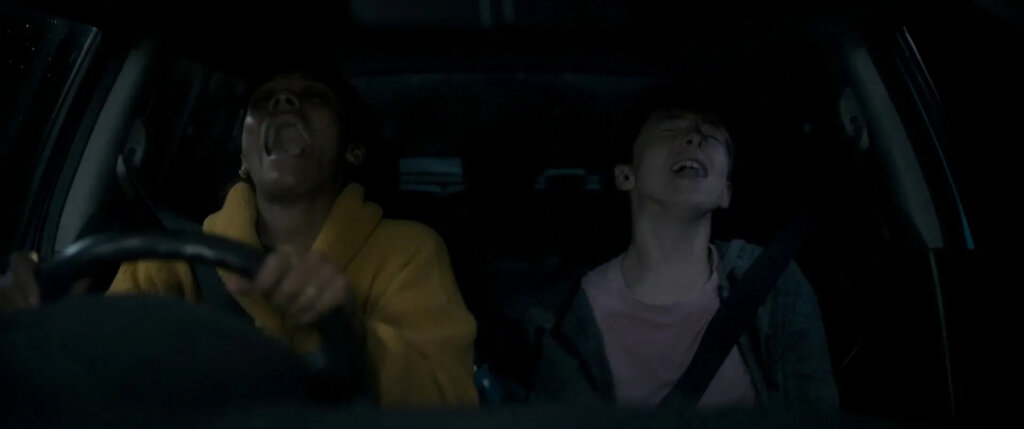
At first, the hand is just another dangerous party activity. Teenagers crowd around, laughing, filming, and waiting to see what the next spirit will do. The possessions are disturbing, but they’re also entertaining. Each person wakes up shaken and immediately wants to watch the footage. The group treats the ritual like a combination of a drug, a viral challenge, and a game of truth or dare.
This is one of the smartest things about Talk to Me. The addiction metaphor isn’t buried under layers of symbolism. The teenagers experience an intense physical and emotional high, ignore obvious dangers, encourage one another to participate, and convince themselves that they remain in control. Even after something goes catastrophically wrong, Mia continues using the hand in private. She tells herself that she’s looking for answers, but her behavior becomes almost indistinguishable from that of an addict chasing an increasingly unreliable high.

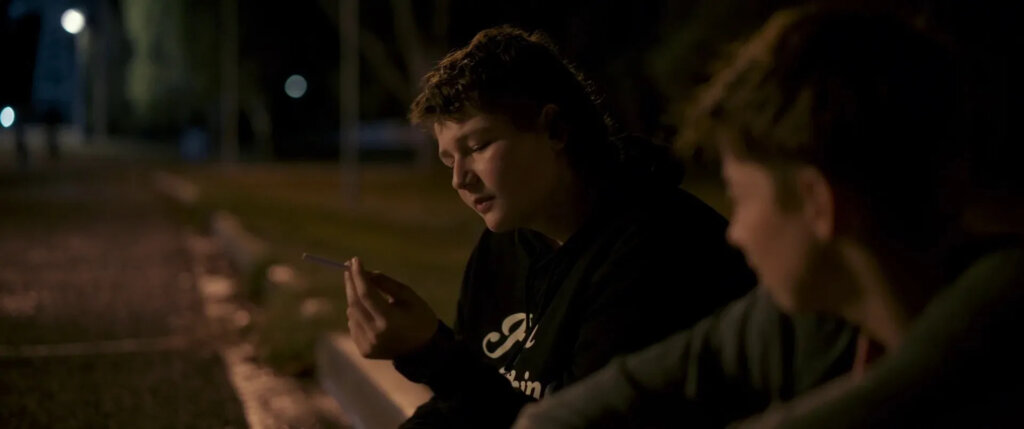
For Mia, however, the attraction goes beyond thrill-seeking. The possibility of contacting her mother gives the hand a power no warning could easily overcome. Grief makes Mia vulnerable, but it also gives her a reason to reinterpret every danger as a necessary risk. She wants the spirit she encounters to be her mother so badly that doubt begins to feel like betrayal.
In this respect, Talk to Me belongs alongside The Babadook (2014), another excellent Australian horror film in which grief creates an opening for something monstrous. Neither film treats mourning as a weakness that can simply be overcome. Grief alters perception. It makes people distrust those trying to help them and place their faith in things that promise relief.
Sophie Wilde is exceptional in the role. Mia could easily have become frustrating as her decisions grow more reckless, particularly when those decisions endanger people around her. Wilde keeps her sympathetic without making her innocent. Her grief is real, but so are her selfishness, denial, and desperation. She can move from euphoria to terror in seconds, and the film frequently holds on her face long enough for us to see her trying to convince herself of something she already suspects isn’t true.
The supporting cast is strong, but Wilde carries the film. Mia is present in nearly every major emotional turn, and Wilde makes her deterioration feel gradual even as the story moves quickly. We understand why she keeps returning to the hand, even when we want to reach into the screen and take it away from her.
Danny and Michael Philippou also have an unusually good sense of pacing. Talk to Me runs for just over 90 minutes and wastes almost none of that time. The rules are established quickly, the first possessions are frightening but strangely fun, and each return to the hand makes the atmosphere more oppressive. Like Hereditary, the film creates dread by making it clear that something irreversible has happened well before its characters understand the real consequences.
The turning point comes when Riley takes the hand. What begins as another possession becomes one of the most upsetting sequences in recent mainstream horror. Riley repeatedly smashes his face against a table before trying to tear out his own eye. The scene is difficult to watch, not merely because a child is being brutalized, but because the violence arrives so suddenly. Moments earlier, the room was filled with laughter and excitement. Then the game reveals what it has always been capable of doing.
The sound design makes the scene even worse. Every impact is blunt, heavy, and horribly immediate. The Philippous don’t use gore simply to decorate the frame. They use sound, physical performance, and brief flashes of damage to make the audience feel each injury.
Anyone who has seen the brothers’ later film, Bring Her Back, will recognize this as something of a defining flourish. The Philippous are willing to place children at the center of exceptionally cruel violence, then refuse to soften the impact merely because the victim is young. Riley’s possession anticipates the knife-biting sequence in Bring Her Back: both moments arrive with such physical force that they temporarily change the way we experience everything around them.
Talk to Me never becomes the sustained ordeal of something like Martyrs, but it shares that film’s understanding that violence should be genuinely unpleasant. There is no comfortable distance between the audience and Riley’s suffering. We aren’t invited to admire an effects sequence. We’re made to feel that something unforgivable has happened.
The film’s principal weakness is its mythology. The practical rules surrounding the hand are wonderfully simple, but the spiritual world behind them is less coherent. Why are nearly all the spirits violent, manipulative, or grotesque? Are they enraged by being trapped in some form of limbo? Are their appearances connected to the ways they lived or died? Or does the hand attract a particularly malicious group of entities?
Some uncertainty makes the film scarier, and a detailed explanation of the hand’s origin would almost certainly diminish it. Still, the final sequence reveals enough about the ritual to raise questions about some of the earlier scares. Without spoiling what happens, the ending recontextualizes the hand and the spirits without fully explaining the relationship between them. It becomes difficult to tell whether certain inconsistencies are part of a deliberately deceptive supernatural system or simply ideas the film hasn’t completely reconciled.
Fortunately, this problem only weakens the film slightly. Horror mythology doesn’t need to function like an instruction manual, particularly when the emotional logic remains this strong. Mia believes because she needs to believe. The spirits understand that need better than she does.
Talk to Me is an excellent horror film because it never allows its metaphors to replace the horror itself. It can be read as a story about grief, addiction, peer pressure, social media, or the danger of using other people’s pain as entertainment. It is also, at times, very frightening. The possession scenes are physical and unpredictable, the violence is difficult to shake, and Sophie Wilde gives the supernatural chaos a tragically human center.
The hand offers Mia exactly what grief often makes people want: one more conversation and one more chance to say the things that were left unsaid. The horror comes from the possibility that something might answer.
Talk to Me (2022) Film Rating: ★★★★ out of 5
If you’d like to watch Talk to Me (2022), the film is currently available to stream, rent, or purchase via Amazon.