


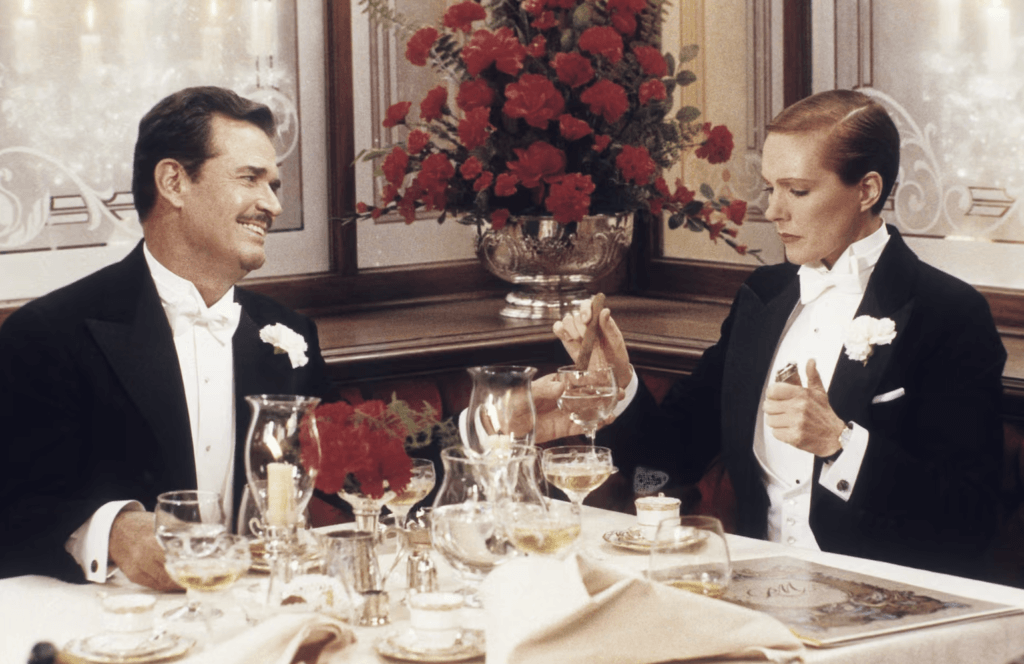
Blake Edwards’ Victor/Victoria is built around a joke that becomes more complicated the longer you think about it. Victoria Grant (Julie Andrews) is a struggling soprano in 1930s Paris who finds success by pretending to be Count Victor Grazinski, a man who performs as a female impersonator. She is a woman playing a man playing a woman, and her success depends upon audiences believing that the femininity they see onstage is artificial.
Adapted from the 1933 German comedy Viktor und Viktoria, the film turns that premise into an elaborate musical farce about gender, sexuality, and the unstable relationship between identity and appearance. The joke is that the same body can be interpreted as male or female depending on what an audience has been told to see. The film was released in 1982, but its willingness to play with sexual ambiguity still feels surprisingly modern.
That ambiguity is easily the film’s most redeeming quality. Victoria’s performances repeatedly force people to reconsider what they think they know about her. When she appears onstage as a glamorous woman, the audience sees femininity. When she reveals herself as “Victor,” the same gestures, clothing, and body are immediately reclassified as a man’s imitation of femininity. Nothing physical has changed. Only the explanation.
King Marchand (James Garner) experiences the same confusion after becoming attracted to Victoria while believing that she is a man. His desire appears before he can place it within a category, and this sends his understanding of his own masculinity into crisis. He becomes less concerned with what he feels than with what those feelings might say about him. The film’s most provocative question is therefore not whether Victoria is sufficiently convincing as a man. It is whether desire has any obligation to respect the identities and categories people construct around it.
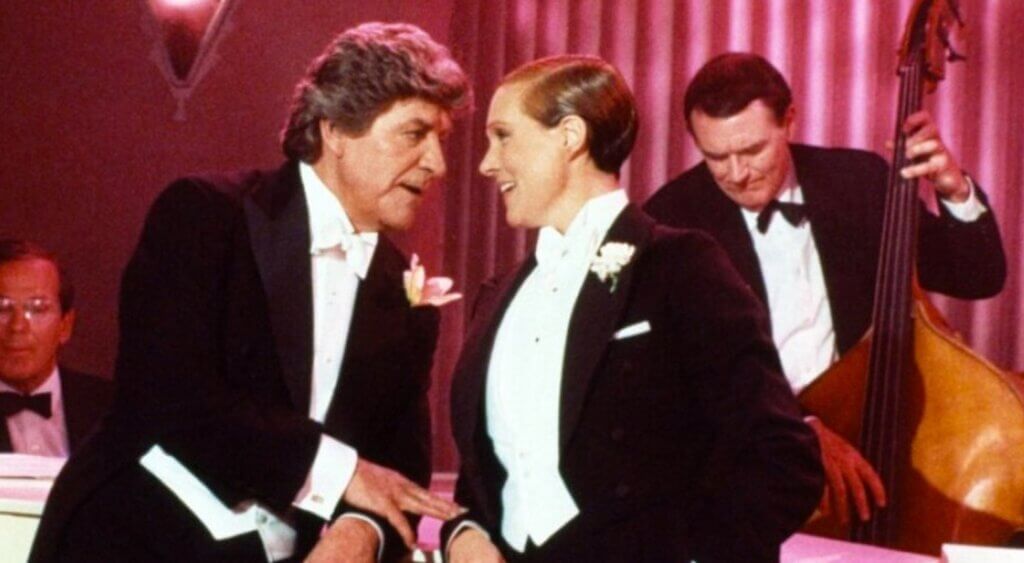
For a mainstream studio comedy released in 1982, Victor/Victoria was genuinely progressive. Its gay characters are not treated as doomed, ashamed, or morally corrupted. Carroll “Toddy” Todd, played by Robert Preston, is confident in his sexuality and rarely concerned with making heterosexual people comfortable. The later revelation that Squash (Alex Karras) is gay is played for surprise, but his relationship with Toddy is treated with warmth rather than disgust.

The film does not have the vocabulary that would accompany a contemporary discussion of gender identity, nor should Victoria be interpreted as a transgender character. Her identity as Victor is initially a professional strategy. Even so, the film recognizes that gender can be performed, socially interpreted, and separated from biological assumptions. Like Pedro Almodóvar’s later film, Law of Desire, it briefly imagines desire as something capable of existing before a person has found the correct label for it.
Julie Andrews handles the vocal and physical demands of her double role with predictable skill, but Preston supplies the warmth that holds the story together. Toddy is Victoria’s mentor, accomplice, friend, and, in many ways, the architect of Victor. Preston gives him a theatrical confidence without reducing him to a collection of flamboyant gestures. He is frequently the funniest person in the room, but he also feels like the person most aware of what Victoria stands to lose.
When Toddy takes Victoria’s place onstage, his deliberately disastrous impersonation becomes the film’s final joke about gender and performance. Victoria, a woman impersonating a male female impersonator, appears completely convincing. Toddy, an actual man performing the same act, looks comically unconvincing.
Unfortunately, the comedy surrounding these ideas is inconsistent. Some scenes have the rhythm and sophistication of a classic farce, particularly when Preston and Andrews are allowed to exchange dialogue without interruption. Others rely on predictable bar fights, mistaken identities, exaggerated reactions, and prolonged physical gags. Lesley Ann Warren commits completely to Norma Cassidy, but the character is written and performed at such a high volume that she seems to belong in an even broader film.
At more than two hours, Victor/Victoria also has difficulty sustaining its momentum. The nightclub performances are lavish, and Henry Mancini’s music gives Andrews ample opportunity to demonstrate her remarkable range. However, the story repeatedly pauses for another showpiece or comic complication after its central idea has already been established. The film remains pleasant, but not consistently funny enough to justify its length.

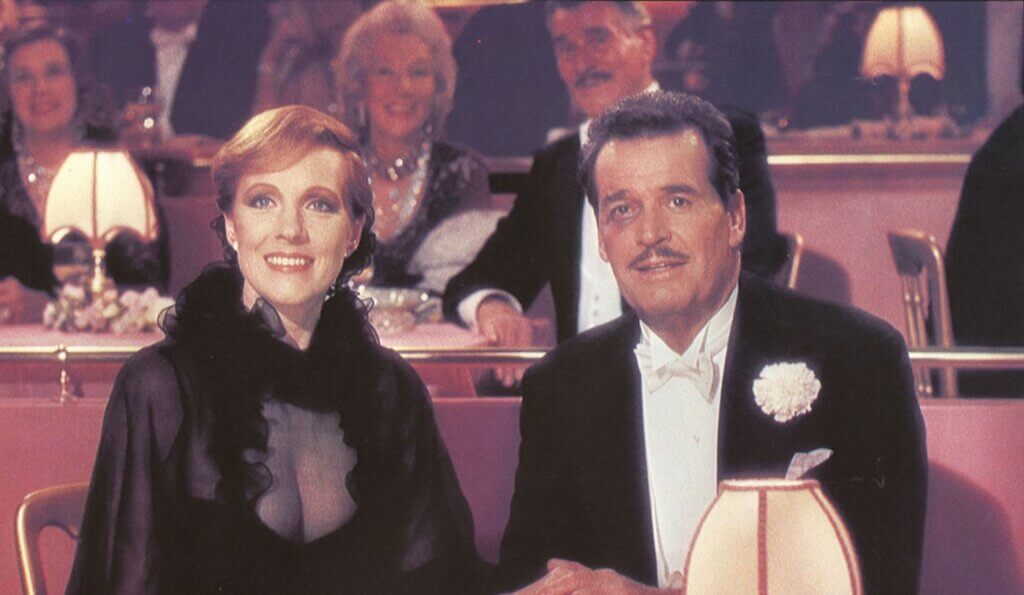
The conventional romance between Victoria and King creates another limitation. For a while, the film appears willing to examine what it would mean for King to love Victoria without first resolving whether Victor is a man or a woman. However, King discovers the truth before their relationship fully develops, protecting both the character and the audience from having to confront that possibility for very long.
The ending retreats even further. Victoria ultimately gives up the Victor persona so that she and King can form a recognizable heterosexual couple, while Toddy assumes her place onstage. The film spends much of its running time destabilizing gender categories, only to restore them when the romance needs a resolution. It permits ambiguity as performance, but becomes more cautious when that ambiguity threatens to reshape the central relationship.
This doesn’t erase the film’s progressive qualities. Victor/Victoria treats its gay characters with unusual generosity, celebrates queer friendship, and repeatedly shows that gender depends as much on presentation and interpretation as it does on the body. It simply stops short of following its most provocative ideas to their logical conclusion.
Victor/Victoria is an intelligent film that I admired more than I enjoyed. Robert Preston is excellent, and the film’s treatment of queer characters was unquestionably progressive for its day. But the inconsistent comedy and conventional romantic resolution keep it from becoming as daring as its premise initially promises.
Victor/Victoria (1982) Movie Rating: ★★★ out of 5
If you’d like to watch Victor/Victoria (1982), the film is currently available to stream, rent, or purchase via Amazon.