


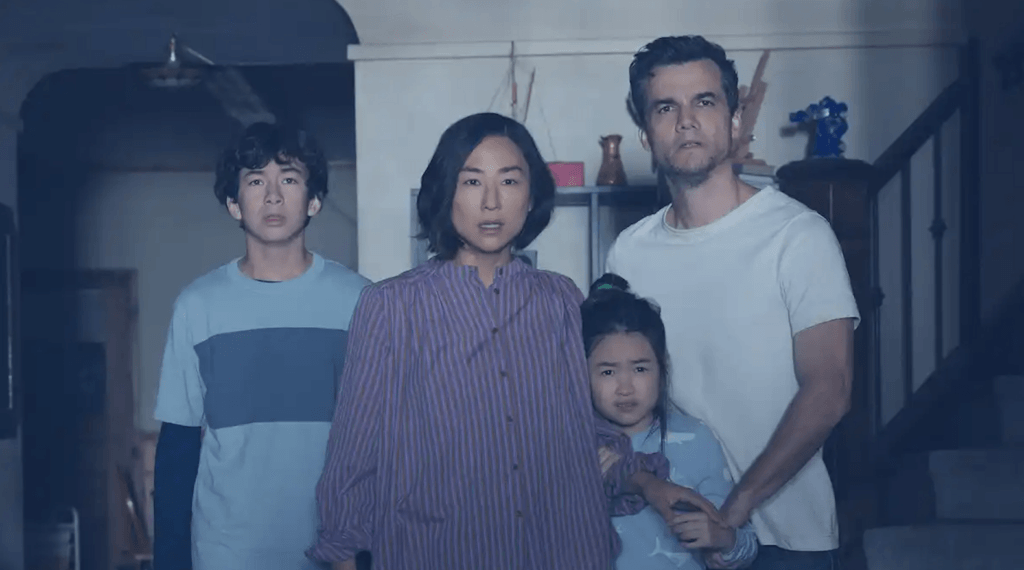
The first half of The Last House (2026) brought back memories of the COVID lockdown for me. I was hunkered down in an apartment in Buenos Aires with my wife and three toy poodles. The only time I went outside for two months was to go to the pharmacy, and the typically bustling city was a ghost town.
There’s a particular kind of anxiety that comes from being told that the outside world is dangerous while having no clear idea when it will be safe to reenter it. Home remains familiar, but it gradually stops feeling like a refuge. The walls do not move, but the space seems to shrink around you.
Director Louis Leterrier initially captures some of that anxiety. Jason (Wagner Moura) and Ann (Greta Lee) live with their children, Ruth and Graham, in an ordinary suburban house. When a strange rain begins to fall, every door and window becomes impossible to open or break. The family can look through the glass, but they cannot cross the invisible boundary separating their home from whatever is happening beyond it.
The premise is a strong one, particularly because the early scenes leave the nature of the confinement unexplained. The family tests the doors, strikes the windows, and searches for some weakness in the structure. Nothing works. There is no government announcement to follow and no expert appearing on television to explain the rules. Their “interactions” with the neighbors even recall Hitchcock’s Rear Window (to a degree).
These scenes of domestic quarantine reminded me of What We Become, though The Last House initially removes the familiar comfort of a recognizable disease. The threat could be environmental, supernatural, or extraterrestrial. That uncertainty allows the house to function as both sanctuary and prison. It keeps the family alive while cutting them off from everything that once gave their lives structure.

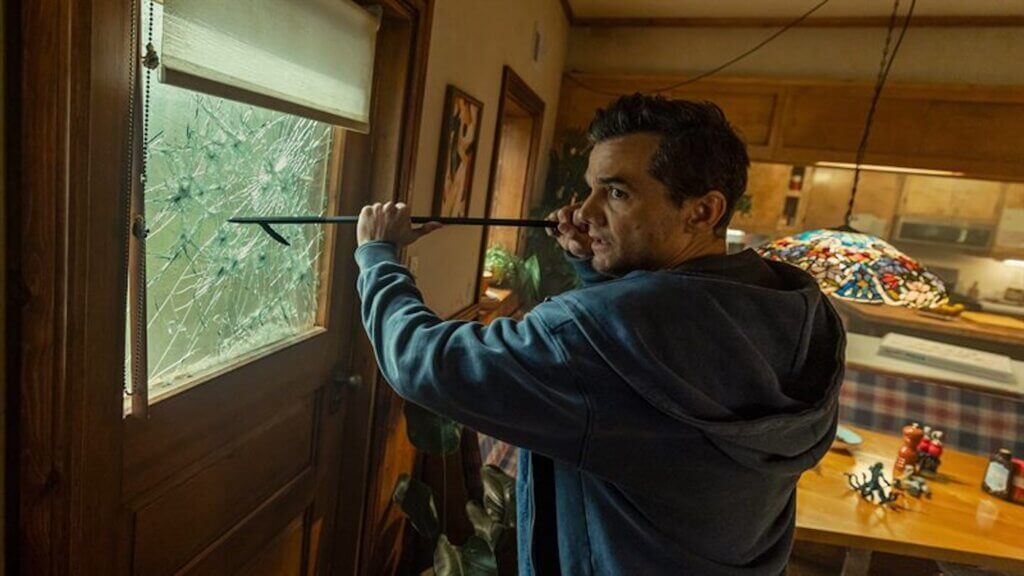
This is where the film is at its best. The first stretch focuses on the mundane logistics of isolation. Food must be counted. The children need reassurance that their parents cannot honestly provide. Days pass without answers, and the family is forced to accept that the emergency may not end anytime soon.
Anyone who experienced a severe COVID lockdown will recognize the emotional architecture of these scenes. At first, there is the expectation that confinement will be temporary. Then the calendar becomes meaningless. Domestic rituals provide a fragile sense of order, but repetition eventually becomes oppressive. The outside world begins to feel abstract, even as the inability to reach it becomes unbearable.
A more patient film might have remained with this psychological pressure. Michael Haneke’s Time of the Wolf understands that the most frightening part of social collapse is not necessarily the catastrophe itself, but the slow disappearance of ordinary life. The Last House gestures toward this idea, but it lacks the confidence to stay with it.
Instead, the film gradually transforms into a suburban survival fantasy. Years pass. The children grow older, the house deteriorates, and nearly every household object becomes part of some improvised system. Floorboards are removed to create an indoor garden. The chimney becomes a route for catching food (an unpleasant activity that we’re made to watch over and over again).
The ingenuity initially makes sense. People trapped for years would naturally experiment with every possible means of survival. The problem is how the film presents these activities. What begins as desperation soon resembles a montage from MacGyver, followed by a more violent variation on Home Alone. The family is no longer enduring an incomprehensible catastrophe, but instead building contraptions for the inevitable showdown.
At this point, The Last House becomes something of a prepper’s wet dream. The suburban family proves that it can survive the end of the world with determination, practical knowledge, and whatever happens to be stored in the garage. Social collapse becomes an opportunity for the resourceful father to demonstrate his usefulness. The family’s isolation is treated less as a material disadvantage than as a test of character.
There is nothing inherently wrong with a survival story built around ingenuity. After the Dark similarly treats the apocalypse as a problem that can be solved by identifying the right skills. Yet these scenarios easily become flattering fantasies for people who already imagine themselves flourishing after everyone else has failed. Survival is reduced to competence, as if access to space and supplies were secondary concerns.
The film also avoids meaningful questions about why this particular family can remain alive for so long. Their home conveniently contains or produces nearly everything the plot requires. Each obstacle invites another clever invention. The result is a strangely optimistic version of complete social collapse, one in which the modern household contains all the raw material necessary to replace civilization.

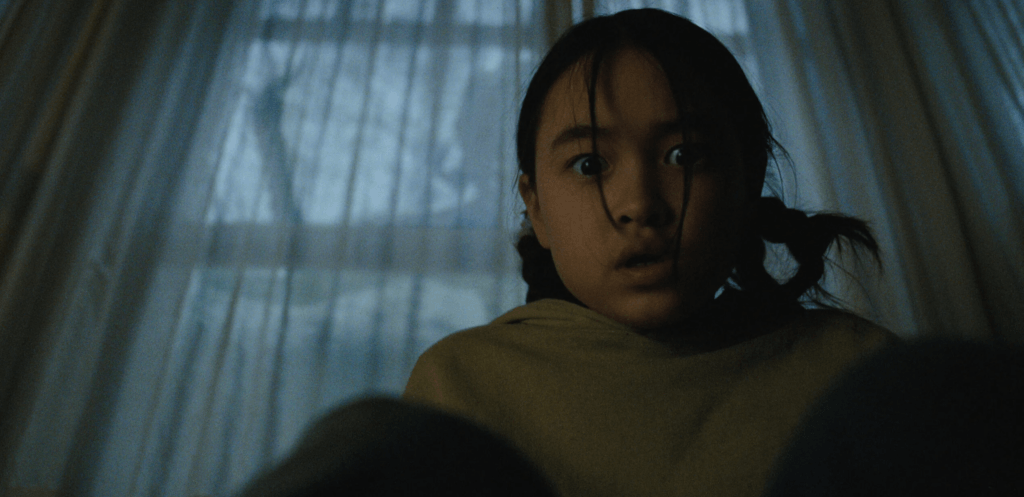
This survivalist fantasy becomes even more frustrating when the environmental implications of the story emerge. The mysterious rain is saltwater, and the creatures outside appear connected to the ocean. The film clearly wants to evoke ecological disruption. Humanity has treated nature as something stable and subordinate, only for the natural world to push back and reclaim domestic space.
The philosophical problem is that The Last House cannot imagine an environmental threat without turning it into a literal monster. Climate change is frightening precisely because it does not behave like a creature that can be trapped, outsmarted, or confronted in a final showdown. It emerges from accumulated human activity and the systems built around it, a reality reflected in the scientific account of human-caused climate change. There is no single antagonist waiting outside the window.
By transforming ecological collapse into an invasion by monsters, the film infantilizes the threat. Nature becomes an angry external force rather than something humanity inhabits and has materially altered. The creatures absolve the characters of any connection to the disaster. The family doesn’t need to reconsider its relationship to the natural world because the natural world has been reduced to something with tentacles.
This is the same narrative mistake that weakens many climate-centered science-fiction films. Voyagers begins with climate change as an existential crisis, only to use it as an excuse for a much more conventional story. The Last House follows a similar path. Environmental anxiety supplies the initial urgency, but the film eventually abandons that complexity for a formulaic monster mash.
The creatures themselves are not particularly frightening. Once they are visible, the uncertainty that sustained the opening disappears. The rain stops being an unknowable environmental event and becomes a delivery system for the next action sequence. The family builds traps, reinforces its defenses, and prepares to battle whatever forces its way inside.
These scenes occasionally provide energy, but they belong to a different and considerably worse film. The transition is not merely tonal. It reveals that The Last House never knew what it wanted to do with its premise. The lockdown imagery suggests a psychological study of isolation. The later time jumps suggest a generational survival drama. The final stretch wants to be a creature feature. None of these approaches is developed enough to justify abandoning the others.
Greta Lee and Wagner Moura do what they can with the material. However, both performances become broader as the film moves toward spectacle, largely because the screenplay stops giving them recognizable people to play.
There are still a few effective moments. The first realization that the house has been sealed is legitimately unsettling. The passage of time is communicated through the physical decline of the home, and the production design gives the setting a history that the characters themselves often lack. But like The Girl with All the Gifts, the film begins with enough intrigue to make its eventual descent into absurdity especially disappointing. What could have been a thoughtful post-COVID examination of isolation and ecological dread turns into a celebration of improvised gadgets, suburban self-sufficiency, and generic monsters.
The Last House (2026) Movie Rating: ★★ out of 5
The Last House is currently available to stream on Netflix.