


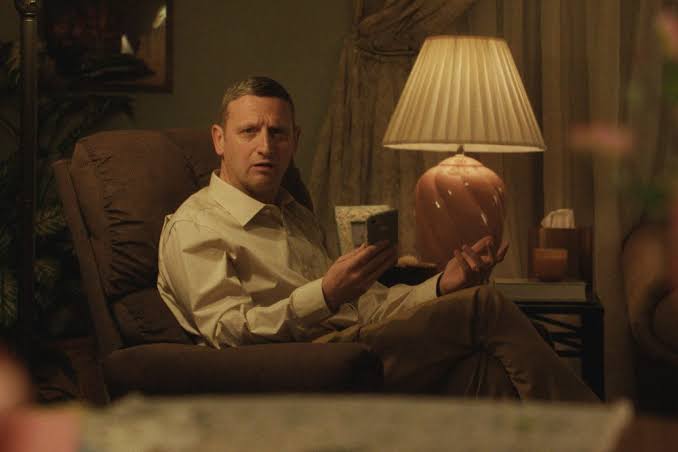
Tim Robinson is at his funniest when a character realizes that he has violated an unwritten social rule and responds by making the situation infinitely worse. A normal person might apologize, quietly withdraw, or accept that the moment has become awkward. Robinson’s characters refuse. They argue, repeat themselves, raise their voices, and commit so completely to the wrong course of action that the surrounding world begins to collapse.
Andrew DeYoung’s Friendship (2024) takes that familiar comedic formula and stretches it across an entire film. The result captures the absurdist style of I Think You Should Leave and The Chair Company, but it also allows the discomfort to develop into something darker. What initially feels like a comedy about an awkward man trying to make a friend gradually becomes a story about obsession, rejection, and the frightening consequences of a person who cannot accept that he is no longer wanted.
Robinson plays Craig Waterman, a suburban marketing executive who appears to have most of the basic components of a normal middle-class life. He has a wife, Tami (Kate Mara), a teenage son, and a stable job. Yet Craig seems disconnected from all of it. He moves through his life with a strange mixture of passivity and suppressed desperation. He doesn’t appear to have close friends, and he lacks even a basic understanding of how adults form meaningful relationships outside of work and family.
That changes when Craig meets his new neighbor, Austin Carmichael (Paul Rudd), a local television meteorologist who seems to possess everything Craig lacks. Austin is relaxed, adventurous, musically inclined, and surrounded by friends. He moves through social situations without appearing to think about them. Craig, meanwhile, studies every interaction as if there might be a correct response hidden somewhere beneath the conversation.
When Austin invites him to hang out, Craig gets a glimpse of a different kind of life. The two drink together, talk about their frustrations, and explore a hidden tunnel system beneath the city. For Austin, it’s a pleasant evening with an unusual neighbor. For Craig, it’s practically a spiritual awakening. He hasn’t simply made a new friend. He believes he’s found a new version of himself.


This early section of Friendship is consistently funny because Craig’s enthusiasm is both understandable and completely disproportionate. He wants what most people want: companionship, recognition, and a sense that someone actively enjoys his presence. The problem is that he treats every small sign of acceptance as proof of an extraordinarily deep connection.
There’s a clear resemblance to The Overnight, another cringe comedy about the difficulty of making friends as an adult. Both films understand that adult friendship can be strangely humiliating. Children can simply ask one another to play. Adults have to disguise the same desire behind invitations, jokes, drinks, and casual conversation. Everyone is supposed to act as though the friendship has happened naturally, even when both people are consciously trying to make it happen (or stop it from happening).
Craig has no instinct for this performance. He cannot appear casual because nothing about the friendship feels casual to him. Every invitation matters way too much. Every joke is a test. Every introduction to Austin’s other friends feels like an opportunity to prove that he belongs. The harder Craig tries to appear comfortable, the more uncomfortable everyone around him becomes.
This is where Robinson’s comedic style works so well. In I Think You Should Leave, his characters often misunderstand a social situation and then defend that misunderstanding long after everyone else has recognized the problem. Craig operates according to the same logic. He doesn’t merely say the wrong thing. He senses that something has gone wrong and responds by pushing harder, as though sheer commitment could force everyone else to accept his version of events.
That approach is perfect for a short comedy sketch, where the scene can end at the exact moment the behavior reaches its most ridiculous point. A feature-length film presents a harder challenge. The character has to continue living after the social disaster. He has to go home, remember what happened, and decide what to do next.
Friendship succeeds because it understands that the aftermath is where Robinson’s comedy can become genuinely sinister. Craig’s worst moments don’t disappear when the scene ends. Each humiliation becomes part of a larger grievance, and every failed attempt to repair the friendship pushes him toward more extreme behavior.
Paul Rudd is an ideal counterweight to Robinson. Austin possesses the effortless likability that has defined much of Rudd’s career. He’s warm enough for Craig’s immediate attachment to make sense, but he’s also distant enough to retain a degree of mystery. Craig sees him less as a complete person than as an image of everything a man is supposed to be. Austin has friends, hobbies, stories, and the confidence to behave as though he belongs wherever he happens to be.
Yet Austin isn’t quite the perfect figure Craig imagines. His charm allows him to avoid many of the social consequences that Craig cannot escape. He can be eccentric because people already like him. Craig interprets this freedom as a set of behaviors he can imitate, without understanding that the same behavior looks very different when performed by someone who makes everyone uneasy.
Craig’s desire is therefore not limited to friendship. He wants access to Austin’s identity. He wants to be included in his social circle, share his interests, and absorb the qualities that make him appealing to other people. When the friendship begins to deteriorate, Craig does not simply feel lonely again. He feels as though Austin has shown him a better life and then taken it away.
The comedy becomes darker because Craig gradually treats friendship as something he has earned. Austin’s initial kindness becomes a contract in Craig’s mind. If they shared one meaningful experience, then Austin should continue providing more. If Craig feels emotionally invested, then Austin should return that investment. The possibility that Austin might simply decide he no longer enjoys Craig’s company becomes an unbearable insult.
Rejection is one of the most ordinary experiences imaginable, but Friendship makes it feel dangerous. Craig cannot process the difference between being hurt and being wronged. His pain is real, yet he uses that pain to justify increasingly invasive behavior. The film allows us to sympathize with his loneliness without asking us to excuse what he does with it.
This is the point at which the cringe comedy begins to resemble psychological horror, to a degree. The viewer can see the danger before Craig does. Every attempt to repair the situation only confirms Austin’s reasons for creating distance. Craig keeps moving toward a friendship that no longer exists, refusing to recognize that his pursuit has become threatening.
Cringe comedy depends on a shared understanding of social boundaries. We laugh because we recognize the rule that the character is breaking, even if the character does not. Friendship complicates that laughter by showing what happens when the rule-breaking continues beyond embarrassment. Craig’s inability to read the room initially makes him ridiculous. Eventually, it makes him (somewhat) frightening.
The tonal shift works because the sinister elements were present from the beginning. Craig’s neediness always contains a trace of entitlement. His excitement always feels one step away from obsession. Even his more innocent attempts at connection carry an uncomfortable intensity. DeYoung does not suddenly transform Craig into a different character. He just removes the comic distance that allowed us to treat his behavior as harmless.
At the same time, the film never completely abandons absurdism. Its world remains slightly detached from reality. Conversations move in unexpected directions, minor characters behave with unexplained intensity, and certain scenes feel like fragments from sketches that have wandered into the larger narrative. The difference is that these moments no longer provide Craig with an escape. The absurdity surrounding him only makes it harder to determine where ordinary awkwardness ends and genuine instability begins.
Robinson gives the film exactly the performance it needs. His body always seems to betray what Craig is trying to hide. His face shifts between confidence, panic, resentment, and childlike excitement before he can settle on the expression appropriate for the moment. When Craig attempts to behave normally, we can practically see him calculating what a normal person would do.
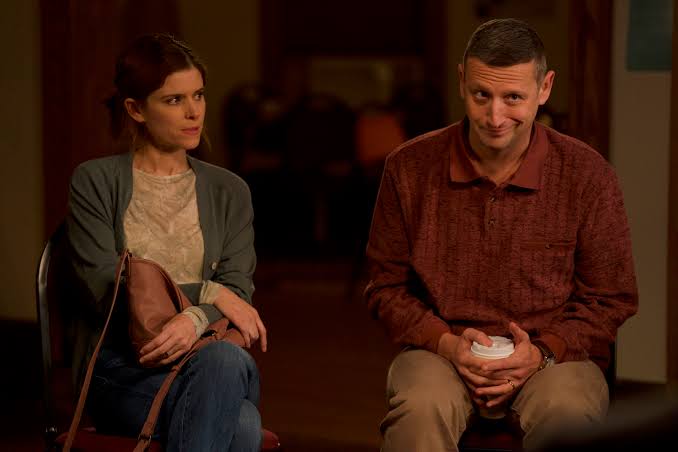
Robinson is also willing to make Craig deeply unpleasant. He doesn’t soften the character to preserve the audience’s affection. Craig can be selfish, oblivious, manipulative, and cruel. Still, Robinson allows enough vulnerability to remain visible that Craig never becomes a simple villain. There are moments when it’s difficult not to feel sorry for him, even after he has done something indefensible.
That tension gives Friendship more substance than a typical comedy about an obnoxious outsider. Craig’s problem is not simply that he lacks friends. He lacks a stable understanding of other people as individuals with desires and boundaries separate from his own. He wants companionship, but he also wants control over the terms of that companionship.
The film’s treatment of male friendship is particularly effective. As I noted in my review of Your Color, films often struggle to address male kinship without turning it into a joke. Friendship certainly makes male loneliness funny, but it does not dismiss that loneliness. Craig’s desperation is exaggerated, though the emotional absence beneath it feels credible.
Many men reach adulthood with few tools for expressing platonic affection. Friendship is supposed to emerge through shared activities rather than direct emotional communication. Austin and Craig can explore tunnels, drink beer, play music, and talk around their feelings. Craig’s attachment becomes overwhelming partly because he cannot name it in a healthy way. He doesn’t know how to say that the friendship matters to him without making the statement sound like a demand.
The film could have done more with Craig’s family. Tami and their son often feel like supporting evidence in the case against him rather than fully developed people. Their emotional distance shows that Craig’s inability to connect extends beyond Austin, but the domestic story occasionally feels underwritten. Kate Mara brings a subtle frustration to Tami, though the film is far more interested in Craig’s fixation than in what his behavior has cost her.
A few of the film’s stranger detours also work better as individual comedic sequences than as parts of a unified story. This is probably inevitable when expanding a style built around short sketches. Not every escalation feels necessary, and the feature occasionally shows the strain of keeping Craig’s particular kind of discomfort alive for more than an hour and a half.
Fortunately, these weaknesses do little to diminish the film’s overall effect. DeYoung understands Robinson’s appeal without simply reproducing I Think You Should Leave in a longer format. He gives Robinson’s familiar comic persona consequences. The man who refuses to leave the awkward situation is still funny, but now we have to remain in the room with him.
Friendship is one of the rare comedies that becomes more unsettling the longer its central joke continues. It begins with the embarrassing difficulty of making a friend in adulthood and ends somewhere much darker, where loneliness has hardened into entitlement and affection has become possession.
Tim Robinson’s performance will naturally appeal most to viewers who already enjoy his style, but the film does more than offer a collection of extended sketches. It examines the sadness and menace hidden beneath his comedy. Craig is hilarious because he cannot recognize when he should leave. He is frightening for exactly the same reason.
Friendship (2024) Movie Rating: ★★★★ out of 5
If you’d like to watch Friendship (2024), the film is currently available to stream, rent, or purchase via Amazon.