


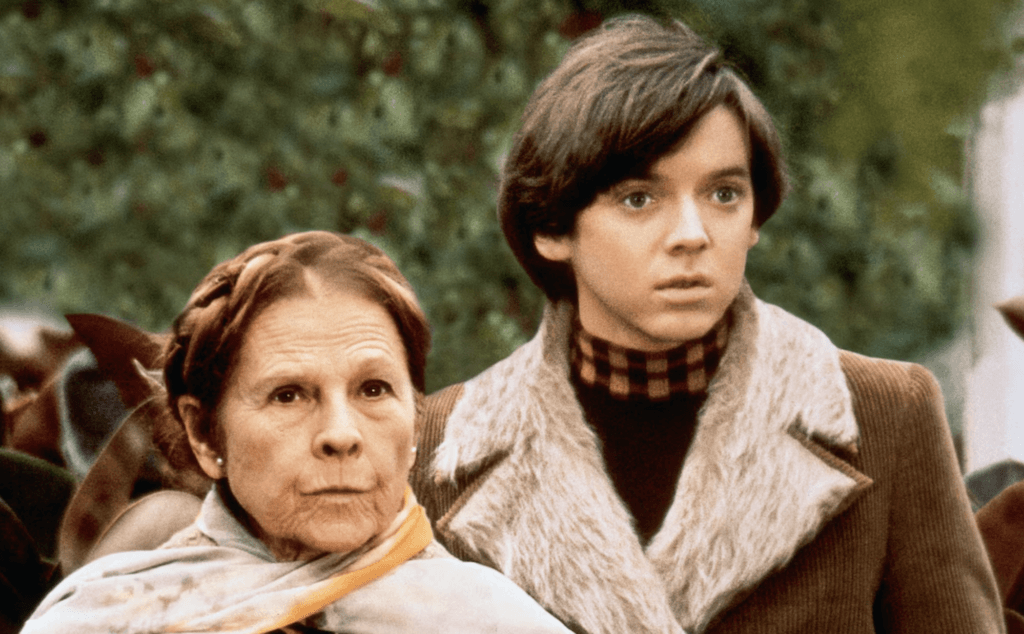
Initial reactions Harold and Maude (1971) upon its release were mixed, and it’s not hard to understand why. Harold (Bud Cort) was a weird little guy doing weird little things from the opening scene onward. His obsession with death stood in stark contrast to the wealthy socialite surroundings curated by his disapproving mother (Vivian Pickles).
That contrast is what gives the film some of its strange power over skeptical audiences. Harold is surrounded by wealth, structure, and all the symbols of a “successful” life, but none of it seems to reach him. He lives in a world where everything has been arranged for him, and yet he has no real place in it. His staged suicides are morbid and absurd, but they also feel like attempts to communicate with people who refuse to listen. He is not only fascinated by death; he is also trying, in his own bizarre way, to prove that he exists.
I think it’s much easier for post-postmodern audiences to sympathize with Harold’s character. He doesn’t fit in. He feels unloved. His mother is overbearing in her desire to direct his life toward conventional goals: marriage, career, and the like. At the same time, she seems completely unwilling to speak to him directly about anything of consequence. Instead, she scoffs and sends him off to be “fixed.” His military uncle has no luck, nor does his psychoanalyst.
Nowadays, we can see Harold for who he is: a young, morose man trying to find himself and find some joy in life. Back in 1971, I think audiences might not have been ready for such an “off-putting” protagonist.
Maude (Ruth Gordon), on the other hand, is much more likeable in the conventional sense. She’s bright and quirky and has an undeniable joie de vivre. She does, however, skirt authority at every turn, stealing cars, escaping from police officers, removing a dying tree from the city sidewalk to replant it in the forest where it can survive.
This is where the film’s existential themes start to come into clearer focus. Harold is obsessed with death, but Maude is not simply obsessed with life in the opposite direction. Her joy is not shallow optimism. She lives as if life has to be actively chosen, again and again, especially in a world that constantly tries to make people smaller, quieter, and more obedient. Harold’s problem is not merely that he is sad. It’s that he has not yet discovered a way to live that feels honest.

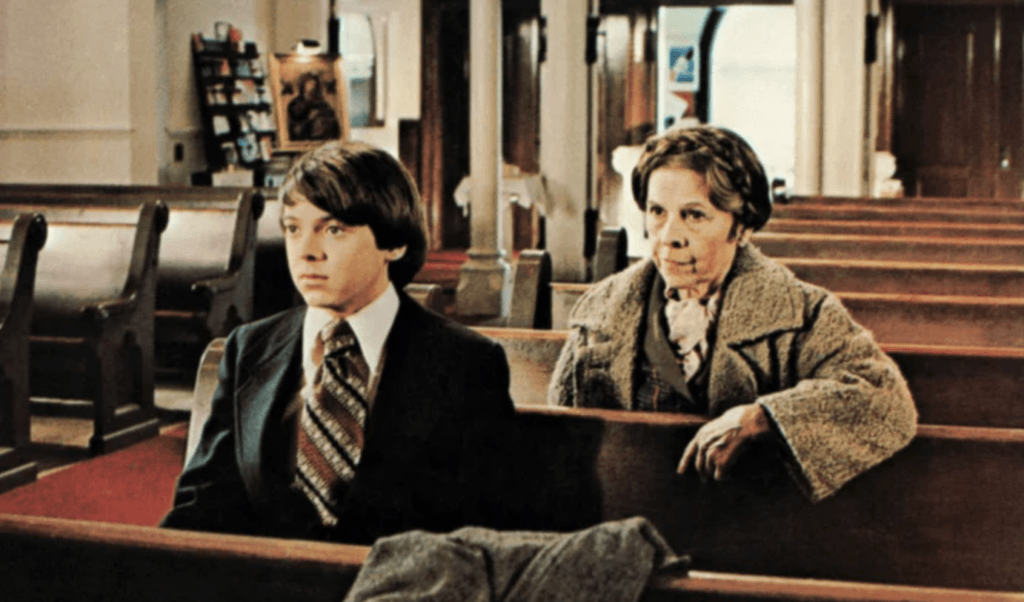
At times, the dichotomy between Harold and Maude is a bit too stark. We get to know these two characters with all the subtlety of a bull in a china shop. Harold is dark and sad. Maude is bright and bubbly.
With time, however, the film finds itself when Harold and Maude are simply given room to interact in more authentic ways. We learn more about Maude’s fascinating life, which we observe through Harold’s eyes, leaving him to remain a bit more enigmatic. On two different occasions, Maude’s internal pain rises to the surface, once when she recalls her husband and fights back tears, and once when Harold catches a glimpse of a numbered tattoo on her wrist, indicating that she survived a Nazi concentration camp.
That moment with the tattoo is brief, but it changes the way we understand Maude. Her love of life is not some whimsical affectation. It is not merely the personality of a charming old woman who likes to break rules. It is a philosophy formed in the shadow of suffering. She has seen what human beings are capable of, and somehow, she has still chosen music, flowers, sensation, rebellion, and tenderness. In that sense, Maude is not naïve. If anything, she may be the least naïve person in the film.
This also makes her relationship with Harold more meaningful. She’s not teaching him that life is always wonderful. She is teaching him that life is finite, fragile, and still worth embracing. Harold treats death like an aesthetic, almost like a private language. Maude understands death as a real presence, which is exactly why she refuses to waste the time she has left.
Their bond works because they meet somewhere between these two understandings. Harold gives Maude his attention and openness, and Maude gives Harold permission to imagine himself outside the suffocating expectations of his class, family, and society.
Harold and Maude struggles with some of the basics of great filmmaking, like editing and pacing, but these imperfections give it a kind of retrospective charm. It is very much a film of the era, with folk music popping up regularly, in the same vein as Midnight Cowboy (1969) and Easy Rider (1969). Though Harold and Maude enjoys its own fresh take on romance and black comedy, it borrows heavily from the counterculture in which it was conceived.
The Cat Stevens soundtrack also adds to this feeling. At times, the songs can feel a little too on-the-nose, but they help create the film’s peculiar emotional rhythm. The music makes Harold’s world feel softer and stranger, as if the film is always trying to pull him away from the funeral parlor and toward the open air.
Of course, what interests most people about Harold and Maude is the age gap between the friends-turned-lovers. Harold is 19-going-on-20, whereas Maude is 79-going-on-80.

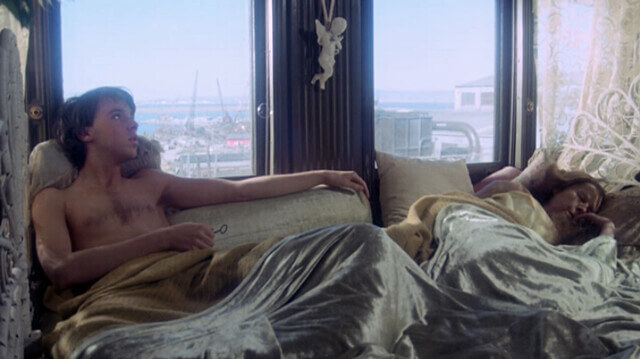
One of the funniest moments in the film comes toward the end, after Harold announces his intention to marry Maude, and he’s sent to various “authority” figures to talk him out of it. The priest, sweating profusely, describes how “disgusting” it would be to imagine a young man’s body with the “flabby, sagging” body of an older woman. The relationship between Harold and Maude is unique, perhaps even strange, but it’s anything but disgusting. The film makes it abundantly clear that they are two souls who’ve found beauty in one another.
And because the film is so sincere about that beauty, the relationship never feels like a cheap provocation. It is provocative, of course, but not in an empty way. The age gap forces the viewer to confront how narrow our ideas of love, intimacy, and companionship often are. Harold and Maude are not a conventional couple, but they understand each other more deeply than anyone else in the film understands either of them. Their connection is less about romance in the ordinary sense and more about recognition.
The ending complicates all of this in a typical 70s fashion. Maude’s decision is difficult to process, especially because Harold has finally begun to move toward life through her. But that may be the point. If Maude has truly taught Harold anything, it is that he cannot make another person the sole reason for his existence. He has to choose life for himself. The final image suggests that he might actually be able to do that. He does not become “normal,” and the film does not pretend that his sadness has vanished. But he has inherited Maude’s defiance, her music, and perhaps most importantly, her willingness to keep going.
Harold and Maude is not a perfect film, but its imperfections are part of what make it linger. It is clumsy in places, blunt in others, and occasionally too pleased with its own oddness. But it also has a strange emotional honesty. It understands that despair can sometimes be a twisted desire for life, and that joy can sometimes come from people who have suffered more than anyone else. Its existential message is not that life is easy, or even that life always makes sense. It is that life is brief, absurd, painful, beautiful, and still worth choosing.
Harold and Maude (1971) Movie Rating: ★★★½ out of 5
If you’d like to watch Harold and Maude (1973), the film is currently available to stream, rent, or purchase via Amazon. For more film reviews like this one, be sure to check out the Philosophy in Film homepage!