


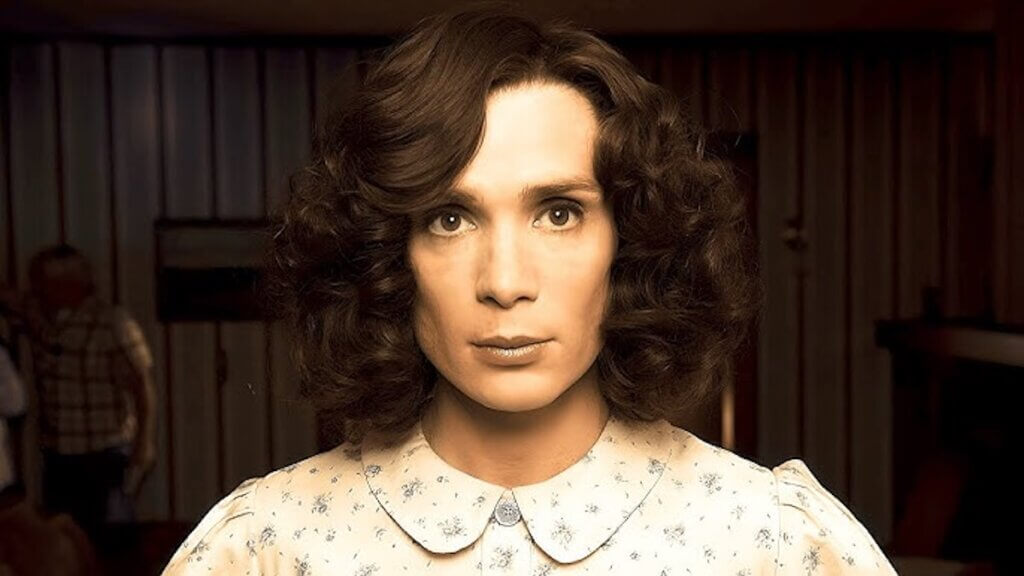
Cillian Murphy drew me to Peacock (2010), but even his unusual double role cannot make this Psycho-inspired thriller hold together.
If you’re like me and you spend far too much time online, there’s a relatively good chance that you’ve seen short videos of Cillian Murphy dressed as a woman, hanging clothes to dry in their yard, when a train suddenly bursts onto screen, knocking Cillian Murphy’s character unconscious. Murphy’s character wakes up to find all the townspeople gathered around to see the crashed train and to find out if this unknown woman is okay. This bizarre occurrence sets off a chain of events that lead to murder, revealing the underlying trauma and mental illness suffered by our anti-heroine in Peacock (2010).
Stream, rent, or purchase Peacock on Amazon.
I’ll rewind briefly to provide a little more context. Cillian Murphy actually plays John, a shy bank clerk living in the town of Peacock, Nebraska. It’s meant to be the 1960s, but some poor hair, wardrobe, and even location choices made me question the setting throughout. Sometimes it felt like it was set in the 1940s, other times the 1980s, and sometimes it landed somewhere in the middle.
In any case, John tries to live a quiet life and keep to himself, but he has a secret. Every day, he dresses up as a woman, Emma, to prepare breakfast and do chores around the house. It’s unclear what, at first, John gets out of this alter ego. At first, Emma seems to be a private part of John’s life that he cannot safely show anyone else. The film later presents John and Emma as separate identities, but it never handles the difference between that psychological premise and Emma’s feminine appearance with much care.
People mistake Emma for John’s wife, with many congratulating John on his marriage. Without any other option, John and Emma keep up the ruse, though John grows increasingly upset with the actions of his alter ego. This is where the film’s debt to Hitchcock’s Psycho (1960) becomes impossible to miss: the controlling mother, the isolated house, and the identity shaped by abuse. John and Emma’s conflict could have raised the sort of questions about how a person’s identity is formed. Here, it mostly gives the screenplay another way to delay its reveal. John tries to repress Emma, while Emma tries to become the dominant identity.
The primary driver of tension is the train caboose that remains firmly planted in John’s yard. The mayor and his wife, Fanny (Susan Sarandon), want to use the train as the setting for a political rally. They also want both John and his wife to be present. John’s behavior at work and about town becomes increasingly erratic as he tries to navigate the delicate situation without revealing the truth about Emma.
There’s also a storyline involving Maggie (Elliot Page), a single mother raising John’s son. She had been receiving checks from John’s mother up until his mother’s death, so she sought assistance from John, only to befriend Emma. John and Emma take two very different approaches to helping Maggie, causing further confusion for all parties.


As the story reaches its finale, it tries harder and harder to pay homage to Psycho. Emma goes to a bar that looks suspiciously modern for the 1960s to seduce a man. She takes him back to a small hotel, only to murder him, staging it as John’s death. It all feels like a cheap knock-off of Hitchcock’s work. However, Peacock can’t hold a candle to Psycho, mostly because all of its different pieces just don’t fit together very well.
Take Emma’s character, for example. In addition to changing clothes and putting on a wig, director Michael Lander made the strange choice to put prosthetics on Cillian Murphy to make him look more feminine (and to make it more believable that the townspeople would think Emma was not just John in a dress). It’s a little creepy and off-putting, and it doesn’t really make sense, because John becomes Emma (and vice versa) very quickly. This choice took me out of the film, because it’s just too difficult to believe that, even with a bit of makeup and prosthetics, people wouldn’t recognize Emma as John.
Murphy has described playing John and Emma as an appealing challenge, and I understand why; my trouble is with how little the film does with the two performances beyond making their coexistence seem ominous.
What irked me even more was the screenplay’s insistence that Emma’s femininity needs a sinister explanation. John’s traumatic history and the film’s portrayal of dissociation are parts of its story. Wearing women’s clothing is something else. Peacock folds them together, then ties the whole thing to violence as though the appearance of a woman were itself a warning sign. That feels cheap, especially for a film released in 2010.
The townspeople’s reaction to Emma could have been interesting in its own right. Even the failed comedy of It’s Pat (1994) finds something revealing in other people’s need to classify a person on sight. Peacock gives its neighbors a secret to uncover, but rarely asks why they feel entitled to uncover it. Sleepaway Camp (1983) also builds shock around a gendered reveal, and even as an 80s B-horror film, it treats gender identity with slightly more awareness.
Setting this issue aside, Peacock is just a mess of a film. It doesn’t flow very well. The writing is lackluster, the acting is flat-out bad because the characters are put in situations that are too unbelievable to begin with, and the filmmakers really cut corners with the budget. Even though they put a lot of time and money into the very short train crash sequence, it doesn’t look that great. I’d even argue that the shot is laughably bad, even though it took so much work to pull off.
Peacock (2010) is, in my opinion, one of those films you watch out of sheer curiosity (as I did). It’s not good, but it’s just bad enough to make you ask why it was made in the first place. It also features big-name stars, which makes you wonder how it fell off the radar so quickly. Aside from a few TikTok and Instagram videos riffing on the train sequence, it’s not a film that anybody really thinks or talks about anymore. And maybe that’s for the best.
Peacock (2010) Rating: ★½ out of 5
If you’d like to watch Peacock (2010), the film is currently available to stream, rent, or purchase via Amazon.