


This review was originally published in April 2017. It was substantially updated in September 2026.
More than a century after its release, Nosferatu: A Symphony of Horror is still capable of producing images that feel genuinely unnatural. Count Orlok rising rigidly from his coffin, creeping through an empty town, and extending his shadow across Ellen’s bedroom wall no longer frighten because the effects are convincing. They frighten because F.W. Murnau understood how little a film needs to show before the imagination creates something worse.
See the available restored editions of Nosferatu on Amazon.
The film surrounding those images is less consistently effective. Its narrative can be uneven, its characters are thinly developed, and several passages feel unnecessarily prolonged. I admire Nosferatu more than I enjoy watching every minute of it. Nevertheless, its strongest sequences remain among the defining achievements of silent horror.
Released in Germany in 1922, Nosferatu: Eine Symphonie des Grauens was an unauthorized adaptation of Bram Stoker’s Dracula. Screenwriter Henrik Galeen changed the characters’ names and moved the story to Germany, but the similarities remained unmistakable. Jonathan Harker became Thomas Hutter, Mina became Ellen, and Count Dracula became Count Orlok.
Hutter travels to Orlok’s remote castle to complete a property transaction. He soon realizes that his host is a vampire, but Orlok has already seen a photograph of Ellen and purchased a house directly across from the couple’s home in Wisborg. The count travels there aboard a ship filled with coffins and rats, leaving the crew dead before bringing disease into the city.
The alterations to Stoker’s novel did not prevent legal action. According to the British Film Institute’s history of Nosferatu, Stoker’s widow, Florence, successfully sued the production company for copyright infringement. A court ordered the prints destroyed, but copies had already circulated outside Germany. The film survived the attempt to erase it and eventually became more culturally enduring than most authorized adaptations.
That history has become inseparable from the film’s mythology. Nosferatu is a story about something that crosses borders, escapes containment, and persists after authorities believe they have destroyed it. The film itself followed almost exactly that path.


Murnau’s greatest departure from Dracula is the connection between vampirism and contagious disease. Orlok doesn’t just attack isolated victims. He arrives with rats, coffins, and the apparent return of plague. People begin dying throughout Wisborg while lines of coffin bearers move through the streets.
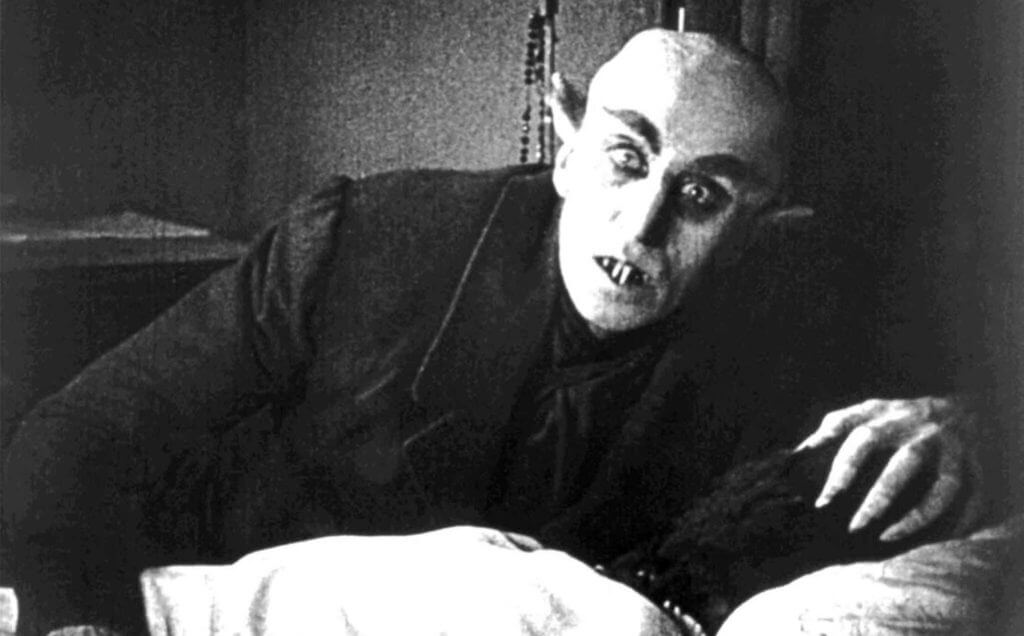
Orlok consequently feels less like an individual villain than a moving source of contamination. His body appears to combine human, corpse, and rat. His elongated fingers resemble claws, while his teeth are positioned like those of a rodent rather than the familiar fangs of later screen vampires. Max Schreck does not play him as an aristocratic seducer. There’s no charm beneath the monstrosity and no tragic romance waiting to humanize him.
Later versions of Dracula frequently invite some degree of identification with the vampire. Immortality becomes seductive, while the desire for blood can represent forbidden sexuality, addiction, or alienation. Orlok offers no similar fantasy. He is hunger, disease, and death moving through a human landscape.
That makes Nosferatu an early example of the categorical instability explored in my list of art horror films. Orlok is disturbing because he occupies several incompatible states at once. He looks alive but moves like a corpse. He has a human outline but carries the physical characteristics of vermin. He can purchase property and sign legal documents, yet he also travels inside a coffin filled with contaminated soil.
The people of Wisborg attempt to interpret the resulting deaths as an ordinary epidemic. Their explanation is not entirely wrong. The symptoms are real, bodies accumulate, and the rats provide a rational mechanism through which disease might spread. What they cannot comprehend is that the epidemic also possesses a face and a will.
Murnau never completely separates the natural from the supernatural. The vampire doesn’t replace disease as an explanation; he gives disease a body. The film transforms an invisible process of transmission into a creature that can cross thresholds, enter bedrooms, and travel from one community to another.
This isn’t cosmic horror in the later Lovecraftian sense, but it anticipates the loss of human importance found in many cosmic horror films. Orlok doesn’t recognize the city’s laws, relationships, or social hierarchies. Wisborg’s inhabitants become bodies within a chain of contamination. Their institutions can count the dead, but they cannot explain what has entered their world.
The film was produced shortly after World War I and the 1918 influenza pandemic. It would be too simplistic to reduce Orlok to a direct symbol of either historical catastrophe, but the plague imagery would not have been remote or abstract to its original audience. Empty streets, mass death, and the inability of authorities to control an invisible threat belonged to recent experience.
The city responds by searching for something visible to punish. Knock, Hutter’s employer and Orlok’s servant, becomes the target of an increasingly frantic crowd. His guilt doesn’t make the pursuit rational. The residents want one identifiable person to contain their fear, even though capturing him cannot stop the deaths.
Here, Nosferatu understands something familiar about collective panic. A frightened community would rather select a scapegoat than admit that the actual threat exceeds its knowledge. Orlok’s physical strangeness makes him the monster, but supposedly ordinary people quickly become capable of their own irrational violence.
The film is routinely identified with German Expressionism, although its visual style is more complicated. Unlike The Cabinet of Dr. Caligari, it doesn’t build its entire world from distorted studio sets. Murnau filmed extensively on location, using actual buildings, landscapes, mountains, and waterways.
As a retrospective Sight and Sound analysis explains, Murnau frequently places the fantastic inside clear, recognizable environments. Orlok’s presence does not transport the characters into another world. It makes the existing world appear infected by something that was always hiding within it.
Murnau relies heavily on fixed compositions and long shots, but the stillness is a deliberate part of a broader visual strategy rather than a technical limitation governing every shot. His framing makes empty space threatening. A doorway remains vacant until Orlok appears within it. A road stretches across the landscape before his carriage moves through it at an unnatural speed. The hold of a ship appears still until the count rises from among the coffins. Murnau allows the audience time to examine the frame, then introduces something that makes the entire space unsafe.
This approach requires patience. Modern horror editing tends to direct attention rapidly through close-ups, sudden cuts, and carefully timed revelations. Nosferatu often asks viewers to search a wider composition. Orlok may occupy only a small portion of the image, but his posture immediately disrupts everything around him.
The effects are simple but effective. Stop-motion animation makes objects move without human assistance. Negative imagery transforms the forest into an alien environment. Orlok’s movements occasionally appear unnaturally fast, while his rigid rise from the coffin ignores the ordinary mechanics of a human body.
These techniques don’t create realism, but they work because they look as though the physical film has become contaminated by the same force threatening the characters.
The shadows remain the film’s most famous visual device. Orlok’s shadow climbs stairs, reaches toward a door, and eventually passes across Ellen’s body. At these moments, he becomes both present and absent. His physical body remains outside the room, yet its outline acts with apparent independence.
A shadow normally confirms that a body is nearby. Murnau turns it into something capable of replacing the body altogether. Orlok becomes most frightening when reduced to a trace.
The surviving versions of Nosferatu can significantly affect how the film is experienced. Poor public-domain copies have often been shown at the wrong speed, stripped of their original tinting or accompanied by unsuitable music. These versions can make the performances look frantic and flatten the visual distinctions between night and day.
The restored version deserves preference. The 2006 restoration reconstructed the film using surviving prints from several archives. It also restored color tinting and Hans Erdmann’s original score. Blue, yellow, and reddish tones help identify nighttime, daylight, and transitional moments. Nosferatu is a silent film, but it was never intended to be a colorless or musically empty experience.
Watching an appropriate restoration doesn’t eliminate my problems with the narrative. Hutter remains an uninteresting protagonist, and his journey occasionally feels like connective material between stronger visual sequences. Character motivations are not always developed clearly, while the limited intertitles force the images to carry emotional transitions they cannot fully communicate.
The first half is especially uneven. Hutter behaves with such exaggerated cheerfulness that he seems disconnected from the danger even before reaching the castle. His rapid movement from confidence to terror lacks psychological depth. Knock’s madness is visually energetic but narratively broad, and several minor characters function primarily as witnesses to the spreading catastrophe.
The film becomes much stronger once Orlok reaches Wisborg. Individual suspense gives way to collective dread. The emptying streets and repeated coffins create a sense that the city itself is dying. Murnau no longer needs Hutter to explain what is happening because the environment has taken over the story.
Ellen also emerges as the film’s actual moral center. The male characters travel, investigate, and consult supposed experts, but none of them can stop Orlok. Ellen discovers that the vampire can be destroyed if a virtuous woman willingly keeps him beside her until sunrise. She opens the window and offers herself as his final victim.
Her decision is troubling because it depends upon an ideal of female purity and self-sacrifice. Ellen can defeat evil only by surrendering her body and accepting death. The film celebrates that sacrifice without questioning why salvation should require a woman to absorb the consequences of male failure.
At the same time, Ellen is the only character who acts with a complete understanding of the cost. Hutter inadvertently brings Orlok into their lives. The doctors misdiagnose the threat, while the city chases a scapegoat. Ellen develops a plan and carries it through voluntarily. The German History in Documents and Images account of the ending similarly emphasizes that she alone recognizes how Orlok can be destroyed.
The conclusion therefore combines agency with martyrdom. Ellen saves the city, but the restoration of social order requires her removal from it. Orlok disappears in the sunlight, and she dies in Hutter’s arms. Evil is defeated, though the victory offers no reward to the person responsible for it.
This ending also changes the meaning of light. Darkness provides Orlok with concealment, but sunlight does more than reveal him. The vampire cannot survive complete visibility.
That idea helps explain why Nosferatu continues to feel so elemental. Its horror depends upon oppositions that cinema can express without dialogue: light and shadow, movement and stillness, presence and absence, living bodies and dead ones. The story is sometimes muddled, but its images are extraordinarily direct.
I still find portions of Nosferatu slow and emotionally distant. Its reputation can make it tempting to excuse every weakness as a consequence of age, yet other films from the silent period possess more coherent storytelling and richer characterization. The best works in my collection of silent films for philosophy students demonstrate that narrative clarity was hardly beyond the abilities of filmmakers in the 1920s.
What Nosferatu possesses instead is an almost inexhaustible visual life. Count Orlok has outlived the film’s production company, the court order intended to destroy him, and generations of technically more sophisticated vampires. He remains frightening because he doesn’t resemble a misunderstood romantic outsider. He resembles the moment when death acquires a shape and crosses the threshold.
Nosferatu (1922) Rating: ★★★½ out of 5
If you’d like to watch Nosferatu (1922), it’s currently available to stream, rent, or purchase via Amazon.