


This essay contains major spoilers.
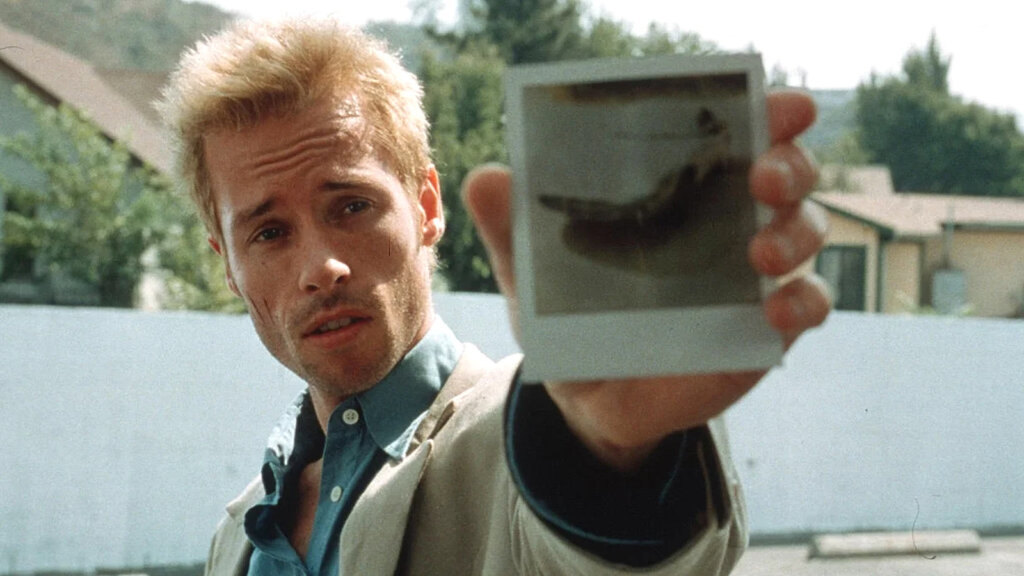
A Polaroid photograph fades instead of developing. Blood moves back into a man’s skull. A bullet returns to the chamber of a gun. Christopher Nolan begins Memento (2000) by reversing a murder, which introduces a world in which evidence can be unmade. A photograph may appear to preserve the truth, yet its meaning depends on who took it, what happened outside the frame, and why someone decided to keep it.
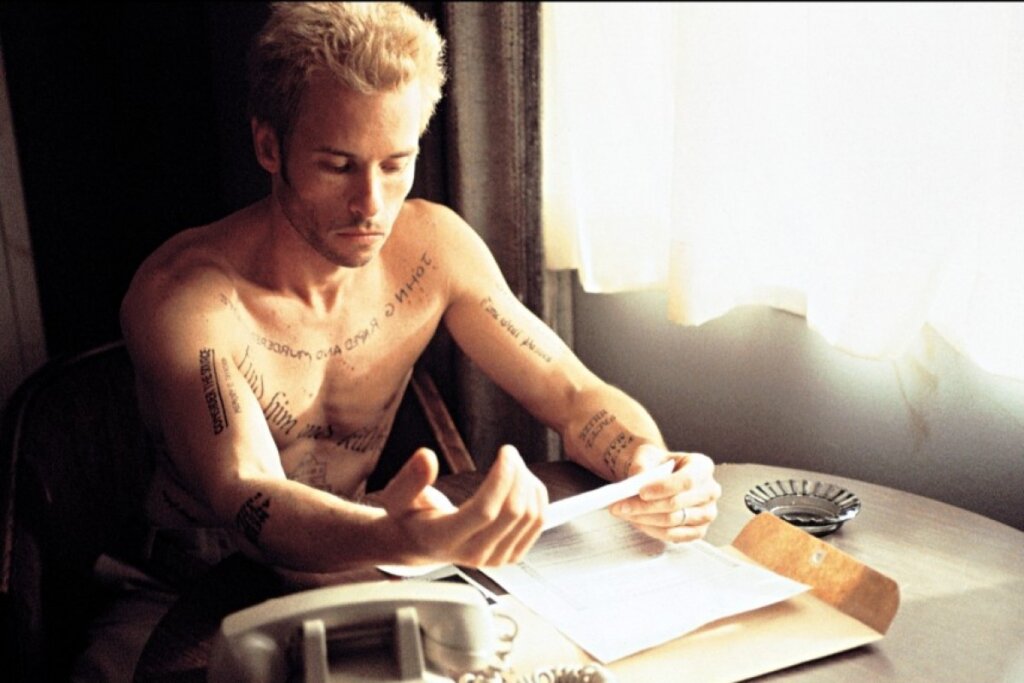
Leonard Shelby believes he has solved this problem. After an injury leaves him unable to form new long-term memories, he replaces recollection with a system of Polaroids, handwritten instructions, and facts tattooed across his body. Memories are unreliable, he argues, because they can change. Facts remain facts.
The ending of Memento reveals the flaw in that distinction. Leonard’s records are not independent of his desires. They are memories he edited before treating them as evidence. He does not only suffer from an inability to remember the truth. He consciously constructs a lie, arranges for himself to forget its construction, and leaves the lie behind as an instruction for his future self.
The central philosophical question is therefore not whether Leonard can know what happened. It is whether a person remains morally responsible when one version of the self deceives another.
Nolan tells the story through two intersecting timelines. The black-and-white scenes move forward as Leonard speaks on the telephone from a motel room. The color scenes move backward, beginning with Leonard’s murder of Teddy and gradually revealing the events that led to it. The timelines meet when Leonard kills Jimmy Grants and watches a Polaroid photograph of the body develop. At that moment, black and white becomes color, apparent objectivity gives way to subjective experience, and the story begins its movement toward the murder we have already seen.
The structure temporarily places the audience inside Leonard’s condition. Each color sequence begins without the information that would ordinarily explain it. Leonard may be running, but neither he nor the audience initially knows whether he is pursuing someone or being pursued. He may find an injured man bound inside a closet, but he cannot remember putting him there. We encounter effects before causes and must make moral judgments before receiving the information needed to support them.

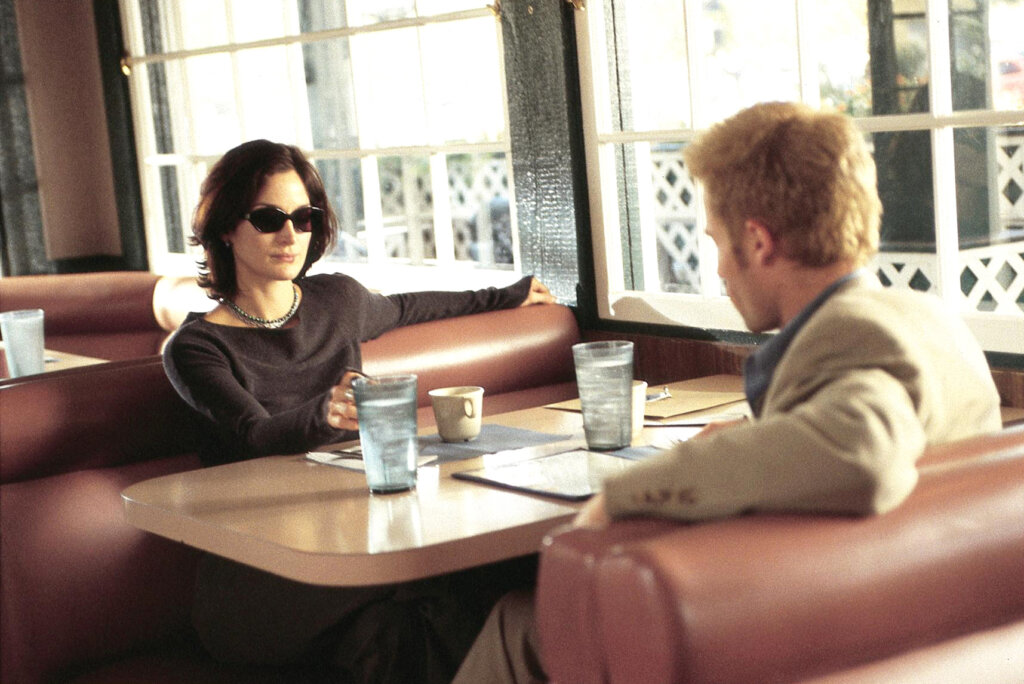
Nolan described this strategy as an attempt to draw viewers into Leonard’s point of view while preserving cinema’s deceptive appearance of objectivity. The camera seems to show events from outside Leonard, even as the narration and structure restrict what can be known to what he knows (Myers, 2014). The film not only tells us that Leonard is confused, but makes confusion the organizing principle of the viewing experience.
There is still an important difference between Leonard and the audience. We eventually see the missing scene. Leonard does not. When one sequence ends, the next reveals what happened immediately before it, allowing us to reconstruct a continuous story. Leonard repeatedly loses that continuity. His life consists of short islands of experience connected by messages from a person he assumes he can trust: himself.
This reliance on external records recalls Andy Clark and David Chalmers’ theory of the extended mind. Clark and Chalmers (1998) argue that cognition does not always stop at the boundaries of the brain. When an external object is consistently available, automatically trusted, and used in the same way as biological memory, it can become part of a person’s cognitive system. Their central example involves Otto, a man with Alzheimer’s disease who depends on a notebook to store information he can no longer reliably retrieve internally.
Leonard’s Polaroids and tattoos serve a similar function. They remind him of what he knows, but they also contain the beliefs that guide his behavior. When he reads “Don’t believe his lies” beneath Teddy’s photograph, he does not treat the statement as testimony that requires investigation. He accepts it as something he already knows.
That automatic acceptance makes his system useful, but it also makes it dangerous. A biological memory can be distorted, but so can a photograph, caption, or tattoo. External evidence does not interpret itself. Someone must decide which moment needs to be photographed, which sentence should be written beneath it, and which apparent fact is important enough to be permanently inscribed on the body.
Leonard insists that he uses facts rather than memories, yet his system contains both observation and judgment. A license plate number may be verifiable. “She has also lost someone” is an interpretation. “Don’t trust her” is a command. His notes collapse the difference between what he saw, what he inferred, and what he wanted to believe.
The scene in which Natalie exploits his condition makes this vulnerability brutally clear. After Leonard strikes her, Natalie hides every available pen and tells him exactly how she intends to manipulate him. She insults his dead wife, describes the pleasure she takes in using him, and then leaves the room. Leonard desperately searches for something with which to record what happened. Before he can find it, his memory resets. Natalie returns, performs distress, thereby supplying him with a new explanation.

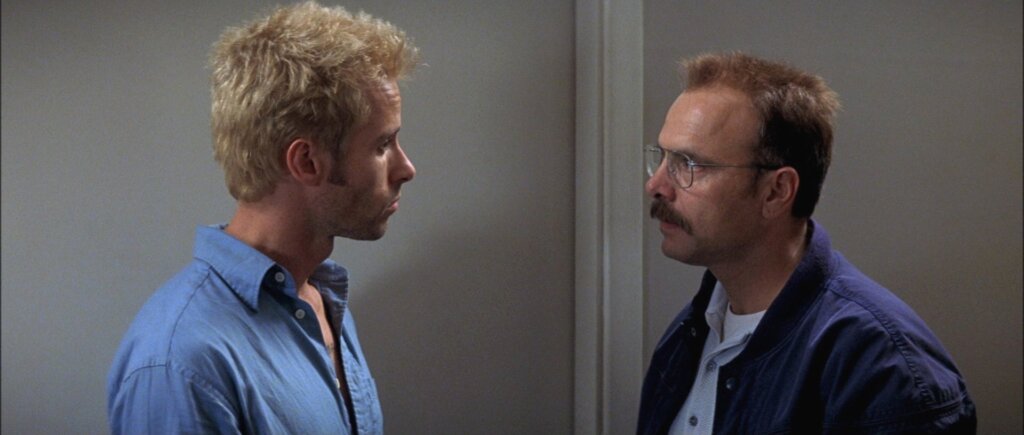
Natalie’s cruelty is disturbing, but her manipulation is not fundamentally different from Leonard’s own method. She waits for one version of him to vanish and then supplies the next version with a more useful story. Leonard eventually does the same thing to himself.
The philosophical importance of memory extends beyond the ability to recall information. Memory helps establish continuity between a person’s past, present, and anticipated future. Questions of personal identity often concern what allows someone to remain the same person across time, even as the body, personality, and circumstances change. Psychological-continuity theories give memory, intention, and other mental connections an especially important role in explaining that persistence (Olson, 2024).
Leonard has lost much of this psychological continuity, but he has not become a completely new person every few minutes. He retains language, professional habits, learned skills, and memories formed before the attack. He knows how to drive, fight, investigate, and manipulate a conversation. His procedural abilities survive even when he cannot remember using them.
More importantly, his values and emotional attachments also persist. He continues to love his wife, resent his condition, and desire revenge. His identity is damaged, but it is not empty. There is enough continuity for each temporary Leonard to inherit the goals established by the others.
What he cannot maintain is an evolving life story. McAdams and McLean (2013) define narrative identity as an internalized account that integrates a reconstructed past with an imagined future, giving life a degree of unity and purpose. Leonard cannot continually revise such a narrative in response to new experiences. Instead, he reduces his identity to a fixed origin and a single objective: his wife was murdered, he was injured, and he must find John G. That story gives his life meaning, but it also prevents his life from changing.
A revenge narrative normally moves toward resolution. The protagonist discovers the guilty person, acts, and must then confront whatever remains. Leonard cannot tolerate that final stage because completion would remove the purpose around which he has organized his existence. He claims that his wife deserves vengeance whether he remembers achieving it or not, but his behavior suggests something else. Revenge matters to him precisely because it provides a future he can continue pursuing.
Teddy claims that Leonard already found and killed the actual attacker more than a year earlier. According to Teddy, Leonard was briefly happy, pointed toward the empty space on his chest where he expected to record his success, and then forgot. Teddy says he began supplying Leonard with additional “John Gs,” using Leonard’s condition to direct him toward criminals Teddy wanted dead.

Teddy also claims that Leonard has transferred his own guilt into the story of Sammy Jankis. Leonard remembers Sammy as a former insurance claimant with a similar condition. In Leonard’s account, Sammy’s wife tested his memory by repeatedly asking him to administer her insulin. Sammy complied each time because he could not remember the previous injection, eventually killing her.
Teddy offers a more disturbing version. Sammy was unmarried, Leonard’s wife survived the assault, and it was Leonard who administered the fatal injections. Brief images complicate Leonard’s account, including a moment in which Leonard appears in Sammy’s place at the institution. The film also shows Leonard imagining a version of domestic peace that includes a tattoo he could not have possessed while his wife was alive.
None of this proves that Teddy tells the complete truth. Teddy lies and has an obvious interest in controlling the explanation. The ending of Memento is not a simple revelation that Teddy has been honest all along. Instead, it establishes that Leonard has no neutral account against which Teddy’s claims can be checked. Every available source has been contaminated by someone’s interests, including Leonard’s.
The Sammy Jankis story nevertheless performs a recognizable psychological function. It relocates guilt. Leonard can describe an amnesiac man killing his diabetic wife without recognizing himself as the subject of the story. Sammy becomes a container for whatever Leonard cannot incorporate into his preferred identity.
Self-deception has traditionally presented philosophers with a paradox. How can someone intentionally make himself believe something he knows is false? A successful deceiver must understand the deception, while a successfully deceived person must remain unaware of it. Philosophers have attempted to resolve the contradiction by dividing the self psychologically or temporally, allowing the deceiving and deceived positions to stay separated (Deweese-Boyd, 2023).
Leonard’s condition makes that temporal division literal. At the moment he writes down Teddy’s license plate number, he does not believe Teddy is his wife’s killer. He knows he is manufacturing a trail. He burns the photograph that could document an earlier revenge killing and chooses not to preserve Teddy’s explanation. Then, he labels Teddy a liar and converts the license plate into one of his supposedly objective facts.
The deception succeeds because the Leonard who knows it is a lie will soon disappear. A later Leonard will inherit the evidence without access to the intention that produced it.


This is what the opening murder means once the ending has been explained. Leonard does not kill Teddy because an investigation independently identifies him as John G. He kills Teddy because an earlier version of himself selected Teddy as a future target and corrupted the evidence. The film’s reverse chronology first presents Leonard as the instrument of the murder and only later reveals him as its author.
His condition does not absolve him of responsibility. The Leonard who pulls the trigger may sincerely believe he is avenging his wife, but the larger person has arranged that belief in advance. His plan depends upon his future ignorance. He uses his disability in the same way another murderer might use an unwitting accomplice, except the accomplice is his own future self.
Teddy’s guilt does not resolve the moral problem. Teddy has exploited Leonard, directed him toward Jimmy, and perhaps helped sustain a cycle of violence. Leonard may reasonably believe Teddy deserves punishment. What he cannot honestly claim is that Teddy has been identified as the man who attacked his wife. Leonard transforms a judgment that Teddy is dangerous into a false statement about Teddy’s identity because the false statement will motivate a form of violence the truth may not.
The tattoos across Leonard’s body give this deception an almost religious permanence. They seem to turn the body into an archive that cannot be lost or discarded. Yet even the most permanent inscription is dependent on the fallible decision that produced it. The permanence of a belief says nothing about its truth.
The title Memento evokes an object preserved as a reminder, while also recalling the tradition of memento mori: the reminder that death is inevitable. Leonard’s entire body has become such a reminder, but not one that teaches him to live under the awareness of mortality. His inscriptions keep a dead relationship from entering the past. They transform grief into a task that can never be completed.
His tragedy is therefore not simply that he forgets. Forgetting might have allowed pain to recede, even if only briefly. Leonard instead builds a system that returns him to the same wound. Every reset makes his wife’s death immediate again. He cannot remember yesterday, but he ensures that the worst event of his life will always feel like the present.
The structure implicates the audience in this desire for coherence. We instinctively arrange scenes into a causal order, identify heroes and villains, and search for the revelation that will make everything stable. We want Teddy to be either truthful or deceitful, while we want Leonard to be either an innocent victim or a calculating killer. The film refuses these clean categories because each character operates through a mixture of truth, exploitation, and need.

Our first impression of Teddy is shaped by a note Leonard wrote. Our understanding of Natalie changes when the chronology reveals why she helps him and how she uses him. Even Leonard’s wife exists primarily through fragments chosen by Leonard: her smile, her belongings, the empty side of a bed, and the violent event that gives his life its purpose. We never encounter her independently of the story he needs her to support.
In this respect, Memento is not only about a man with an unusual neurological condition. Leonard’s predicament intensifies an ordinary feature of human identity. People do not remember their lives as complete, neutral records. They select episodes, assign causes, suppress contradictions, and arrange experience into stories that explain who they are. Memory is reconstructive, while narrative identity joins a reconstructed past to an imagined future (Michaelian, Sutton, & Sant’Anna, 2026; McAdams & McLean, 2013).
Most people remain at least partially open to correction. New evidence can force an old memory to be reconsidered. Another person can challenge a flattering account. A contradiction can become too large to ignore. Leonard builds his identity to prevent that process. He treats the products of his own interpretation as unquestionable facts while destroying evidence that might revise them.
That is why the film’s deepest concern is not the unreliability of memory. Perfect records would not save Leonard because he does not want an archive capable of contradicting him. He wants one that will preserve his motive.
At the chronological turning point, Leonard asks himself whether he lies in order to be happy and decides that, in Teddy’s case, he will. Happiness may be the wrong word. The lie does not make him happy. It keeps him purposeful. It allows him to remain the grieving husband and righteous avenger rather than becoming a man who has already obtained revenge and must decide how to live afterward.
The final scene is therefore both an origin and an ending. It ends our attempt to understand Leonard as someone passively trapped inside a broken memory. It begins the chain of false evidence that will lead him to murder Teddy. Most importantly, it reveals that Leonard’s identity has not survived despite his lies. It survives through them.
Memento asks whether memory makes us who we are, but its answer is more unsettling than a simple equation between recollection and identity. Leonard remains recognizably himself without the ability to form new long-term memories. What defines him is the story he repeatedly chooses to inherit. His moral failure lies not in forgetting the truth, but in ensuring that the truth cannot interfere with the person he has decided to become.
References
Clark, A., & Chalmers, D. J. (1998). The extended mind. Analysis, 58(1), 7–19.
Deweese-Boyd, I. (2023). Self-deception. The Stanford Encyclopedia of Philosophy.
McAdams, D. P., & McLean, K. C. (2013). Narrative identity. Current Directions in Psychological Science, 22(3), 233–238.
Michaelian, K., Sutton, J., & Sant’Anna, A. (2026). Memory. The Stanford Encyclopedia of Philosophy.
Myers, S. (2014). Christopher Nolan remembers “Memento”. Go Into the Story.
Nolan, C. (Director). (2000). Memento [Film]. Summit Entertainment.
Olson, E. T. (2024). Personal identity. The Stanford Encyclopedia of Philosophy.