


This essay contains major spoilers for Shutter Island (2010).
I remember the first time I saw Shutter Island vividly. My father and I were watching it together, and you could have heard a pin drop the entire time. The final line of dialogue is delivered, and the credits begin to roll. Suddenly, my father jumps forward in his chair and shouts, “Oh, come on!” He had been so enthralled by the film, and he simply couldn’t believe that there wasn’t a concrete explanation or payoff. The ending left him baffled and frustrated, a sentiment that millions of viewers have shared over the years. I will now attempt, to the best of my abilities, to explain the ending of Shutter Island, with the hope that future audiences can find more resolution in the film than my father ever did.
The ending of Shutter Island is most convincing when Andrew Laeddis is understood to be sane enough to know what he is doing. He has not simply relapsed when he once again calls Dr. Sheehan “Chuck.” He is performing Teddy Daniels for the final time. His question—“Which would be worse: to live as a monster, or to die as a good man?”—reveals that he remembers the truth and has decided that he cannot continue living with it. The lobotomy will not literally make him a good man, but it will destroy the consciousness that knows why he considers himself a monster.
That interpretation changes the ending from one last plot twist into an ethical problem. Andrew has spent the film fleeing from reality, but the treatment devised by Dr. Cawley finally succeeds. He recognizes his identity, remembers what happened to his family, and understands the delusion he created. Recovery gives him the truth without giving him a way to endure it. He then uses his restored awareness to arrange its own destruction.
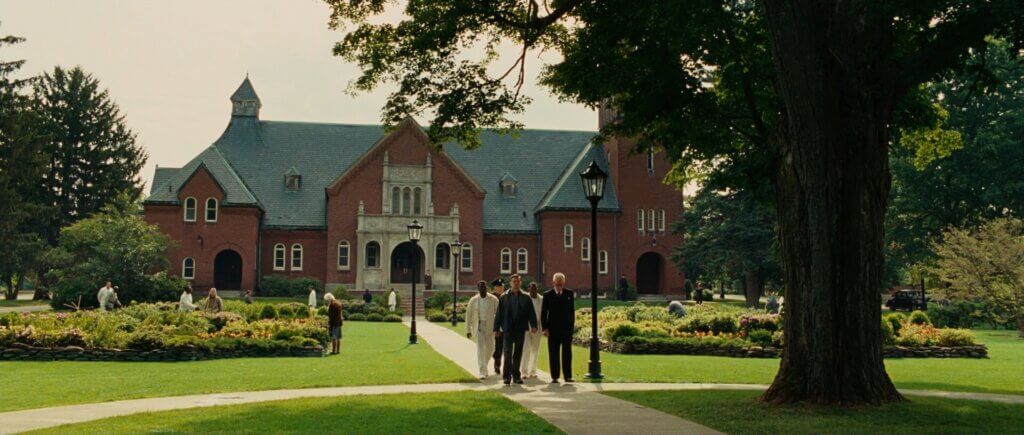
Martin Scorsese initially presents Andrew as Edward “Teddy” Daniels, a U.S. marshal sent to Ashecliffe Hospital with his new partner, Chuck Aule. A patient named Rachel Solando has apparently disappeared from a locked room. Teddy suspects that the hospital is conducting experiments, hiding prisoners, and preparing to prevent him from leaving the island. He also claims to be searching for Andrew Laeddis, the arsonist responsible for the fire that killed his wife, Dolores.
The investigation gradually collapses. Teddy is Andrew Laeddis, not a visiting marshal. Chuck is Dr. Lester Sheehan, his psychiatrist. The hospital staff have constructed an elaborate role-play in the hope that Andrew can follow his own fantasy to its breaking point. Rachel Solando does not exist as Teddy imagines her. Her name is an anagram of Dolores Chanal, just as Edward Daniels is an anagram of Andrew Laeddis. Even the mystery’s language has been assembled from material Andrew is trying not to recognize.


The reality is worse than the story he invented. Dolores did not die in a fire. After her mental health deteriorated, she drowned their three children in the lake behind the family home. Andrew found them, removed their bodies from the water, and then shot Dolores. He did not murder his children, but he believes that his failures made their deaths possible. He had ignored the severity of his wife’s condition, dismissed warnings, and moved the family to the lake house after she set fire to their apartment. The Teddy Daniels identity turns this guilt into a mystery with an external villain. Andrew Laeddis becomes an arsonist Teddy can hunt rather than a name he must inhabit.
This is why the delusion is more than convenient amnesia. Andrew does not merely forget an intolerable event. He rearranges it into a moral structure that allows him to remain innocent. Dolores becomes the murdered wife rather than the woman he killed. Andrew becomes the criminal who destroyed Teddy’s family rather than the grieving husband himself. The asylum becomes a corrupt institution conspiring against a righteous investigator. Every part of the fantasy moves responsibility away from Andrew while preserving his image of himself as a protector.
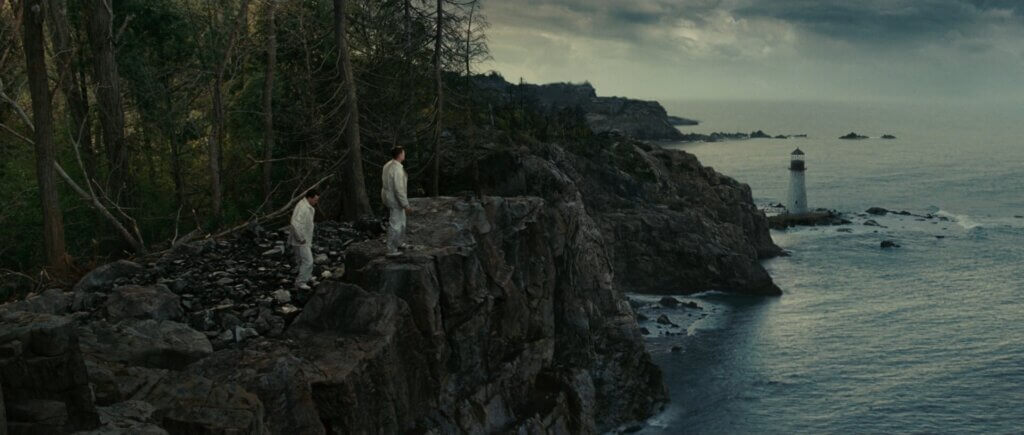
The film’s recurring opposition between fire and water reinforces that division. Fire belongs to the story Teddy prefers. Dolores was supposedly killed in a fire, Laeddis is supposedly an arsonist, and Teddy repeatedly produces matches as he moves through the darker spaces of Ashecliffe. Water carries the memories he cannot control. He becomes sick on the ferry, is trapped by a violent storm, and repeatedly sees his drowned daughter before he can admit who she is. The lake, not the burning apartment, contains the history his mind has buried. Fire gives him a villain. Water returns his children.
These images also explain why the conspiracy story remains persuasive after its factual basis weakens. It is emotionally coherent. Teddy’s suspicion gives form to Andrew’s knowledge that something terrible has been concealed. His fear of experimentation reflects the real threat of lobotomy. His distrust of the doctors allows him to experience treatment as persecution. The delusion is false, but it is not meaningless. It translates guilt into a world he can survive.
Philosophical accounts of self-deception help clarify what is happening without requiring Andrew to knowingly tell himself a lie. Self-deception is difficult to define because it appears to demand that a person believe and disbelieve the same claim. More recent accounts often describe it as motivated belief: fear, desire, or some other emotion distorts how a person interprets evidence, even when the false belief is not consciously selected (Deweese-Boyd, 2023). Andrew’s fantasy follows this pattern. Its details protect him from an unbearable conclusion, but this does not mean that he designed the entire delusion while lucid.
Psychosis should not be treated as a simple failure of honesty. Andrew’s condition limits his relationship to evidence and interrupts his awareness of his actions. Philosophers commonly distinguish between having caused harm and possessing the control and knowledge necessary for full moral responsibility (Rudy-Hiller, 2022). The film does not provide enough clinical clarity to distribute blame with confidence, and its portrayal of delusional disorder is shaped by the demands of a Gothic thriller rather than the standards of psychiatric diagnosis (Clyman, 2010). Andrew feels entirely responsible for what happened, but the intensity of that feeling does not prove that his judgment is fair.
His guilt is broader than the act for which he was committed. He killed Dolores, yet he also condemns himself for failing to prevent everything that came before it. The distinction between action, negligence, and helplessness disappears. In his own moral accounting, he is responsible for noticing too little, acting too late, and surviving when his children did not. The word “monster” compresses this complicated history into a permanent identity.
Andrew’s memories of Dachau deepen that self-condemnation. As an American soldier, he witnessed the bodies of concentration camp victims and participated in the execution of surrendering German guards. Teddy remembers these scenes as evidence that he has confronted evil. Andrew may remember them as evidence that the boundary separating good men from monstrous acts was never as stable as he wanted it to be. The marshal persona allows him to stand on the side of justice. His history keeps showing him that violence has already compromised that position.
Jean-Paul Sartre’s account of bad faith offers a useful parallel, though it should not be mistaken for a diagnosis. Sartre describes bad faith as a refusal to hold together two aspects of human existence: the facts of what has already happened and the freedom through which a person remains responsible for what comes next. One form of bad faith denies the past in favor of unrestricted possibility. Another treats the past as a fixed essence from which no future action can escape (Aho, 2023).
Andrew moves between both forms. As Teddy, he denies his history and imagines himself free to expose the island’s conspiracy. Once he accepts the truth, he moves to the opposite extreme. His guilt becomes his entire identity. He no longer sees Andrew Laeddis as a person who committed terrible acts, failed people he loved, and might still have some capacity for responsibility. He sees a monster. If the earlier delusion erases the past, the final judgment erases the future.
This tension also places Shutter Island among existential films concerned with identity, authenticity, and self-deception. Andrew cannot accept that he is both constrained by what he has done and still present as the person who must respond to it. Teddy offers innocence without responsibility. The monster offers responsibility without the possibility of change. Neither identity allows him to live as a morally complicated human being.
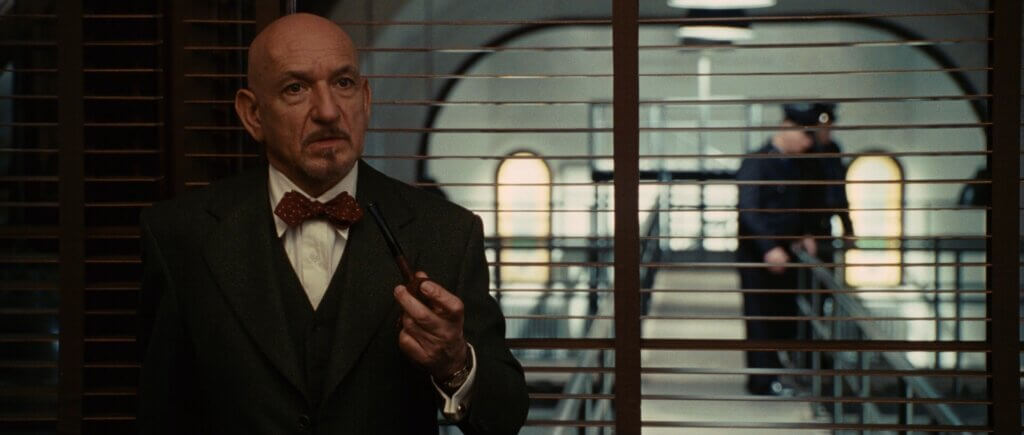
The doctors’ role-play is supposed to break this cycle by permitting Andrew to discover the truth rather than merely being told it. Dr. Cawley believes that force and punishment cannot return a person to reality. His experiment depends upon trust: the patient must eventually recognize that the people he perceives as enemies are trying to help him. Suzanne Cataldi Laba argues that Shutter Island makes this problem of trust central to both treatment and spectatorship. Viewers occupy Andrew’s perspective, share his suspicions, and must decide whether an institution with enormous power over him can nevertheless be telling the truth (Laba, 2019).
The hospital deserves some of that suspicion. Cawley may oppose lobotomy, but Andrew’s survival as a thinking person remains conditional. If he cannot demonstrate the correct relationship to reality, the institution will alter his brain irreversibly. The role-play is compassionate relative to the alternative, yet the alternative is always waiting behind it. Ashecliffe asks Andrew to trust people who possess the power to destroy the part of him capable of trust.
This does not make Teddy’s conspiracy true. The lighthouse contains no hidden laboratory of the kind he imagines, and the evidence strongly supports Cawley’s account of Andrew’s history. Still, learning the truth does not dissolve the imbalance of power. Andrew can accept the doctors’ explanation, but he cannot reject their authority over his body. His only apparent choices are to live under institutional control as Andrew or lose himself through surgery.
Scorsese’s ending departs from Dennis Lehane’s novel by adding the final exchange about living as a monster or dying as a good man. Lehane interpreted the line as a momentary flash of sanity during an otherwise genuine relapse. James Gilligan, the film’s psychiatric adviser, understood it differently. He argued that Andrew knowingly submits to lobotomy because returning awareness has made his guilt impossible to bear (Cox, 2010). The film cannot prevent either reading, but its performances and staging give greater weight to Gilligan’s interpretation.
Andrew does not merely call Sheehan “Chuck.” He follows the apparent relapse with a statement that distinguishes the man he is from the man he wants to be. A fully restored Teddy would have no reason to describe himself as a monster; within the fantasy, he is a grieving marshal fighting corrupt doctors. The final question only acquires its force if Andrew remembers both identities and understands what the waiting orderlies will do. Sheehan’s startled response—he calls after him as “Teddy”—suggests that he recognizes the message beneath the performance.
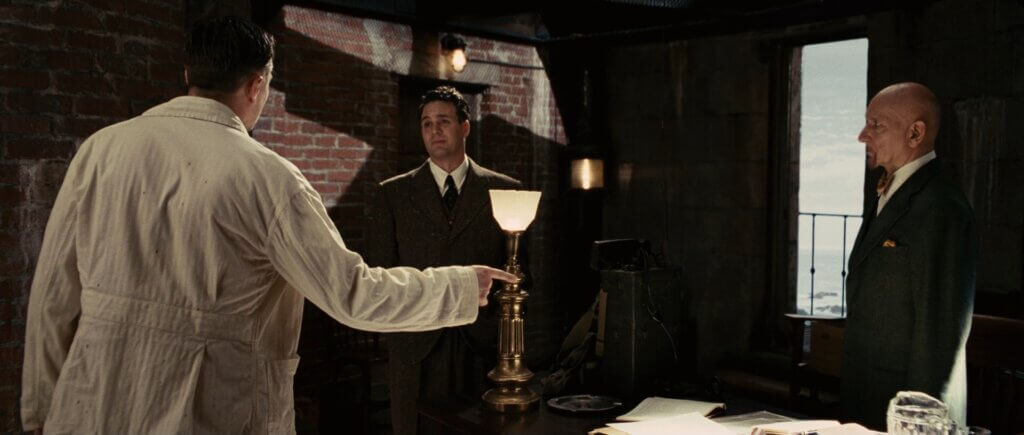
Andrew’s behavior changes as well. Earlier attempts to restrain or contradict him produced panic and violence. At the end, he rises calmly and walks toward the men who will take him away. He does not need to be subdued. The doctors believe the role-play has failed because he has resumed its language, but Andrew uses that language to control the final consequence. His last performance of madness is the most deliberate action he takes in the film.
The meaning of the final line therefore depends upon the identities attached to its two choices. To “live as a monster” is to remain Andrew Laeddis: the man who ignored Dolores’ deterioration, arrived too late to save his children, and killed his wife. To “die as a good man” is to preserve Teddy Daniels as the final story Andrew tells about himself. Teddy is a marshal, a veteran, a bereaved husband, and an enemy of institutional cruelty. He possesses all the virtues Andrew believes he has forfeited.
The death in question is not an execution. Andrew will remain biologically alive after the lobotomy, but the procedure threatens memory, personality, judgment, and agency. In the sense that matters to him, the person who knows the truth will be gone. The operation offers him a form of suicide that does not require him to kill his body. He consents to the destruction of the self that can remember.
It is tempting to treat this decision as redemption. Andrew faces the truth and accepts punishment. His final line is lucid, restrained, and morally serious. It may even sound heroic. Yet self-destruction does nothing for the people he lost, and it prevents the difficult work of living responsibly after wrongdoing. Punishment can satisfy a desire for suffering without producing accountability.
The distinction becomes clearer beside the question of agency and sacrifice in the ending of Donnie Darko. Donnie’s death may preserve other lives, even if the degree of freedom involved remains uncertain. Andrew’s submission does not rescue his children or restore Dolores. It primarily ends his own contact with guilt. Calling that sacrifice risks turning escape into a moral achievement.
What Andrew owes the dead cannot be paid through pain alone. Nothing can undo their deaths, but continued awareness would at least preserve the truth about them. It would require him to remember Dolores as more than either an innocent victim or a monster, to distinguish what he did from what he failed to prevent, and to abandon the heroic identity that has protected him. That life would not be pleasant. It might, however, be the only remaining form of responsibility available to him.
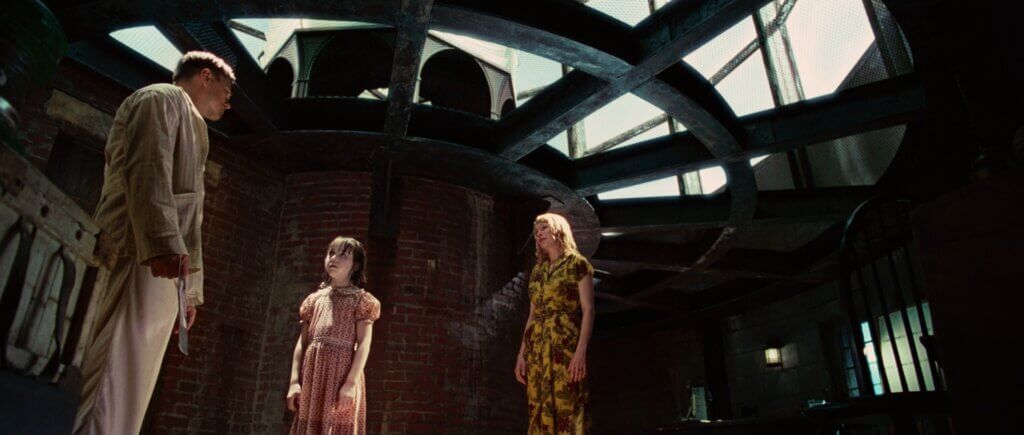
His decision resembles the self-protective uncertainty at the center of The Headless Woman, though the two films move in different directions. Lucrecia Martel’s protagonist depends upon her social world to absorb evidence and soften the possibility of guilt. Andrew constructs an entire investigative world to accomplish something similar. When that construction fails, he does not revise his identity. He chooses to eliminate the mind that would have to revise it.
The ending is tragic precisely because Cawley’s treatment works. If Andrew had simply relapsed, the doctors would lose him to his illness. If he remains lucid, they lose him after briefly returning him to himself. Their success produces the awareness that motivates his final refusal. Therapy defeats the delusion but cannot persuade Andrew that a truthful life is still worth living.
The final question is also a last attempt to control the narrative. Andrew cannot change what happened at the lake, but he can decide which character appears to walk toward death. The institution will see a patient whose treatment failed. Sheehan sees enough to suspect otherwise. Andrew sees Teddy Daniels, the good man he invented, taking responsibility for a monster’s fate.
That story offers dignity at the moment of surrender. It is also the film’s final act of self-deception. Andrew does not literally become Teddy by choosing lobotomy, nor does the destruction of his memory alter the moral past. He chooses the appearance of a good death over the reality of a compromised life.
For this reason, the ending of Shutter Island is not asking whether Andrew is secretly innocent or whether the doctors fabricated everything. It asks whether truth remains valuable when a person believes it can offer nothing except guilt. Andrew answers no. He would rather disappear inside the role of a good man than continue as someone who must remember his failures.
The more difficult answer is the one he rejects. Living with guilt would not prove that he is a monster. It would keep open the distinction between a person and the worst things attached to that person’s history. Andrew’s final choice closes that distinction forever. He uses his last moment of freedom to destroy the possibility of any future freedom.
Sources
- Aho, K. (2023). “Existentialism.” Stanford Encyclopedia of Philosophy.
- Clyman, J. (2010, February 23). “Shutter Island: Separating Fact From Fiction.” Psychology Today.
- Cox, D. (2010, July 29). “Shutter Island’s Ending Explained.” The Guardian.
- Deweese-Boyd, I. (2023). “Self-Deception.” Stanford Encyclopedia of Philosophy.
- Laba, S. C. (2019). “Trust and Truth in Shutter Island.” Film-Philosophy, 23(3), 351–371.
- Rudy-Hiller, F. (2022). “The Epistemic Condition for Moral Responsibility.” Stanford Encyclopedia of Philosophy.
- Scorsese, M. (Director). (2010). Shutter Island [Film]. Paramount Pictures.