


This essay contains major spoilers.
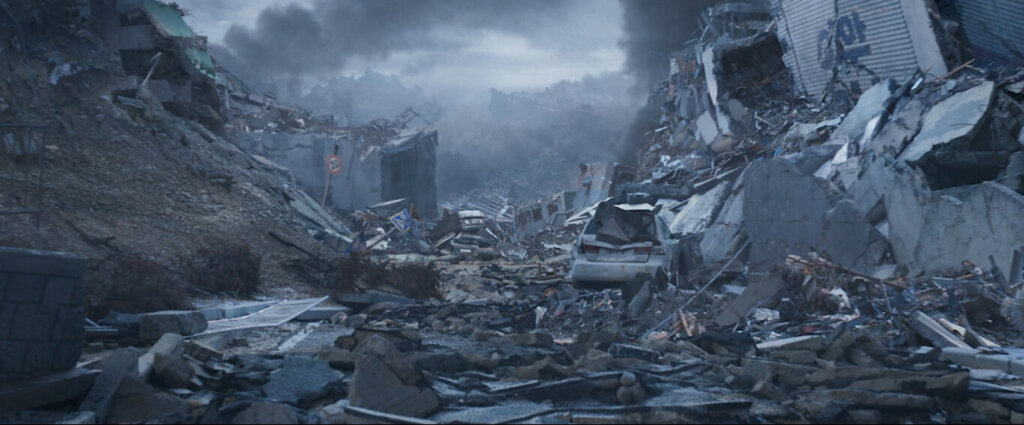
In Concrete Utopia, an earthquake destroys Seoul but leaves one piece of the old world remarkably intact: a property boundary.
The residents of Hwang Gung Apartments have no electricity, running water, reliable communication, or functioning government. Nevertheless, everyone still understands the difference between a resident and an outsider. That distinction becomes the foundation of the new society built inside the only apartment building left standing.
At first, creating a delineation between resident and outsider seems practical. Hwang Gung contains limited food, medicine, and space. Allowing every survivor into the building might endanger the people already living there. But Um Tae-hwa’s film gradually reveals what’s underneath that tribalistic inclination. The residents do not just ration scarce resources. They convert ownership into citizenship and citizenship into a judgment about whose life deserves protection.
The film begins with a brief history of apartment construction in South Korea. Buildings rise, units become desirable, and prices climb. The montage establishes the apartment as more than a home. It is an investment, a source of status, and visible proof that its owner has secured a place within the modern city.
Within this context, Hwang Gung does not become socially valuable only after the earthquake. The disaster magnifies a hierarchy that already existed. According to South Korea’s Data and Statistics Research Institute, the country’s owner-occupied housing rate fell to 57.3 percent in 2021, while 88.3 percent of people under 30 owned no home. Apartments remain objects of aspiration even as ownership has become increasingly difficult to attain.
Um has described South Korea’s relationship with apartments as one of both love and hate. In an interview with The Korea Herald, he connected the film’s setting with the social importance of apartment ownership and the hierarchies it produces. He also grew up aware of the fierce competition surrounding opportunities to purchase apartments.

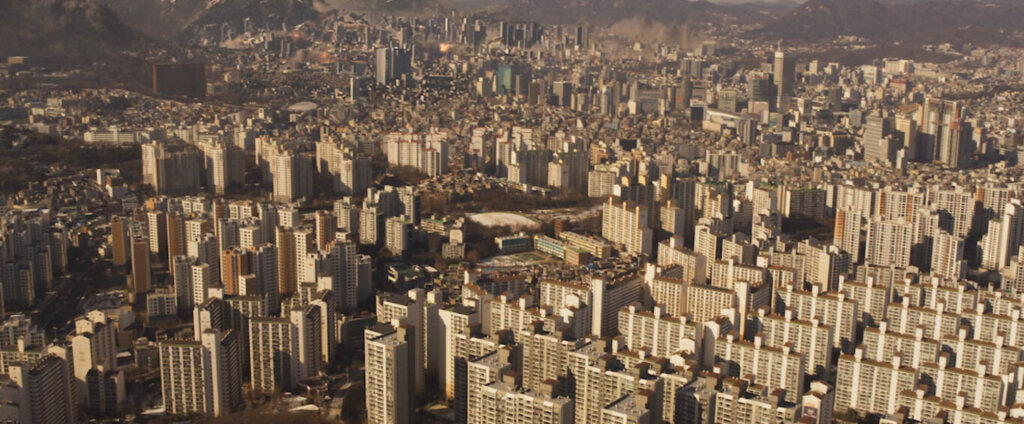
The earthquake temporarily resets this system. Money is useless. Government authority disappears. Prestigious buildings collapse alongside ordinary ones. Hwang Gung survives largely by chance. Its residents have not earned their safety through greater intelligence, morality, or preparedness. Yet they quickly reinterpret good fortune as entitlement.
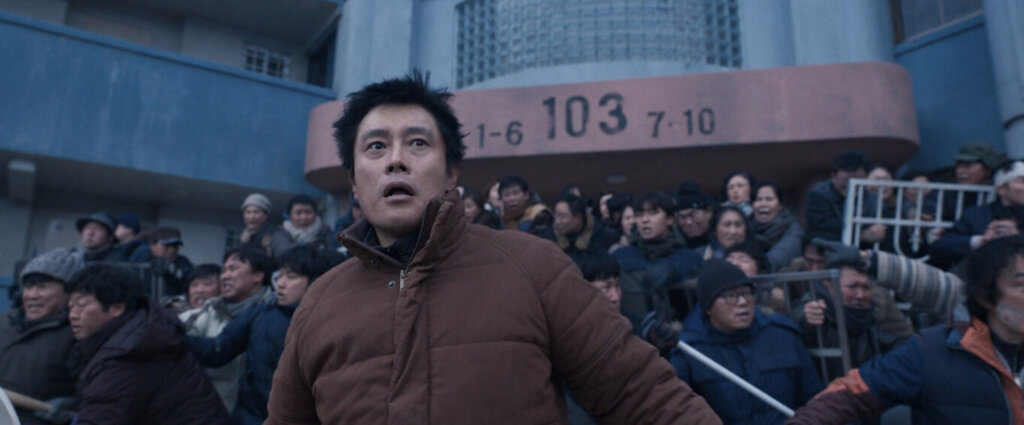
The film’s central political event is a vote. After conflicts develop between residents and displaced survivors, the apartment owners gather to decide who should be allowed to remain. The majority votes to expel everyone who did not live in Hwang Gung before the earthquake.
Because the decision is democratic, the residents can distribute responsibility among themselves. No dictator initially forces them to remove the outsiders. They discuss the problem, raise their hands, and accept the result. Violence becomes easier to justify because it has passed through a recognizable political procedure.
This resembles a primitive social contract. In its broadest form, social contract theory holds that political and moral obligations arise through an agreement among people forming a society. Hwang Gung’s residents establish rules, assign work, distribute food, punish theft, and elect Yeong-tak as their leader. Their organization provides security that isolated individuals could not create on their own.
But the contract has a serious limitation: only property owners and recognized residents are permitted to participate in it. The outsiders do not receive a vote on whether they may live. Hwang Gung creates equality among insiders by enforcing inequality against everyone else.
The residents chant that the apartments belong to them. Under ordinary conditions, this would be an unremarkable statement of property rights. After the earthquake, however, ownership carries a much greater power. To own an apartment is to possess food, warmth, protection, political representation, and membership in a community. A residential address has effectively become a passport.


This is where Concrete Utopia extends the class conflict found in many Marxist films. In Parasite, for example, architecture separates the wealthy from the poor through elevation, light, space, and privacy. In Concrete Utopia, the class boundary is even more explicit. The wall surrounding Hwang Gung separates those whose lives count from those who can be left to freeze.
The residents insist that exclusion is necessary for survival. The film does not dismiss that concern as entirely irrational. Resources really are limited, outsiders sometimes become violent, and generosity carries risks. An ethical decision would be easier if kindness guaranteed safety. Concrete Utopia is more difficult because it asks whether moral obligations survive when fulfilling them might reduce one’s own chance of living.
Myeong-hwa provides the clearest opposition to the residents’ logic. As a nurse, she continues treating injured people according to need rather than membership. Her moral world extends beyond the apartment gates. She does not deny the danger surrounding the community, but she refuses to accept that danger has eliminated every obligation to strangers.
Her position resembles an ethic of care more than an abstract political program. She responds to particular people who are hungry, wounded, or frightened. For the apartment leadership, these individual faces are inconvenient. Their system functions more efficiently when outsiders remain an anonymous mass.
The residents eventually begin calling outsiders “cockroaches.” The word reduces displaced people to contaminating creatures that enter homes, consume resources, and must be removed. The Stanford Encyclopedia of Philosophy notes that dehumanization can involve regarding people as less than human, treating them in ways that damage their humanity, or combining both processes.
The residents do not literally forget that outsiders are human. Their hatred depends upon recognizing that the people beyond the gates can organize, deceive, suffer, and retaliate. The language of infestation performs a different function. It places those people outside the moral category in which ordinary rules of compassion apply.
This process will be familiar to viewers of apocalyptic horror. As I discuss in my list of philosophical zombie films, stories about social collapse frequently revolve around the boundary between persons and nonpersons. Concrete Utopia does not need zombies. Its survivors create a disposable population through language alone.
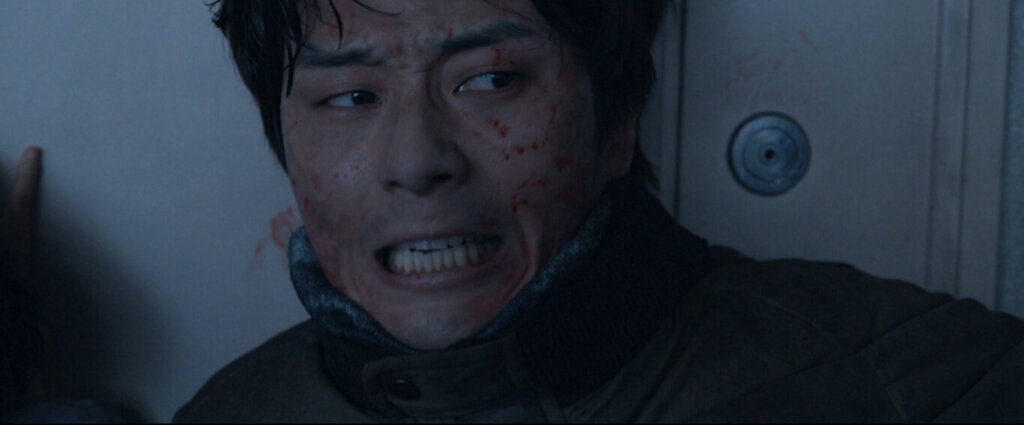
Min-sung becomes the film’s most important example of how an ordinary person adapts to this system. He does not begin as a fanatic. He loves Myeong-hwa and initially appears uncomfortable with the community’s violence. Once Yeong-tak places him on the security team, however, responsibility toward his wife becomes an excuse for harming other people.
Min-sung’s choices are understandable in isolation. He wants to protect his home, contribute to the group, and keep his wife alive. The cumulative result is participation in raids, theft, beatings, and collective punishment. He allows the role assigned to him by the community to narrow his moral attention.
The film therefore avoids the reassuring claim that cruelty belongs to a separate class of evil people. Actor Lee Byung-hun described the characters as ordinary people containing both good and evil. The disaster does not reveal one permanent human nature. It creates institutions that reward some impulses and punish others.
Yeong-tak is the most revealing product of those institutions. His authority initially rests on action rather than status. He extinguishes a fire and appears willing to protect the building. The residents elect him because they need someone who can turn fear into order.
Lee plays this transformation with remarkable control. Yeong-tak’s early awkwardness never entirely disappears beneath his authority. His desire to lead is inseparable from his need to be recognized. Each public victory allows him to inhabit the person he believes he should have been.
The communal performance of Yoon Soo-il’s “Apartment” captures this transformation particularly well. The residents sing, drink, and celebrate their apparent success while Yeong-tak presides over them. Um momentarily turns authoritarian solidarity into a musical spectacle. The gathering feels joyful because exclusion has given the residents a shared identity.
This identity depends upon a lie. Yeong-tak is not the owner of the apartment in which he lives. Before the disaster, he had tried desperately to purchase a unit but was defrauded. He confronted the apartment’s real owner, killed him during their struggle, and assumed his identity after the earthquake. Therefore, the man most committed to removing outsiders is an outsider himself.
This revelation does more than expose Yeong-tak as a hypocrite. It reveals the absurdity of the entire political order. Nothing about his courage, labor, intelligence, or capacity for leadership changes when the residents learn the truth. Only his relationship to a property record has changed. The community that celebrated him moments earlier suddenly regards him as illegitimate based on the very rhetoric that he espoused.
Yeong-tak could have responded to his exclusion by rejecting the hierarchy that injured him. Instead, he becomes its most violent defender. He does not want to abolish the distinction between owners and outsiders. He wants to occupy its protected side.
His behavior reflects one of the most durable features of class hierarchy. People denied status do not always oppose the system distributing it. Sometimes they become more invested in the system because recognition appears to be the only way to repair their humiliation. Yeong-tak’s authority provides the belonging that property ownership had denied him.
This also complicates a purely economic interpretation of the film. Hwang Gung does not survive only through the possession of material resources. It survives by producing stories about itself. The residents imagine their community as disciplined, self-sufficient, and morally superior to the disorder outside. Yeong-tak is the hero who embodies that story.
The film’s large group scenes show how quickly this mythology develops. Individual anxieties disappear into chants, songs, uniforms, and assigned social roles. The apartment functions as a state in miniature, complete with borders, labor requirements, armed patrols, political ceremonies, and an enemy population.
Yet Concrete Utopia never suggests that collective organization is inherently oppressive. Without cooperation, the residents would probably die. Their mistake is not creating a community, but defining community through exclusion and allowing responsibility toward insiders to erase responsibility toward everyone else.

The collapse of Hwang Gung follows from that decision. Its residents raid other survivors rather than forming alliances with them. Every successful act of violence creates more enemies. The security promised by exclusion proves temporary because the outside world does not passively accept the enforced moral hierarchy.
The building eventually becomes what the residents feared the outsiders would make it: chaotic, violent, and uninhabitable. Its destruction is not simply punishment for individual cruelty. It is the consequence of constructing a society that can survive only while everyone outside its walls remains powerless.
Myeong-hwa encounters a different community near the end of the film. These survivors live inside an apartment building that has fallen onto its side. The camera slowly rotates, forcing the viewer to reconsider which surfaces count as walls and which count as floors. A structure designed for one form of life has been adapted to another.
When Myeong-hwa asks whether she may stay, the survivors appear confused by the question. Their response is essentially that living is sufficient reason to live among them. Unlike Hwang Gung, this community does not demand proof of prior ownership before recognizing her right to exist.
The contrast risks appearing overly neat. The film gives us little time to understand how this second group distributes scarce resources or handles conflict. We cannot know whether its openness will survive prolonged hunger and fear. It should not be treated as a fully realized utopia.
Its importance lies in demonstrating that Hwang Gung was not inevitable. The earthquake created extreme conditions, but it did not dictate one political response. People still decided whether property, need, force, or shared humanity would determine membership.
The final camera movement gives that alternative a visual form. Hwang Gung remained upright while its moral world became distorted. The second apartment lies sideways, yet its inhabitants have developed a more humane way of living. The built environment has lost its intended orientation, allowing the social relationships inside it to be reorganized as well.
This does not mean that Concrete Utopia rejects homes or material possessions. Shelter remains essential, and the desire to protect one’s family is not treated as shameful. As in my comparison of Nebraska and Happy People: A Year in the Taiga, material objects can provide dignity, security, and practical freedom. The danger begins when possession is the primary measure of human worth.
The earthquake destroys Seoul’s buildings in minutes. The hierarchy represented by those buildings proves much harder to destroy. It survives in language, memory, aspiration, and the residents’ belief that ownership entitles them to more than shelter.
Concrete Utopia ultimately asks whether a society can protect its members without withdrawing moral recognition from everyone else. Hwang Gung answers by turning property into citizenship and outsiders into pests. Its residents create order, but the order contains the cause of its own destruction.
The alternative offered at the end is fragile and incomplete. It begins with a much simpler principle: a person does not earn the right to live by possessing the correct address. Being alive is enough.
Sources
- “Concrete Utopia.” Korean Film Council.
- “Director Um Tae-hwa Explores Koreans’ ‘Love and Hate’ of Apartments in Concrete Utopia.” The Korea Herald, August 9, 2023.
- Saito, Stephen. “Um Tae Hwa on Building Around Human Nature in Concrete Utopia.” The Moveable Fest, November 28, 2023.
- “Actor Lee Byung-hun Captivated by Morally Complex Characters in Concrete Utopia.” The Korea Times, August 1, 2023.
- “Key Trends in Housing.” Data and Statistics Research Institute, South Korea.
- “Social Contract Theory.” Internet Encyclopedia of Philosophy.
- “Dehumanization.” Stanford Encyclopedia of Philosophy.