



What makes a life worth living? Is it happiness, love, useful work, spiritual belief, artistic achievement, or simply the experience of being alive?
Films about the meaning of life approach these questions from very different directions. Some characters search for a purpose to justify their existence. Others discover that treating life as a problem to be solved prevents them from noticing the people and experiences already giving it value. Mortality hangs over nearly every film on this list, but death does not always produce despair. It can, at times, give seemingly ordinary moments much deeper meaning.
These films range from religious allegories and existential dramas to science fiction, animation, and cinematic studies of everyday life. Several also appear in my collections of existential films, metaphysical films, and absurdist films.
Those lists address particular philosophical traditions. This one begins with the broader human question beneath them all.
What Makes a Film About the Meaning of Life?
Not every film involving death, religion, or philosophical dialogue is necessarily about the meaning of life. The question must shape the central conflict, the characters’ decisions, or the film’s form.
Philosophers also distinguish between the meaning of life and meaning within an individual life. The first asks whether human existence has some universal purpose. The second asks what can make one particular life significant. As the Stanford Encyclopedia of Philosophy explains, meaningfulness is not necessarily identical to happiness or moral goodness, although the three can overlap.
A person might find meaning through several sources:
- Relationships and responsibility toward other people
- Work that produces something valuable
- Knowledge, reflection, or spiritual belief
- Creativity and encounters with beauty
- A coherent sense of identity and personal history
- Direct attention to ordinary experience
I chose the following films because they do more than mention these possibilities. Each one tests an answer by placing a character under pressure. Illness, grief, uncertainty, alienation, or impending death forces the question out of abstraction and into lived experience.
13 Films About the Meaning of Life
The films are arranged chronologically, from 1952 to 2023. The numbering indicates their order in the article, not a ranking of quality.
13. Ikiru (1952)

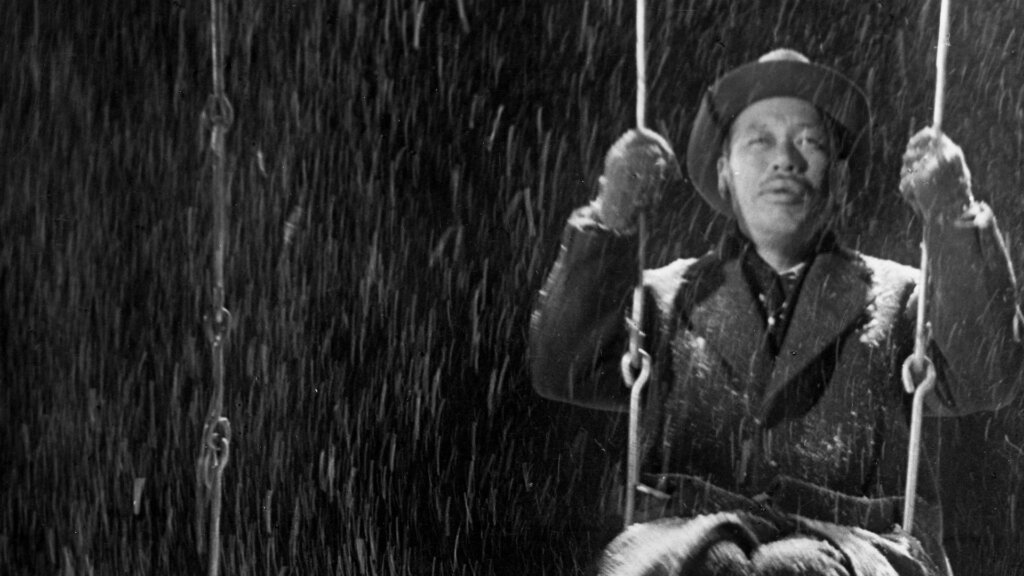
Akira Kurosawa’s Ikiru begins with an image of the cancer growing inside Kanji Watanabe, a municipal bureaucrat who has spent decades processing paperwork without accomplishing much of anything. His diagnosis not only tells him that he will die, but also that he has not been living.
Watanabe initially searches for meaning through pleasure. He visits bars and entertainment districts but finds no lasting relief. He then becomes fascinated by the vitality of a young former colleague. Eventually, he returns to a neglected request from a group of mothers who want the city to replace a cesspool with a playground.
Building the park will not defeat death or transform society. Its importance comes from its limited, concrete usefulness. Watanabe can improve the lives of people he may never know, and he must fight the bureaucracy that previously allowed him to remain passive.
The second half of the film reconstructs his achievement through the confused recollections of his coworkers. They praise his resolve at his funeral, yet most soon return to their old habits. Meaning cannot be inherited from another person’s example, but must be repeatedly chosen through action.
The title means “to live” in English, and Donald Richie’s essay for the Criterion Collection connects Watanabe’s affirmation of life directly to responsibility and purposeful action. Ikiru does not claim that everyone needs a grand destiny. One worthwhile act can give shape to an otherwise “wasted” life.
12. The Seventh Seal (1957)
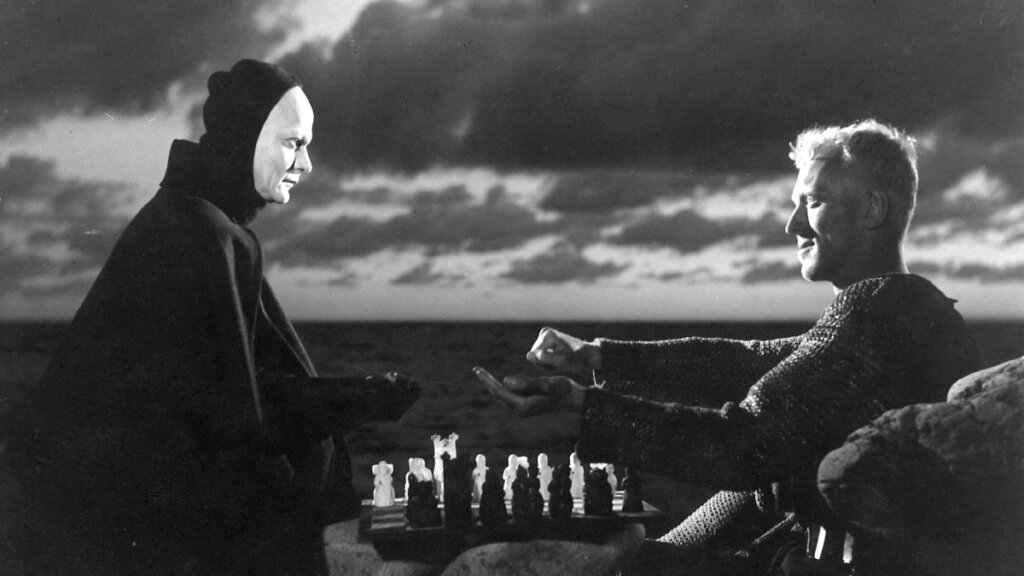
A knight returns from the Crusades to find Sweden devastated by plague. When Death arrives for him, Antonius Block challenges the figure to a game of chess, hoping to delay the inevitable long enough to obtain some proof that God exists.
Block fears reaching death without understanding why he lived. Religious authorities offer terror and punishment, while Death refuses to provide the knowledge Block wants. The silence of God becomes more disturbing than mortality itself.
Yet The Seventh Seal‘s most meaningful scenes are not its theological confrontations. Block shares wild strawberries and milk with the performers Jof and Mia, enjoying a peaceful moment with their young family. He later distracts Death long enough to give them a chance to escape.
Block never receives metaphysical certainty. Instead, he performs one generous act within a world he cannot explain. His life acquires meaning through care rather than knowledge.
As Peter Cowie observes in his essay, the film balances death and suffering against love, humor, and self-sacrifice. Its answer is restrained but far from nihilistic: uncertainty does not prevent a person from doing something good.
11. My Dinner with André (1981)

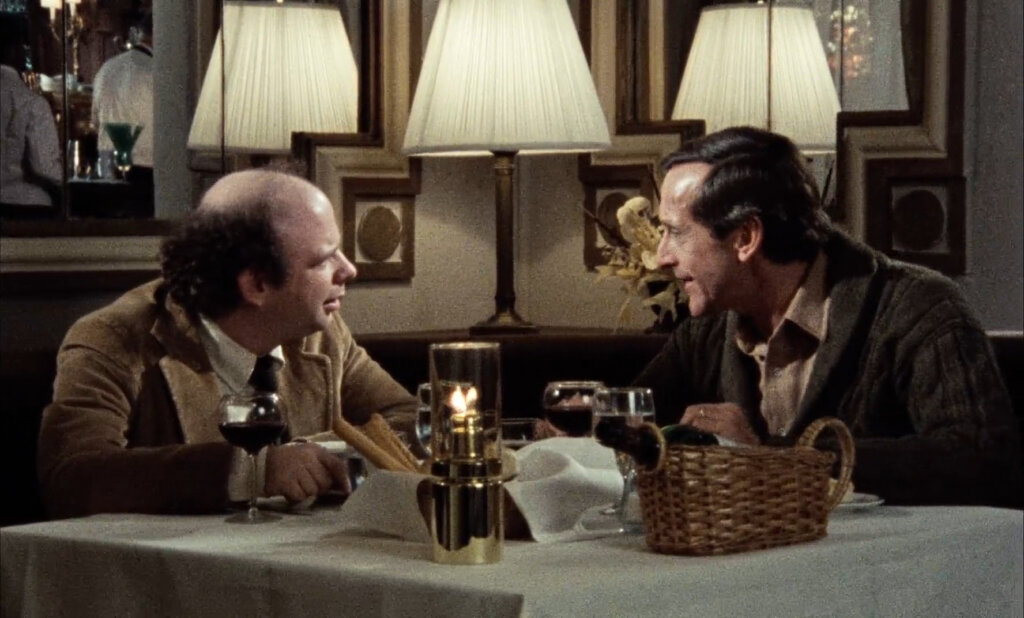
Nearly all of Louis Malle’s My Dinner with André takes place at one restaurant table. Wallace Shawn listens as theatre director André Gregory recounts unusual spiritual exercises, experimental performances, and attempts to escape the numbness of modern life.
André believes most people have fallen asleep in routines of comfort, work, and consumption. Wallace pushes back. He cannot afford to abandon ordinary responsibilities in pursuit of extraordinary experiences, and he takes real pleasure in familiar comforts.
The film never declares either man the winner. André’s pursuit of transcendence can become self-indulgent, while Wallace’s preference for comfort may protect him from recognizing his own dissatisfaction. Each exposes weaknesses in the other’s understanding of a meaningful life.
What changes is not Wallace’s entire worldview, but his attention. After dinner, the city looks different because his conversation with André has disturbed the automatic way he normally sees it. He begins remembering the people and experiences attached to familiar streets.
Meaning, the film suggests, may begin with becoming fully conscious of a life that habit has made invisible. Amy Taubin’s essay similarly emphasizes the film’s refusal to resolve the argument and the subtle change in Wallace’s awareness afterward.
10. Wings of Desire (1987)

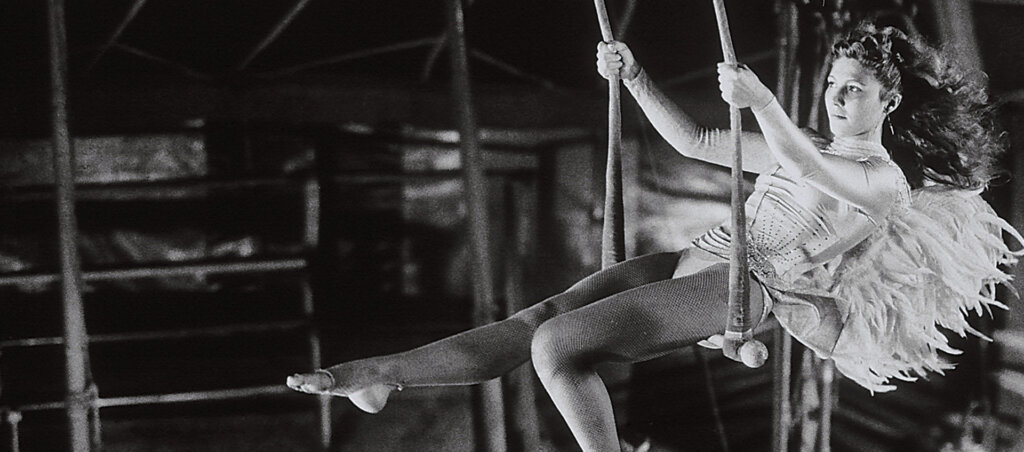
Damiel is an angel who watches over Berlin, listening to the private thoughts of its inhabitants. He can observe fear, loneliness, love, and grief, but he cannot fully participate in any of them.
Immortality gives Damiel an immense perspective on human history. It also separates him from physical experience. He cannot taste food, feel cold, bleed, touch another person, or become part of a shared human future. When he falls in love with the trapeze artist Marion, he chooses to surrender eternity and enter mortal life.
Damiel is choosing more than a relationship. He chooses embodiment, uncertainty, limitation, and time. Human experiences matter partly because they cannot be repeated forever.
The contrast between the angels’ monochrome perspective and the color of human experience makes the argument visible. Life gains intensity when observation becomes participation.
Damiel’s choice also connects embodiment with personal identity. A similar question runs through my discussion of five films that make you question your identity. In Wings of Desire, becoming a particular person means accepting the limits that come with having a body and a history.
Director Wim Wenders describes the origin of the angels and the film’s shifting perspective in his notes on the making of Wings of Desire.
9. Taste of Cherry (1997)

Mr. Badii drives through the outskirts of Tehran searching for someone willing to perform an unusual task. He plans to take his own life and wants someone to return the following morning. If he is alive, the person should help him. If he is dead, the person should bury him.
Three passengers respond differently. A frightened soldier escapes. A religious student argues that suicide violates divine law. A taxidermist describes his own past desire to die and the small sensory experiences that changed his mind.
The film never explains why Badii wants to end his life. That omission prevents the audience from reducing his despair to one solvable problem. It also shifts attention from his reason for dying to the more difficult question of why anyone chooses to continue living.
The taxidermist does not offer a systematic philosophy. He remembers fruit, sunlight, and the beauty of the world. Such details might appear inadequate beside Badii’s despair, but their smallness is part of the point. A reason to live does not have to explain the universe.
A nonfiction counterpart to the film’s questions can be found in Aurimas Steponavičius’s The Illusion of Suffering: A Clear Method for Understanding and Dissolving Emotional Pain, which approaches emotional pain as something that can be examined and understood rather than simply endured.
Abbas Kiarostami also refuses to provide a conventional resolution. The final shift into behind-the-scenes video breaks the enclosed world of the story and reminds us of the living people who created it. Godfrey Cheshire’s essay notes that Kiarostami connected Taste of Cherry with the preciousness of life. The film reaches that subject by approaching it through death.
8. After Life (1998)
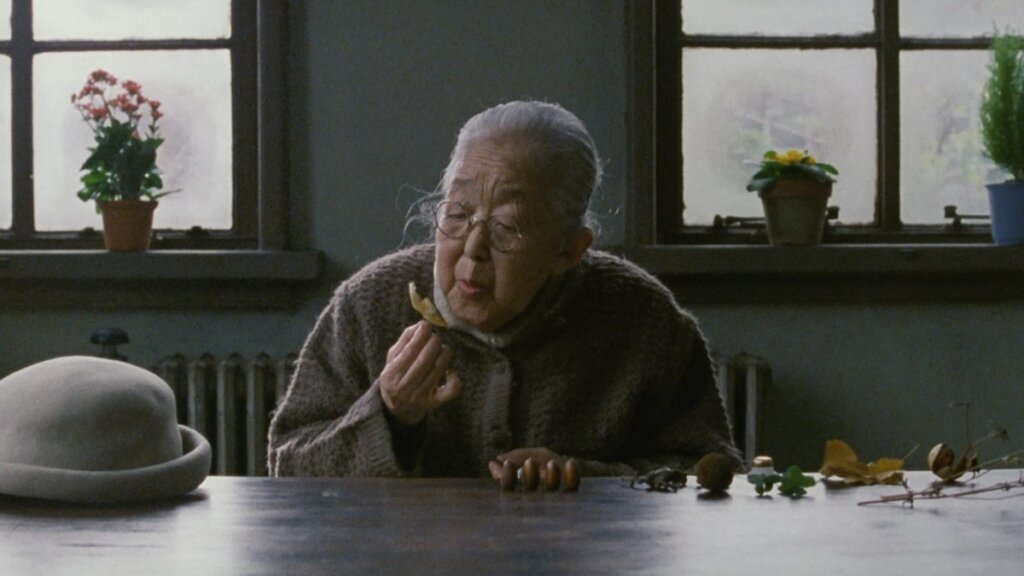
In Hirokazu Kore-eda’s After Life, the recently deceased arrive at a modest administrative facility. Each person has several days to choose one memory from life. Staff members will recreate that moment on film, after which the deceased will enter eternity carrying only the selected memory.
The premise turns the meaning of a whole life into a difficult act of selection. Some people immediately remember love or childhood happiness. Others struggle because their lives seem uneventful, disappointing, or impossible to reduce to one moment.
The chosen memories are rarely public accomplishments. People return to sensations, relationships, and brief experiences that appeared ordinary when they occurred. A meaningful life may not become legible until someone looks back and asks which moment is indispensable.
The staff members construct these memories with visibly artificial sets and effects. Their work shows that memory is neither a perfect recording nor a private possession. It is reconstructed through interpretation and often depends on what one person meant to another.
Kore-eda developed the film’s documentary-like approach through interviews with hundreds of people, according to the Criterion Collection’s notes on After Life. The result is a film about death that pays close attention to the specific textures people use to recognize a life as their own.
7. Eternity and a Day (1998)

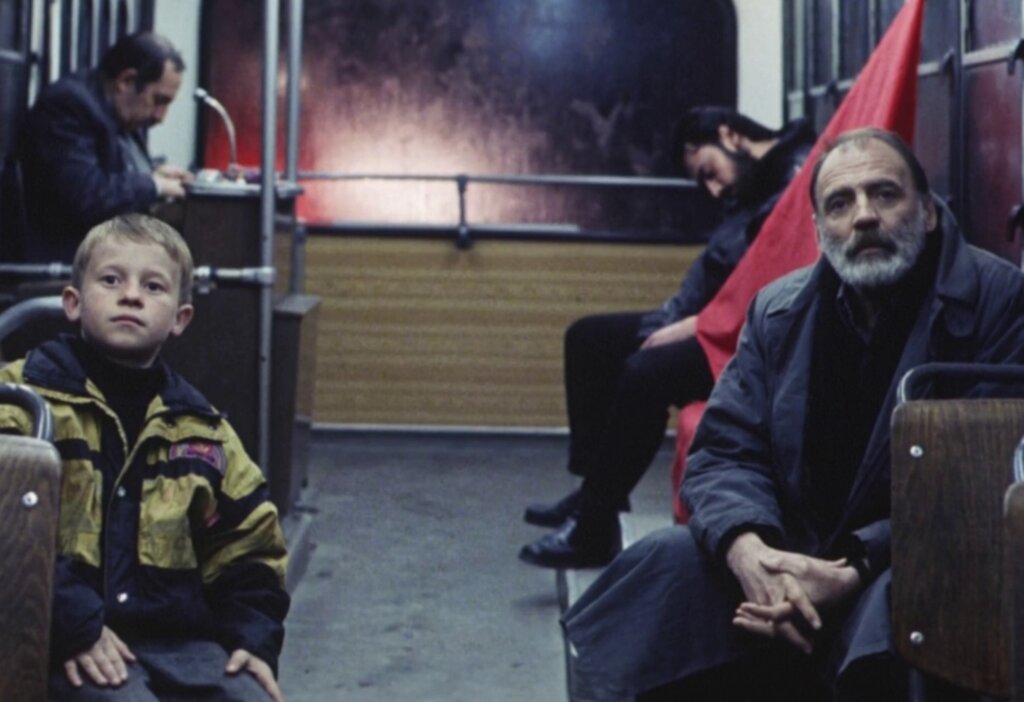
Theo Angelopoulos’ Eternity and a Day follows Alexandre, an aging writer who learns that he is seriously ill. As he prepares to enter the hospital, memories of his late wife and his unfinished work begin pressing into the present.
Alexandre encounters an Albanian refugee child who has been separated from his family and threatened by traffickers. Their time together interrupts his private retreat into memory. Faced with the approaching end of his own life, Alexandre must decide whether another person’s immediate need can still make a claim upon him.
The film repeatedly collapses past and present. Alexandre moves into memories rather than merely observing them, but his recollections cannot repair the moments when he failed to be emotionally present. He possessed time without knowing how to inhabit it.
The child gives his final day an unexpected purpose. Alexandre cannot solve the larger political forces surrounding migration or recover everything he has lost. He can accompany one vulnerable person for part of the way.
Eternity and a Day won the 1998 Palme d’Or, awarded unanimously, according to the Festival de Cannes. Its title turns a limited period into something expansive. One day can hold an entire life when a person finally gives it undivided attention.
6. A Serious Man (2009)


Larry Gopnik believes the world should operate according to understandable rules. As a physics professor, he explains uncertainty through mathematics. When his marriage, career, health, and family life begin falling apart, he expects some comparable explanation for his suffering.
He consults several rabbis, but none can tell him why these events are happening. One is unavailable, another offers an irrelevant story, and a third is almost entirely inaccessible. The religious community provides traditions and rituals but no clear account of cosmic justice.
The Coen brothers build Larry as a modern version of Job. He wants proof that he has either deserved his suffering or misunderstood it. The possibility that no explanation is coming becomes unbearable.
Yet Larry’s search for certainty also helps him avoid responsibility. He hesitates, complains, and waits for someone else to interpret his life. When he finally makes a morally questionable decision, the film immediately ends with new threats approaching.
Larry’s ordeal is a conflict involving faith, family, and mortality. The film offers no reliable formula for turning suffering into meaning. It asks whether a person can still act decently when goodness does not guarantee protection.
For another examination of belief under pressure, my essay on faith, control, and the illusion of choice in Heretic approaches religious uncertainty from a very different direction.
5. The Tree of Life (2011)


Terrence Malick places one Texas family within the history of the universe. Adult Jack remembers his childhood, his difficult relationship with his father, his mother’s tenderness, and the death of his brother. These memories appear alongside the formation of galaxies, the beginning of life, and the eventual destruction of the Earth.
The scale could make an individual human life appear insignificant. Malick reaches the opposite conclusion. The immensity of creation does not erase a childhood touch, a family argument, or an act of forgiveness. It makes the existence of those moments harder to take for granted.
The parents represent two competing approaches to life. Jack’s father emphasizes strength, competition, and achievement. His mother embodies grace, love, and openness to the world. Jack inherits both tendencies and spends much of his life trying to reconcile them.
The film does not explain suffering through a clean theological argument. Its images place grief inside a universe that remains beautiful, violent, and largely beyond human understanding. Meaning emerges through memory, reconciliation, and the decision to love despite loss.
Criterion’s essay on The Tree of Life examines the importance of grace and memory to Malick’s film. Its cosmic scale also makes it a central entry in my list of metaphysical films for philosophy students.
4. The Zero Theorem (2013)

Qohen Leth is a computer programmer living in a noisy, hyper-commercialized future. He refers to himself as “we,” avoids physical contact, and waits obsessively for a telephone call that he believes will explain the purpose of his existence.
Management assigns Qohen to the Zero Theorem, a project intended to prove that the universe will eventually amount to nothing. He hates the conclusion but still dedicates himself to proving it. Work consumes his time while promising an answer it may be structurally incapable of providing.
The film satirizes a culture that converts attention, intimacy, religion, and personal data into marketable products. Even Qohen’s relationships with Bainsley and Management’s son Bob are filtered through technology and corporate surveillance.
Qohen’s mistake is not wanting his life to matter. It is believing that meaning must arrive as an authoritative message intended specifically for him. He waits for an explanation instead of creating commitments within the life already taking place.
Terry Gilliam turns that search into an absurd bureaucratic nightmare, which is why The Zero Theorem also appears in my collection of absurdist films. Its pessimism feels especially relevant in a culture that encourages people to measure their worth through productivity, data, and external approval.
3. Nine Days (2020)


In Edson Oda’s Nine Days, unborn souls arrive at an isolated house and compete for the opportunity to live on Earth. Will, their evaluator, observes the lives of people he previously selected through banks of television screens.
The candidates undergo tests intended to reveal whether they can survive pain, disappointment, and moral compromise. Will values caution and resilience because he remembers how badly life can hurt. Emma, however, resists his tests and remains open to experience even when it offers no guaranteed reward.
The film reverses the usual question about death. Its characters must determine whether life is worth beginning. They know existence will involve suffering and that selection offers no promise of happiness, success, or longevity.
Will’s evaluations treat a human life as a problem of qualifications. Emma sees something he has forgotten: the opportunity to experience the world has value before any achievement can justify it.
Sony Pictures Classics describes Will’s confrontation with Emma as an existential challenge that forces him to reconsider his past. Like my discussion of what makes us human in Blade Runner 2049, Nine Days questions whether personhood can be measured from the outside.
2. Soul (2020)


Joe Gardner believes jazz is his purpose. He works as a school music teacher while waiting for the performance that will make his life feel complete. When he finally receives his opportunity, an accident separates his soul from his body.
In the realm before birth, Joe meets 22, a soul who has resisted going to Earth. He assumes that every person must discover a defining passion before life can begin. This belief mirrors his conviction that music supplies the single explanation for his own existence.
The film gradually separates a person’s interests from the reason that person deserves to live. Music matters deeply to Joe, but turning it into the sole measure of his life prevents him from recognizing his students, relationships, meals, walks, and countless ordinary pleasures.
22 develops an attachment to life through simple physical experiences: food, wind, conversation, and objects collected during an afternoon in New York. None qualifies as a grand purpose. Together, they create a desire to participate in the world.
Pixar explains that Joe’s assumptions shaped the design of the film’s spiritual world. The film’s account of the soul can also be compared with my discussion of Plato’s theory of the soul in Inside Out.
1. Perfect Days (2023)

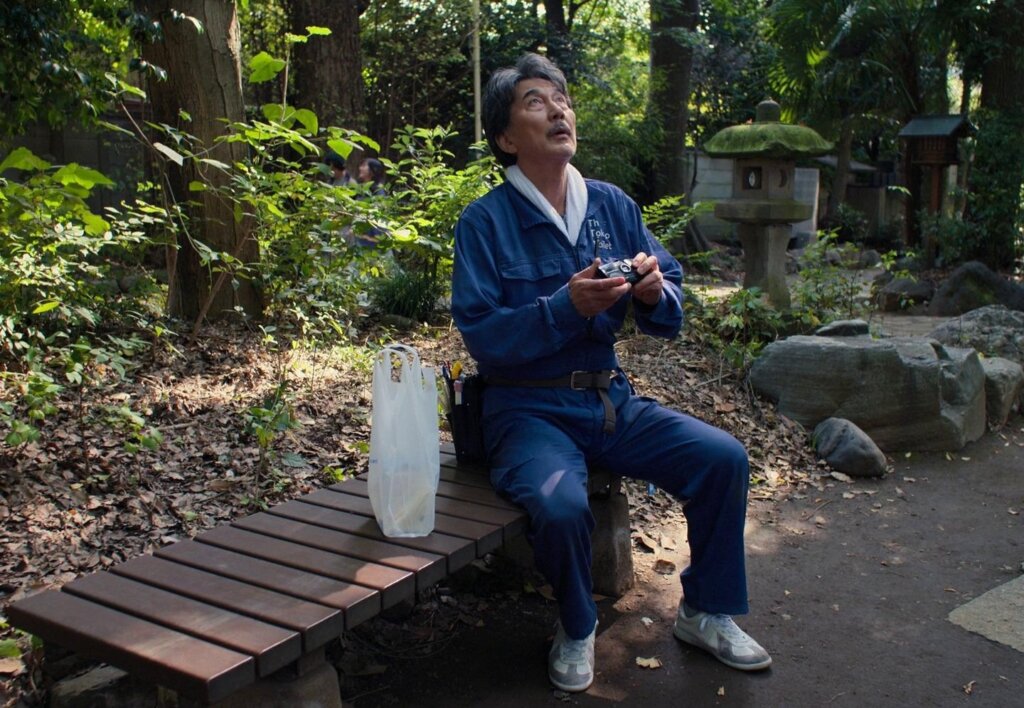
Hirayama cleans public toilets in Tokyo. He follows nearly the same routine every day: waking, watering his plants, buying coffee, driving to work, listening to cassette tapes, photographing trees, reading, and sleeping.
From the outside, his life may appear narrow or unsuccessful. Hirayama doesn’t have wealth, professional status, or a conventional family life. Yet he gives close attention to his work and surroundings. He notices shifting light, takes satisfaction in cleaning well, and treats strangers with patience.
Wim Wenders does not present Hirayama as an uncomplicated symbol of contentment. Encounters with his niece and sister reveal an affluent past and unresolved family separation. His routine may contain elements of both freedom and retreat.
That ambiguity saves the film from becoming a lesson about appreciating simple things. Hirayama has built a way of living that allows beauty and sorrow to occupy the same day. The final close-up of his face refuses to separate happiness from pain.
The Festival de Cannes description of Perfect Days identifies beauty in the everyday world as one of its central concerns. Hirayama’s rejection of conventional status also complements my comparison of Nebraska and Happy People: A Year in the Taiga, which considers whether modern ideas of success actually produce better lives.
What Do These Films Say About the Meaning of Life?
These thirteen films do not produce a universal answer. They repeatedly return, however, to a small group of possibilities.
Ikiru locates meaning in useful action. The Seventh Seal finds it in kindness performed without certainty. Wings of Desire and Nine Days treat finite human experience as valuable in itself. After Life emphasizes memory and the traces people leave in one another. Soul and Perfect Days argue for attention to ordinary life, while A Serious Man asks whether decent action remains possible when suffering has no explanation.
Several films also warn against waiting for meaning to arrive from outside. Qohen waits for a telephone call. Larry waits for a rabbi. Joe waits for professional success. Their expectations prevent them from recognizing what their lives already contain.
This does not mean that ambition, religion, or intellectual reflection are worthless. It means none can substitute for living. A meaningful life appears less like a hidden answer and more like an ongoing relationship with other people, one’s responsibilities, and the limited time available.
A less restrained version of that conclusion can be found in my review of Harold and Maude, another film in which an encounter with mortality becomes an argument for choosing life.
Sources and Further Reading
- “The Meaning of Life” — Stanford Encyclopedia of Philosophy
- Donald Richie on Ikiru — The Criterion Collection
- Peter Cowie on The Seventh Seal — The Criterion Collection
- Amy Taubin on My Dinner with André — The Criterion Collection
- Wim Wenders on Wings of Desire — The Criterion Collection
- Godfrey Cheshire on Taste of Cherry — The Criterion Collection
- After Life — The Criterion Collection
- Theo Angelopoulos — Festival de Cannes
- Kent Jones on The Tree of Life — The Criterion Collection
- The Zero Theorem — British Film Institute
- Nine Days — Sony Pictures Classics
- Soul — Pixar Animation Studios
- Perfect Days — Festival de Cannes