


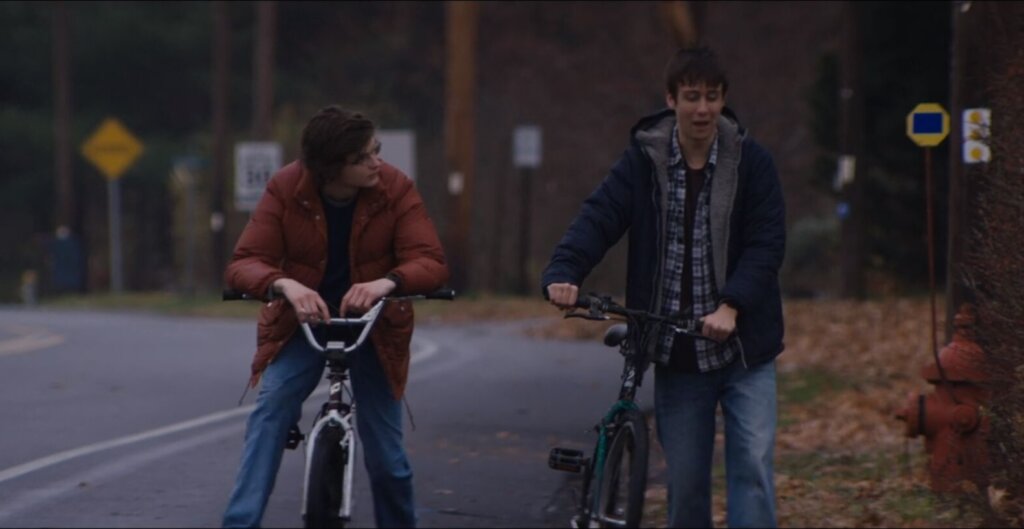
Near the end of Super Dark Times (2017), Zach tries to stop Josh with the one kind of speech the boys have spent the entire film avoiding. “We’re friends. Remember?” he says. Then, more urgently: “You’re my best friend. I love you.” It is a sincere declaration, but it comes in the middle of an act of violence, when sincerity has almost lost its power. Josh is no longer simply the friend Zach remembers, and Zach can no longer pretend that their shared secret is the same thing as intimacy. The moment is devastating because it states what the film has been showing all along: these boys love each other, need each other, and have no usable language to communicate either fact.
That failure of expression is the real subject of Super Dark Times. Critics often describe the film as a story about adolescent guilt, or even more simply as the origins of a teenage killer. Both descriptions are accurate, but incomplete. Its violence does not intrude upon an otherwise healthy male friendship from somewhere outside. It develops within the friendship, out of feelings Zach and Josh can experience but cannot admit directly: dependency, jealousy, fear, grief, and even love. Allison becomes the person through whom those feelings are displaced. She is at once a genuine object of affection, a measure of masculine status, and an intermediary through whom the boys communicate with one another. The film’s tragedy is therefore not that male intimacy was absent, but that the intimacy was present in a form its participants had been taught to distrust.
I became acquainted with the film because my brother knew the screenwriters, Ben Collins and Luke Piotrowski, who grew up in Athens, Georgia (Wheeler 2017). The film is not set in Georgia, and that connection never gave me access to any privileged information concerning the film’s “true” meaning. It did, however, make the boys harder for me to dismiss as distant monsters. Director Kevin Phillips has called the film primarily a tragedy rather than a work of nostalgia, despite its mid-1990s setting. He has also said that the filmmakers wanted to examine American suburbia before Columbine and before the internet made white male alienation a familiar public spectacle. What interested them, he explains, was the enduring fragility of masculinity and how easily it can be distorted (Gingold 2017). Thus, Super Dark Times is not an origin story for a uniquely modern pathology, but an account of the emotional conditions from which later forms of masculine grievance could grow.

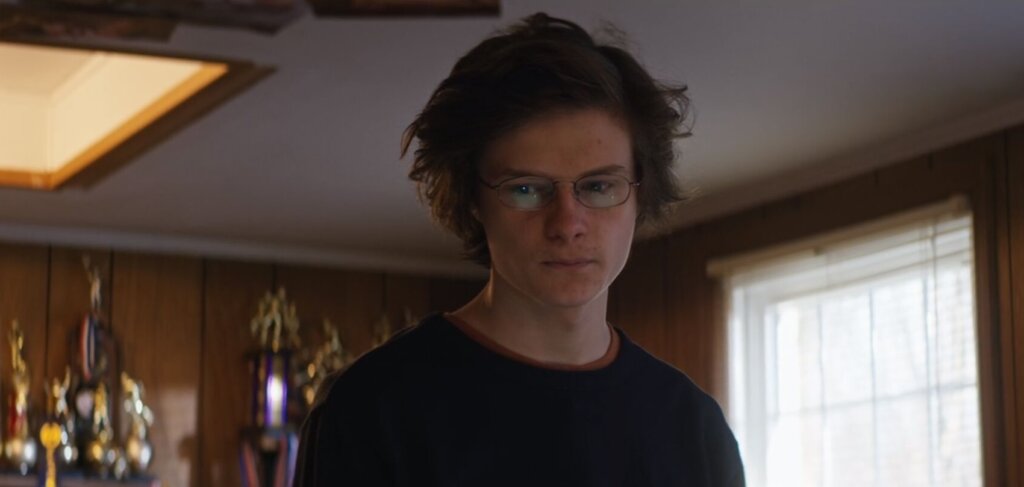
Eve Kosofsky Sedgwick’s theory of male homosocial desire provides a useful way to understand those conditions. In Between Men, Sedgwick studies social bonds between men, especially the recurring erotic triangle in which two men appear to compete for a woman while their relationship with each other remains structurally central. “Desire” in this context should not be reduced to a claim that the men are secretly gay. It includes attachment, rivalry, identification, dependence, and the need for recognition. Under patriarchal and homophobic conditions, men are encouraged to seek one another’s approval while denying the emotional intensity of that need. A woman can then function as the socially acceptable route along which feeling passes between them (Sedgwick 1985).
The opening scenes of Super Dark Times establish this triangle before anything overtly horrific occurs. Zach and Josh look through a school yearbook, evaluating girls with the casually objectifying confidence expected of adolescent boys. Allison is different because she belongs to their shared world. Zach likes her, but Josh quickly announces that he likes her too. The exchange is less a revelation of two independent romantic interests than the creation of a relational problem. Each boy’s desire becomes legible through the other’s. Allison will matter partly because the friend values her, and winning her attention will mean something because the friend is watching.
Outside Allison’s house, the boys convert their anxiety into performance. They are more comfortable shouting about a penis as a joke than speaking honestly about attraction. The vulgarity is not evidence that they feel no intimacy; it is one of the forms intimacy is allowed to take. They can share embarrassment if they disguise it as humor. They can look at girls together, trade insults, ride bicycles, discuss comics, and dare one another. What they cannot do is say that the friendship itself matters to them, because doing so would expose a dependency at odds with the independence masculinity demands.
Niobe Way describes a similar process in Deep Secrets, her study of boys’ friendships. Boys often speak with striking emotional intensity about close male friends, yet many lose those relationships as they move through adolescence. Way calls this a “crisis of connection”: the need for intimacy persists while cultural pressure teaches boys to treat vulnerability as feminine, childish, or suspect (Way 2011). Zach and Josh have not lost the capacity for closeness. Their early scenes are full of its evidence. They have instead inherited a narrow vocabulary for maintaining it. The film does not present emotional repression as an empty space. It shows how jokes, rituals, competition, and shared risk rush in to occupy that space.


The sword intensifies those dynamics. It belongs to Josh’s older brother, who is away in the military, and his absence gives the object an additional masculine authority. At first, the katana is contraband to display and handle, much like the stolen marijuana. The boys gather around it, testing bravado in front of one another. Daryl’s death is accidental, but the situation that produces it is not socially neutral. Humiliation, status, and group performance have already made retreat difficult. When the play turns into a fight, the weapon changes from a symbol of borrowed adulthood into an actual instrument of death.
The accident could have forced the boys into honest dependence. Instead, the concealment of Daryl’s body creates a counterfeit version of intimacy. Zach and Josh now possess a secret no one else can understand, but secrecy does not bring them closer. It makes each boy the living evidence of the other’s guilt. Their bond becomes surveillance. Every silence can be interpreted as accusation; every absence raises the possibility of betrayal. What they share is enormous, yet the magnitude of it leaves them with even fewer words.
Zach’s response is to move toward Allison while withholding the fact that would allow her to understand him. When she visits, he breaks down, and she comforts him. It is one of the film’s gentlest scenes, but also one of its most ethically complicated. Zach can cry in front of a girl in a way he cannot cry in front of Josh. Allison becomes a permitted recipient of vulnerability, but she is asked to care for pain whose cause is hidden from her. The scene makes clear that having feelings is not the same as communicating honestly, and that male repression often transfers its emotional labor to women.
The film’s most revealing image of the triangle comes in Zach’s nightmare. Sex with Allison takes place at the site where Daryl was buried, while Josh watches and the sword hangs over the scene. Zach cannot imagine desire apart from guilt, and he cannot imagine being with Allison apart from Josh’s gaze. The dream compresses the structure of Zach’s world: Allison as desired person, Josh as rival and witness, Daryl as the secret binding them, and the sword as the violence that now mediates every relation. Sedgwick’s triangle becomes almost literal. The apparent line between Zach and Allison is crossed by a second line running between Zach and Josh.


That same structure returns at Allison’s party. Josh arrives after distancing himself from Zach and brings his brother’s marijuana, immediately converting private loss into social value. His performance is directed toward Allison, but it is also a message to Zach. Josh can prove that he is interesting, daring, and desirable without asking his friend for anything. Rivalry offers both boys a masculine way to acknowledge their attachment while denying it. They compete because competition permits sustained attention to each other.
Allison, however, is more than the third point in a theoretical diagram. Reducing her to a conduit between boys would repeat the instrumentalization the film criticizes. She has her own loneliness, judgments, and desires. In fact, she understands the structure of the friendship more clearly than either boy. When Zach pulls away, she asks whether the problem between him and Josh is somehow her fault. She recognizes that Josh likes her, but she also tells Zach that she likes him. Her directness exposes the boys’ evasions. Allison can name desire without turning it into a contest; Zach and Josh cannot.
The difference between them also matters. An analysis of masculine social pressure should not flatten Zach and Josh into equivalent victims of the same system. Both participate in the concealment of Daryl’s death. Both objectify girls, withhold truth, and allow fear to govern their choices. Yet trauma does not mechanically produce the same response in each. Zach moves unevenly toward confession and responsibility. Josh converts shame into domination. His violence is not an unavoidable consequence of loneliness, nor is it excused by his inability to communicate. The film offers an explanation for the emotional logic of his actions without mistaking explanation for absolution.
This is why the climax is so painful. Zach’s “I love you” is the first fully direct statement of their bond, but it comes only after Josh has made violence into his clearest form of expression. The declaration cannot restore an earlier innocence, because that innocence was always compromised by the rules governing their friendship. They were allowed to need one another only indirectly. By the time Zach finally speaks without a joke, a dare, a girl, or a secret between them, Josh has made reciprocal recognition nearly impossible.

The film’s ending refuses to let the boys’ tragedy swallow Allison’s experience. She survives, visibly scarred, and the final classroom scene turns toward a question about women’s contribution to the Industrial Revolution. The detail can seem almost incidental. Allison has spent much of the film being watched, desired, competed over, and finally attacked within a crisis produced between boys. Now she is the one called upon to speak, in a scene concerned with who receives recognition in the telling of history. Her scars remain evidence that male conflict has material consequences for women, but her survival prevents her from being reduced to those consequences.
This is also where the film comes into limited contact with later incel culture. It would be imprecise to call Josh an incel. The story takes place before the contemporary online subculture developed its vocabulary, and romantic rejection alone does not explain his violence. Research on incels also cautions against treating loneliness as a direct route to violent behavior; most people who identify with the subculture do not commit violence, even though misogynistic and violent discourse circulates in many of its forums (Sparks, Zidenberg, and Olver 2022). What Super Dark Times anticipates is not a label but an emotional economy: isolation becomes grievance, desire becomes entitlement, and a girl is blamed for a rupture that originates in a boy’s relation to himself and to other boys.
One response to the film makes that displacement especially visible. In a later interview, screenwriters Ben Collins and Luke Piotrowski discussed an online theory claiming that Allison secretly committed the killings. Piotrowski rejected the reading as misogynistic, noting that nothing in the film establishes it as a hidden plot point (Tomczak and Nelson 2021). The theory is revealing even though it is unsupported. Faced with a story about male violence, some viewers reconstruct the woman as its concealed author. Allison becomes responsible not only for the boys’ rivalry but for the violence done around and to her. The interpretation repeats the very logic the film exposes.
What makes Super Dark Times philosophically unsettling is that it does not locate danger in a spectacularly alien kind of boy. Zach and Josh’s friendship contains affection, humor, resentment, envy, and dependence in ordinary proportions. The horror emerges when that emotional complexity is forced through too few acceptable forms. Sedgwick helps us see that Allison does not simply come between them. She is made to carry a bond they cannot acknowledge as their own.
The ethical alternative is therefore more demanding than teaching boys to be nicer to girls, necessary as that is. Boys also need forms of friendship in which dependence does not register as weakness, jealousy can be admitted without becoming possession, and love can be spoken before catastrophe makes it desperate. Super Dark Times reaches its bleakest insight in the moment Zach finally says what has always been true. He loves his friend. The tragedy is that both boys have learned to recognize that truth only when it is already surrounded by violence.
References
- Gingold, Michael. “Exclusive Interview: Super Dark Times Director Kevin Phillips on Youth Violence and Nostalgia Horror.” Rue Morgue, October 6, 2017.
- Sedgwick, Eve Kosofsky. Between Men: English Literature and Male Homosocial Desire. New York: Columbia University Press, 1985.
- Sparks, Brandon, Alexandra M. Zidenberg, and Mark E. Olver. “Involuntary Celibacy: A Review of Incel Ideology and Experiences with Dating, Rejection, and Associated Mental Health and Emotional Sequelae.” Current Psychiatry Reports 24 (2022): 731–740.
- Tomczak, Melissa, and Malley Nelson. “Entering the Industry During Super Dark Times.” Aspect: Journal of Film and Screen Media, April 22, 2021.
- Way, Niobe. Deep Secrets: Boys’ Friendships and the Crisis of Connection. Cambridge, MA: Harvard University Press, 2011.
- Wheeler, André-Naquian. “‘Super Dark Times’ Is a Horror Movie About Coming of Age in Suburbia.” i-D, October 3, 2017.