


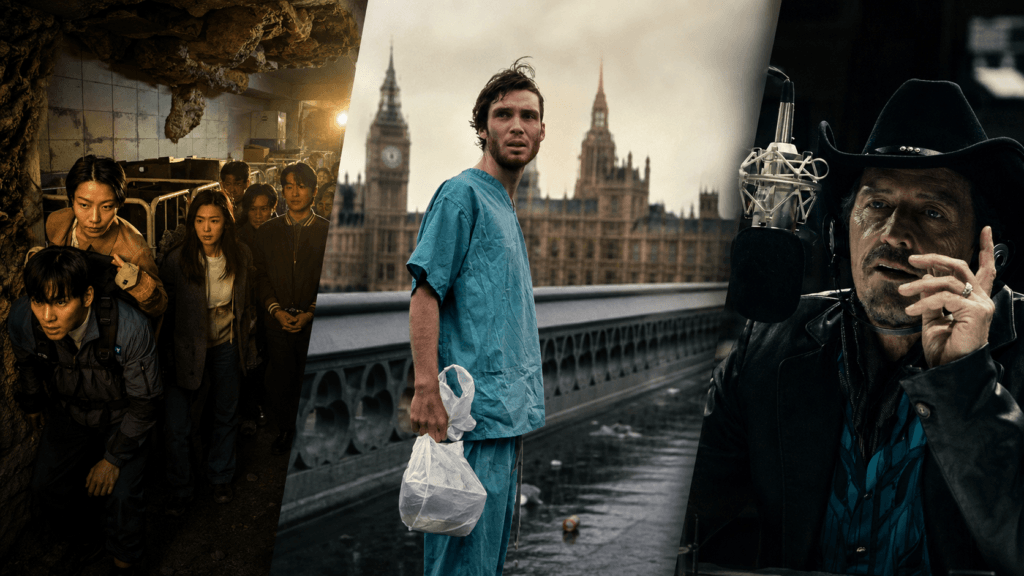
Zombie films rarely stay focused on the dead for very long. The initial outbreak provides urgency, but the survivors soon confront harder questions about power, identity, responsibility, and the limits of human cooperation. The zombies destroy the ordinary social order. What people build (or refuse to build) in its place reveals the film’s actual philosophy.
The genre has also changed alongside the societies producing it. Early zombies embodied colonial domination and forced labor. George A. Romero transformed them into figures of racial violence, consumerism, and institutional failure. More recent films have used infection to examine neoliberal individualism, posthuman identity, linguistic instability, artificial intelligence, and collective consciousness. As Todd K. Platts (2013) argues, zombie narratives reflect the material and cultural conditions surrounding their production. Their changing bodies register changing social anxieties.
The cinematic zombie should not be confused with the “philosophical zombie” discussed in the philosophy of mind. A philosophical zombie is physically indistinguishable from an ordinary human being but lacks conscious experience (Kirk, 2023). Most cinematic zombies are visibly different from the living. Nevertheless, the two concepts lead toward similar questions. Is consciousness what makes someone a person? Is humanity grounded in memory, rationality, autonomy, moral responsibility, or membership in a biological species?
The following films approach those questions from very different directions. They are arranged chronologically rather than ranked. Inclusion does not necessarily mean unqualified praise. In a few cases, the philosophical premise is considerably more interesting than the film itself.
Spoiler warning: The following list discusses important plot developments and endings.
1. White Zombie (Victor Halperin, 1932)

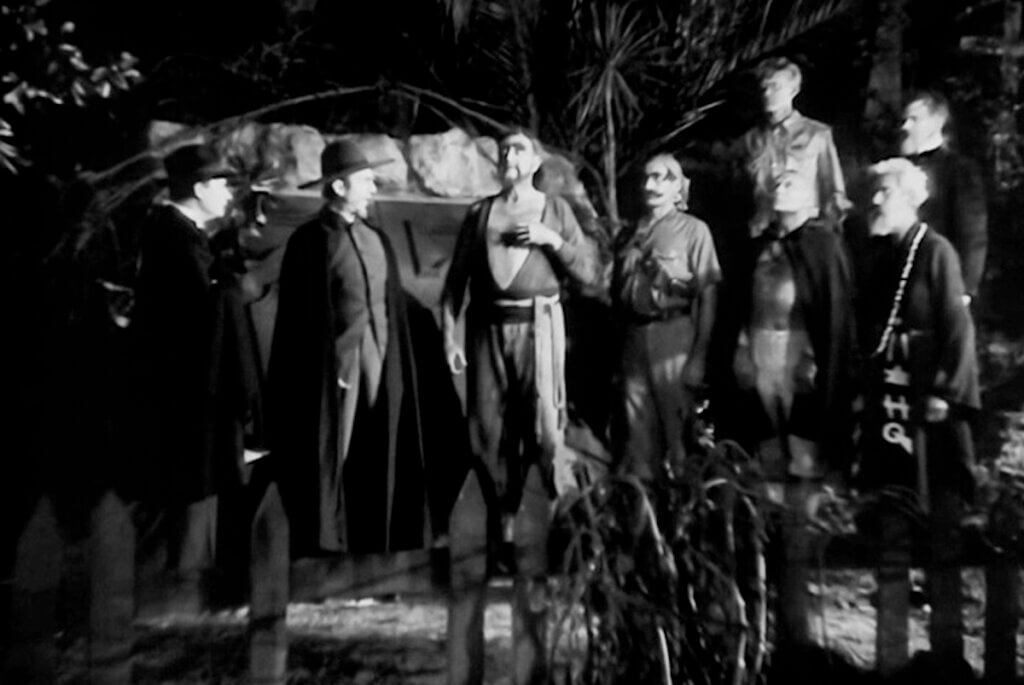
Can a person remain human after losing control over her own will?
Often identified as the first feature-length zombie film, White Zombie (1932) bears little resemblance to the apocalyptic stories that now dominate the genre. Its zombies do not consume human flesh or spread an infectious disease. They are living people deprived of agency and forced to labor under the control of Murder Legendre, played by Bela Lugosi.
Legendre operates a sugar mill in Haiti using zombified workers. Their bodies remain functional, but their choices no longer belong to them. When Charles Beaumont asks Legendre to help him possess Madeleine, the film extends this system of domination from plantation labor to sexual ownership. Beaumont wants to eliminate her capacity to choose anyone else.
The result resembles a nightmarish version of the master-slave relationship. A zombie remains biologically alive but has been reduced to an instrument of another person’s intentions. Consciousness without effective agency becomes its own form of imprisonment.
The film’s depiction of Haiti remains inseparable from American fears and fantasies about race, revolution, and colonial authority. Kyle William Bishop (2008) argues that the early voodoo zombie reflected imperialist anxieties about slavery and the possibility of white protagonists being subjected to the same domination imposed on colonized people. White Zombie treats Madeleine’s loss of autonomy as uniquely horrifying, even though Legendre’s mill already contains an entire workforce of enslaved Haitian bodies.
That contradiction gives the film much of its historical importance. It recognizes the horror of human beings becoming property while still viewing that horror largely through a white colonial gaze.
2. Night of the Living Dead (George A. Romero, 1968)

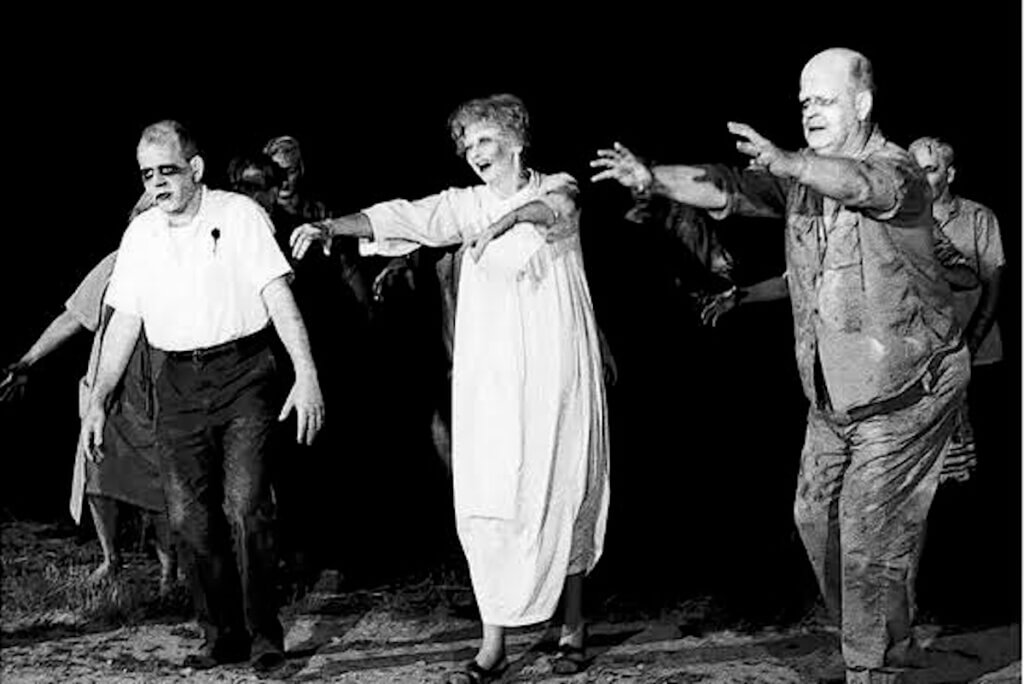
Who has the right to exercise authority when social institutions collapse?
The creatures in Night of the Living Dead (1968) are actually called “ghouls,” but Romero’s film established much of what audiences now recognize as the modern zombie. The dead return without individual identities, consume the living, and spread catastrophe through an expanding population of bodies.
Yet the central conflict develops inside the farmhouse. Ben attempts to organize the survivors and defend the main floor. Harry Cooper insists that everyone retreat into the cellar. Both men can offer reasonable arguments, but their hostility makes sustained cooperation nearly impossible. The question is whether authority can remain legitimate when it depends almost entirely on force, confidence, and the willingness of frightened people to listen.
Duane Jones’s performance as Ben transformed the film’s political meaning. Tony Quick (2025) emphasizes Jones’s role in shaping a Black protagonist who refused the submissive conventions often imposed on Black performers in American cinema. Ben is capable, decisive, and frequently correct, but these qualities cannot protect him from the racial order beyond the farmhouse.
After surviving the zombies, Ben is casually shot by a white posse that mistakes (or possibly just treats) him as another target. His body is dragged away with hooks and burned. The still photographs accompanying the ending evoke lynching imagery and destroy any comforting distinction between civilization and savagery.
The zombies threaten human life, but the armed men supposedly restoring order deliver the film’s final act of violence. Survival does not guarantee recognition as a person.
3. Dawn of the Dead (George A. Romero, 1978)

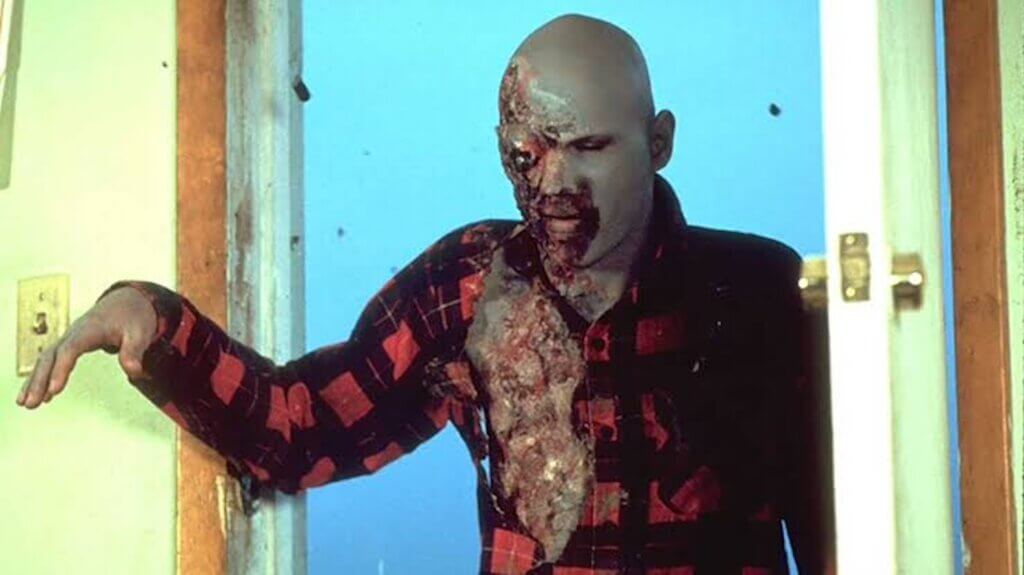
If consumer goods no longer have practical value, why do people continue to organize their identities around possessing them?
Romero moved the zombie apocalypse into a shopping mall and created the genre’s most famous critique of consumer culture. The zombies return to the mall because some residual memory draws them toward a place that mattered while they were alive. They shuffle through its corridors with no understanding of what the merchandise means, imitating consumer behavior after losing the social system that gave that behavior purpose.
The human survivors initially appear more rational. They secure the mall, block its entrances, and gain access to food, clothing, weapons, and entertainment. Gradually, however, survival turns into ownership. The mall becomes “theirs,” even though the economic and legal institutions that once defined property have collapsed.
Kyle William Bishop (2010) reads the film’s zombies as an idle proletariat cut off from productive labor but still trapped inside consumer ideology. The survivors are not entirely different. They possess virtually everything in the mall but remain unsatisfied and defensive. When a motorcycle gang invades, both groups risk their lives over commodities that nobody can meaningfully own.
Dawn of the Dead (1978) does not just argue that mindless consumers resemble zombies. Its criticism cuts deeper. Consumer identity has shaped the living so thoroughly that they reproduce it after capitalism has ceased to function.
Readers interested in this side of the film may also want to explore my list of 10 Marxist Films for Philosophy Students.
4. 28 Days Later (Danny Boyle, 2002)

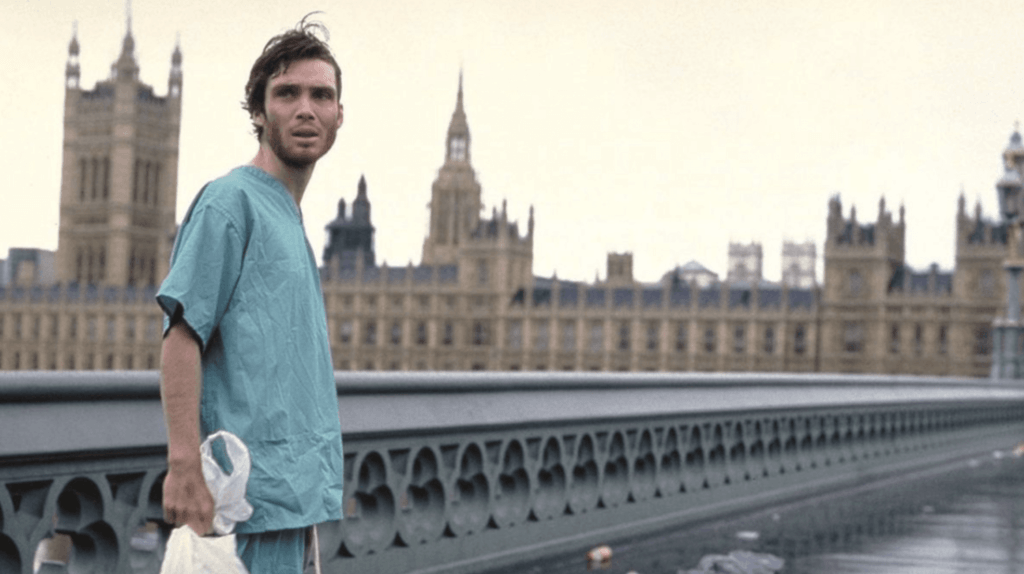
Does social collapse reveal humanity’s natural violence, or does it create new institutions that encourage violence?
The infected in 28 Days Later (2002) are not undead. They are living people overwhelmed by the Rage virus. Their speed and aggression helped redefine the zombie genre, but the film’s most disturbing threat comes from people who remain uninfected.
Jim awakens in an abandoned hospital and discovers a country emptied of ordinary social life. The deserted streets initially suggest a Hobbesian state of nature: without government, law, or reliable institutions, every stranger may represent a mortal threat. Selena responds by adopting a ruthless survival ethic. Attachment creates hesitation, and hesitation gets people killed.
The soldiers at the fortified mansion appear to offer an escape from that condition. They have weapons, shelter, leadership, and a chain of command. Their version of civilization, however, depends on imprisoning women and forcing them into sexual and reproductive servitude.
Bishop (2009) situates the zombie renaissance surrounding films such as 28 Days Later within the fears that shaped the post-9/11 period. The infected evoke sudden, incomprehensible violence, but the film refuses to suggest that greater militarization will make people safe. Its soldiers use emergency conditions to justify domination.
Jim eventually adopts the same explosive violence as the infected to rescue Selena and Hannah. That parallel creates the film’s most uncomfortable question. If rage becomes necessary for survival, what separates the survivor from the monster?
My review of 28 Years Later examines how the series later expanded these concerns into an existential study of death, isolation, and social decay.
5. Fido (Andrew Currie, 2006)
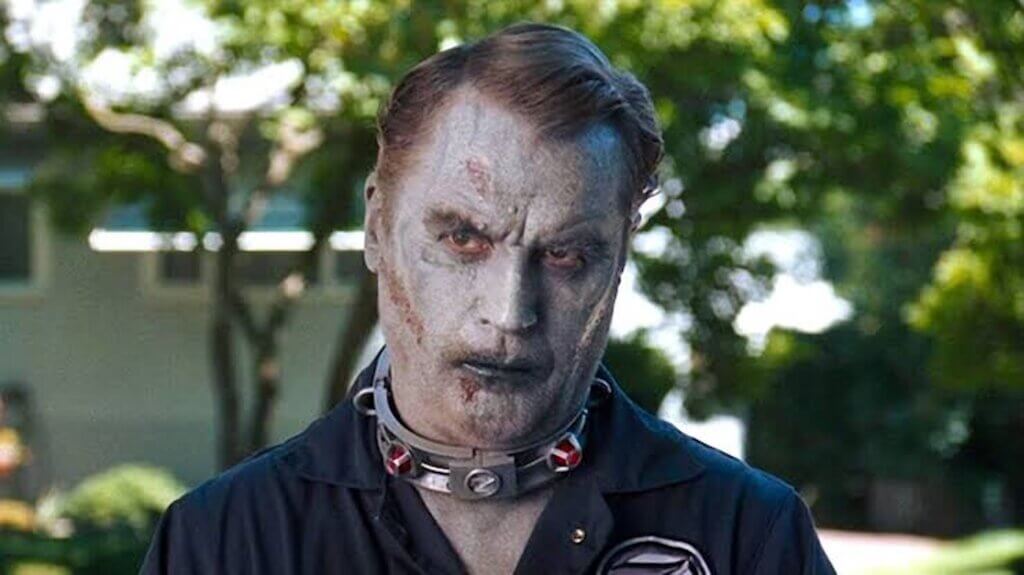
Can slavery become morally acceptable if society stops recognizing the enslaved as persons?
Fido (2006) imagines an alternate 1950s in which humanity has survived a zombie war and learned to control the undead with electronic collars. The ZomCon corporation turns zombies into gardeners, factory workers, servants, and domestic helpers. Suburban prosperity now rests on a labor force incapable of refusal.
The satire is deliberately cheerful. Bright lawns, polished kitchens, and smiling advertisements conceal the coercion supporting the entire community. Zombies are dangerous when their collars malfunction, but their ordinary existence is defined by obedience. They perform unpaid labor and can be destroyed when they become inconvenient.
Timmy’s relationship with his family’s zombie, Fido, disrupts the accepted distinction between person and property. Fido shows affection, loyalty, fear, and a developing capacity for choice. The adults continue to classify him as equipment because recognizing his personhood would threaten the economic and social order they enjoy.
The film therefore asks whether moral status depends on a being’s actual capacities or on the categories imposed by those in power. If Fido can form relationships and respond to others, his inability to speak does not make his enslavement harmless.
This is also why the film’s comedy remains unsettling. ZomCon does not need to convince people that slavery is good. It only needs to convince them that zombies are things.
6. Pontypool (Bruce McDonald, 2008)

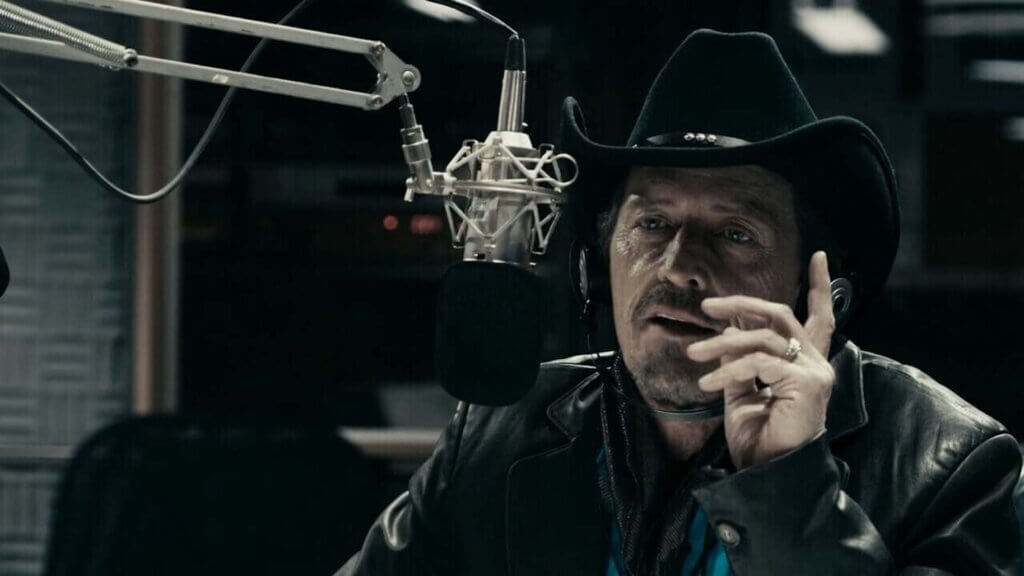
What happens when language stops communicating meaning and begins transmitting violence?
Most zombie films make visual identification easy. A survivor sees an altered face, an unnatural movement, or an attacking body and immediately understands the danger. Pontypool (2008) removes that certainty by placing most of the action inside a radio station.
Grant Mazzy and his colleagues initially experience the outbreak through incomplete reports, interrupted telephone calls, and descriptions they cannot verify. The audience knows only what they know. Information becomes necessary for survival, but every message may be inaccurate, misunderstood, or actively dangerous.
The infection itself spreads through particular words in the English language. Victims repeat phrases as their ability to generate meaningful speech deteriorates. Language no longer connects one mind to another. It becomes an autonomous system using human speakers to reproduce itself.
Scott Christiansen (2010) argues that Pontypool locates its horror in uncanny sound, repetition, and failed communication rather than the familiar visual spectacle of the zombie body. That shift gives the film an unusual philosophical force. Language normally helps us organize reality and share private experience. Here it becomes the barrier preventing genuine understanding.
The radio host’s profession makes the situation even more perverse. Grant survives by speaking to an audience, yet speech may be spreading the very catastrophe he is attempting to describe. The medium that should coordinate public action instead amplifies confusion.
Pontypool turns the zombie outbreak into a crisis of meaning. If words can no longer be trusted, neither individual thought nor collective cooperation can remain stable for long.
7. Train to Busan (Yeon Sang-ho, 2016)
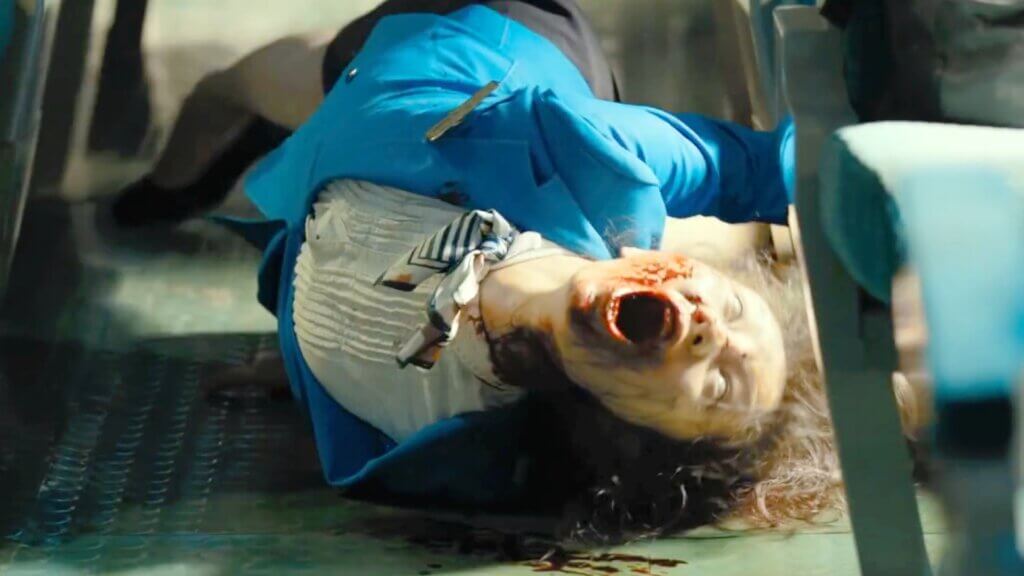
Can solidarity survive in a society that teaches people to treat self-interest as rationality?
Train to Busan (2016) places passengers inside a confined social experiment. As infection moves through the train, survival depends on strangers coordinating their actions, sharing information, and accepting risks for one another. At the same time, several passengers repeatedly attempt to secure themselves by excluding everyone they view as a possible threat.
Seok-woo begins the film as a fund manager accustomed to professional competition and emotional distance. His daughter, Su-an, recognizes the moral limits of this worldview before he does. The outbreak forces him to decide whether survival means protecting only his immediate interests or joining a fragile community of people whose lives are interdependent.
Executive Yon-suk represents selfishness disguised as prudence. He manipulates fear, abandons others, and treats exclusion as common sense. His decisions may protect him for a few additional minutes, but they steadily destroy the cooperation everyone needs.
Jaecheol Kim (2019) connects Train to Busan to neoliberal social structures and the failure of institutions to protect the people dependent on them. The film’s train becomes a compressed version of a society in which class position, occupational authority, and individual competition continue shaping behavior even during an emergency.
I remain less enthusiastic about the film itself than its reputation might suggest. Its sentimentality frequently overwhelms its social criticism, and much of its message is delivered with little subtlety. As I noted in my reviews of Train to Busan and Train to Busan 2: Peninsula, the original often feels like a lower-quality Snowpiercer with zombies.
Even so, its central philosophical conflict remains relevant. The alternative to selfish individualism is not the elimination of individuality. It is cooperation among individuals who understand that nobody survives alone.
8. The Girl with All the Gifts (Colm McCarthy, 2016)

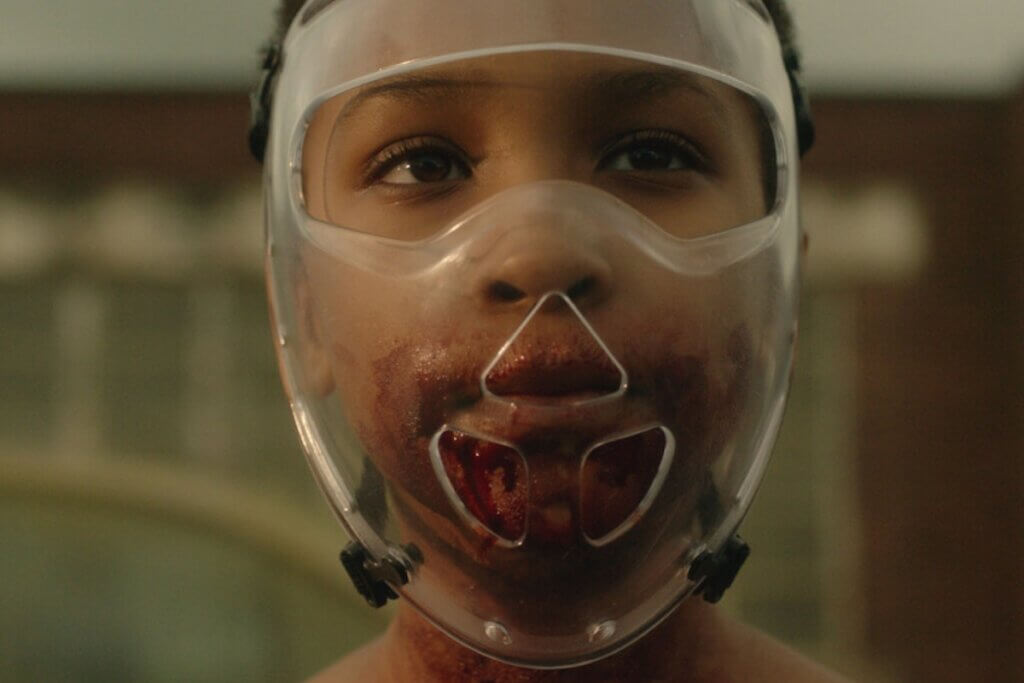
Does a new form of intelligent life have the right to replace humanity?
Melanie is a child, a student, an experimental subject, and a human-fungal hybrid. She can think, speak, form attachments, and exercise considerable self-control. Nevertheless, the adults surrounding her bind her to a wheelchair, restrain her at gunpoint, and discuss dissecting her body in the hope of developing a cure.
Dr. Caldwell views Melanie through utilitarian logic. If sacrificing one hybrid child might save humanity, then the experiment is justified. That calculation depends on denying Melanie equal moral status. Her intelligence makes her scientifically valuable, but it does not make her life inviolable.
The film complicates the issue by presenting the hybrids as a potential successor species rather than merely sick human beings. Hubert Le Boisselier (2024) argues that the film’s posthuman and ecological dimensions challenge the assumption that humanity’s continued dominance must remain the unquestioned moral objective.
Melanie’s final decision embraces a world in which Homo sapiens will no longer control the future. Human extinction is horrifying from the human perspective, but the film asks whether preserving one species justifies destroying another conscious population before it can exist freely.
As I argued in my review of The Girl with All the Gifts, the premise is stronger than the film’s increasingly far-fetched and cloying second half. Its uneven execution does not erase the importance of its central question: if Melanie possesses thought, emotion, and moral agency, on what grounds can the humans continue treating her as something less than a person?
9. The Cured (David Freyne, 2017)

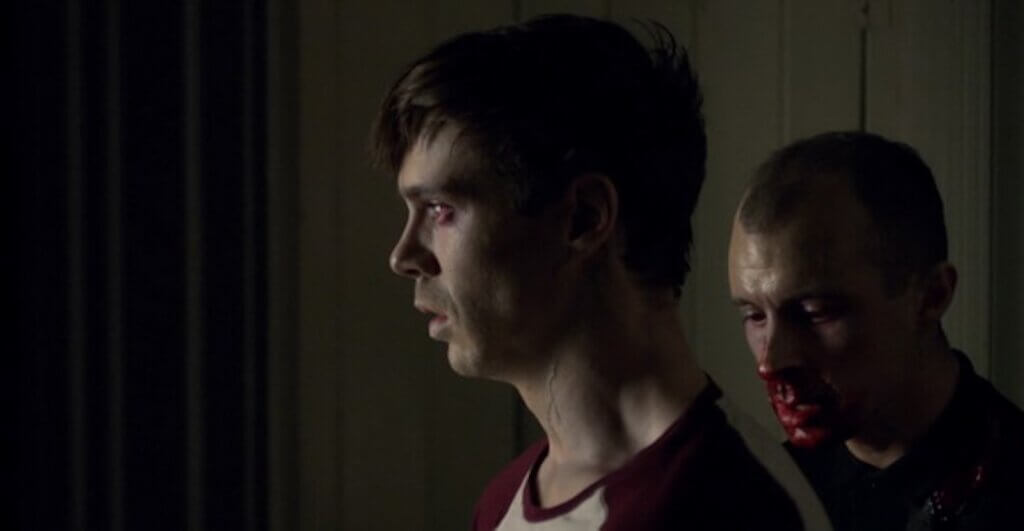
Can people be morally responsible for atrocities committed when they had no control over their actions?
Most zombie films offer only two categories: infected and uninfected. The Cured introduces a third. A treatment allows many former infected people to recover, but they retain detailed memories of everything they did while the disease controlled them.
Senan remembers killing his brother. He returns to live with his brother’s widow, Abbie, without initially telling her the truth. His body committed the act, and his memory preserves it, but the infection had removed his capacity for choice. Is he a perpetrator, a victim, or both?
The problem resembles the philosophical debate over moral luck. Williams and Nagel (1976) examine how moral judgment often depends on consequences and circumstances beyond a person’s control. Senan’s case pushes the problem further because the causal connection remains intact while intentional agency has disappeared. He remembers the killing from the inside, even though he could not prevent it.
The broader society offers little room for that distinction. Recovered people face surveillance, employment discrimination, public hostility, and collective blame. Some respond by forming a radical political movement. Their anger is understandable, but their willingness to renew violence threatens to confirm every prejudice directed against them.
The Cured (2017) uses the aftermath of infection to explore punishment and reintegration. A society cannot demand that former offenders resume normal lives while permanently defining them by actions they were incapable of choosing. At the same time, recovery does not erase trauma or eliminate obligations to those who suffered.
Cure, in this film, is a medical fact rather than a social resolution.
10. Colony (Yeon Sang-ho, 2026)

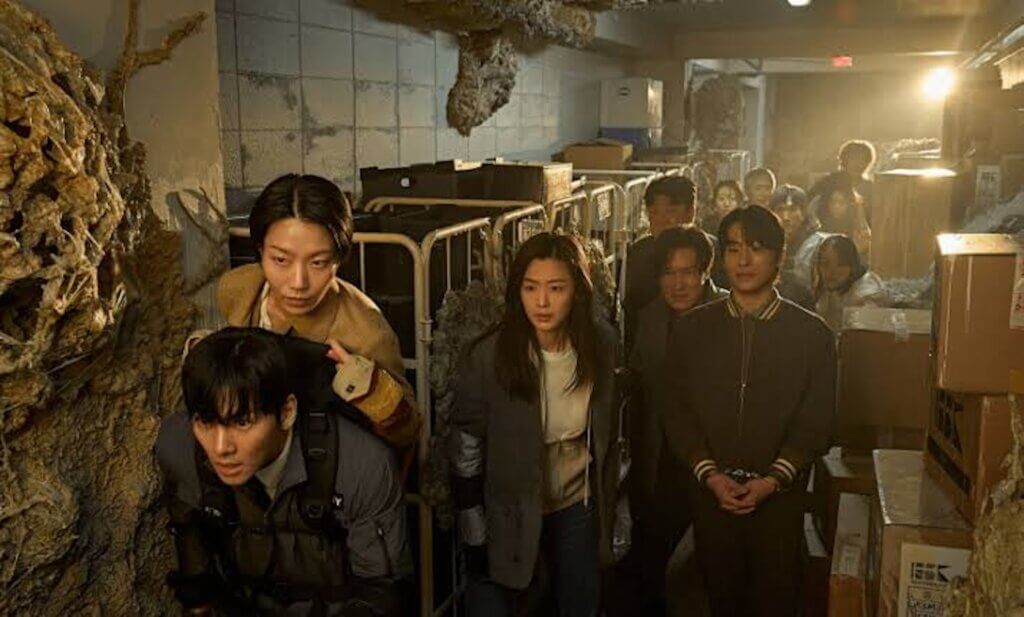
Is a perfectly coordinated collective more intelligent than a group of imperfect individuals?
Colony (2026) replaces the usual zombie horde with a neural network. Its infected share perception and coordinate their movements as parts of a single biological intelligence. They do not merely attack together. They think together.
This collective consciousness possesses enormous advantages. Information travels instantly across the network. Individual hesitation disappears. The infected can adapt as one organism because no member needs to independently understand the whole situation.
The human survivors rely on a much messier form of coordination. They watch security cameras, exchange messages, issue instructions, improvise, misunderstand one another, and revise failed plans. Their cooperation is slower and less reliable because every participant retains an individual perspective.
Yet that apparent weakness eventually becomes their advantage. A collective can process information efficiently, but it may also become trapped by the uniformity of its own reasoning. Individuals can disobey expectations, interpret evidence differently, and invent actions the larger system has not anticipated.
Director Yeon Sang-ho explicitly connected the infected network to contemporary anxieties about artificial intelligence and groupthink. In an interview with ABC, he described genuine solidarity as something that requires acknowledging difference rather than erasing it (Winter, 2026).
The film’s defense of individuality should not be confused with a defense of isolation. No individual character can defeat the network alone. The survivors succeed through cooperation, but their cooperation preserves disagreement, creativity, and independent decision-making.
That distinction is the heart of the film. Extreme collectivism destroys the individual, while extreme individualism makes coordinated survival impossible. Colony instead proposes a cooperative individualism: people acting together without surrendering the differences that make adaptation possible.
My full essay, Colony and the Limits of Collective Intelligence, examines this conflict in greater detail.
Honorable Mentions
Several other zombie films could easily support philosophical discussions of their own:
- I Walked with a Zombie (1943) approaches desire, colonialism, and Caribbean identity through Gothic melodrama.
- Day of the Dead (1985) asks whether consciousness can reemerge in the undead and whether scientific knowledge can survive military authoritarianism.
- Land of the Dead (2005) turns the zombie uprising into a class revolt against a fortified society built on extreme inequality.
- Warm Bodies (2013) considers whether memory, love, and narrative identity can restore a person who has lost nearly everything else.
- Cargo (2017) examines parental obligation and moral responsibility when infection makes future violence inevitable.
- One Cut of the Dead (2017) uses zombies to celebrate artistic cooperation, improvisation, and the unglamorous labor behind filmmaking.
- Blood Quantum (2019) connects immunity, borders, and tribal sovereignty to the continuing effects of settler colonialism.
The genre’s philosophical range also extends into comedy. My essay on reversing gender norms in the modern zom-com examines how zombie comedies can challenge traditional masculinity as well as conventional horror.
The zombie has never represented only one thing. It began in American cinema as a distorted image of colonial slavery. It later became a consumer, a racialized target, an infectious terrorist, an exploited worker, a linguistic virus, a posthuman child, and a networked intelligence.
Across these variations, one concern remains constant: the boundary between person and nonperson. Zombie films repeatedly show characters deciding whose thoughts matter, whose suffering counts, and whose bodies may be used or destroyed. The dead become frightening, but the living usually decide what the apocalypse will mean.
The best films in the genre do more than ask how humanity might survive. They ask whether the social order being defended deserves to survive, and what kind of people the survivors will become if it does.
References
Bishop, K. W. (2008). The sub-subaltern monster: Imperialist hegemony and the cinematic voodoo zombie. The Journal of American Culture, 31(2), 141–152. https://onlinelibrary.wiley.com/doi/10.1111/j.1542-734X.2008.00668.x
Bishop, K. W. (2009). Dead man still walking: Explaining the zombie renaissance. Journal of Popular Film and Television, 37(1), 16–25. https://www.tandfonline.com/doi/abs/10.3200/JPFT.37.1.16-25
Bishop, K. W. (2010). The idle proletariat: Dawn of the Dead, consumer ideology, and the loss of productive labor. The Journal of Popular Culture, 43(2), 234–248. https://onlinelibrary.wiley.com/doi/10.1111/j.1540-5931.2010.00739.x
Christiansen, S. (2010). Speaking the undead: Uncanny aurality in Pontypool. Cinephile, 6(2), 4–8. https://vbn.aau.dk/da/publications/speaking-the-undead-uncanny-aurality-in-pontypool/
Kim, J. (2019). Biocalyptic imaginations in Japanese and Korean films: Undead nation-states in I Am a Hero and Train to Busan. Inter-Asia Cultural Studies, 20(3), 437–451. https://www.tandfonline.com/doi/full/10.1080/14649373.2019.1649015
Kirk, R. (2023). Zombies. In E. N. Zalta and U. Nodelman (Eds.), The Stanford Encyclopedia of Philosophy. https://plato.stanford.edu/entries/zombies/
Lauro, S. J., & Embry, K. (2008). A zombie manifesto: The nonhuman condition in the era of advanced capitalism. boundary 2, 35(1), 85–108. https://read.dukeupress.edu/boundary-2/article-abstract/35/1/85/25269/A-Zombie-Manifesto-The-Nonhuman-Condition-in-the?redirectedFrom=fulltext
Le Boisselier, H. (2024). The Girl with All the Gifts as post-horror: A generic hybrid exploring the philosophical boundaries of humanity. Imaginaires, 27, 160–180. https://imaginaires.univ-reims.fr/index.php/imaginaires/article/view/67
Platts, T. K. (2013). Locating zombies in the sociology of popular culture. Sociology Compass, 7(7), 547–560. https://compass.onlinelibrary.wiley.com/doi/10.1111/soc4.12053
Quick, T. (2025). The inauguration of Black horror: Duane Jones’s racial revision of Night of the Living Dead. In R. R. M. Coleman and N. Lawrence (Eds.), The Oxford handbook of Black horror film (pp. 187–199). Oxford University Press. https://academic.oup.com/edited-volume/59633/chapter-abstract/505034961
Williams, B., & Nagel, T. (1976). Moral luck. Aristotelian Society Supplementary Volume, 50(1), 115–152. https://academic.oup.com/aristoteliansupp/article-abstract/50/1/115/1779834
Winter, V. (2026, June 20). Train to Busan director Yeon Sang-ho on Colony, AI and the dangers of groupthink. ABC News. https://www.abc.net.au/news/2026-06-20/yeon-sang-ho-colony-the-interview/106813376