


The following essay contains major spoilers for Colony (2026).
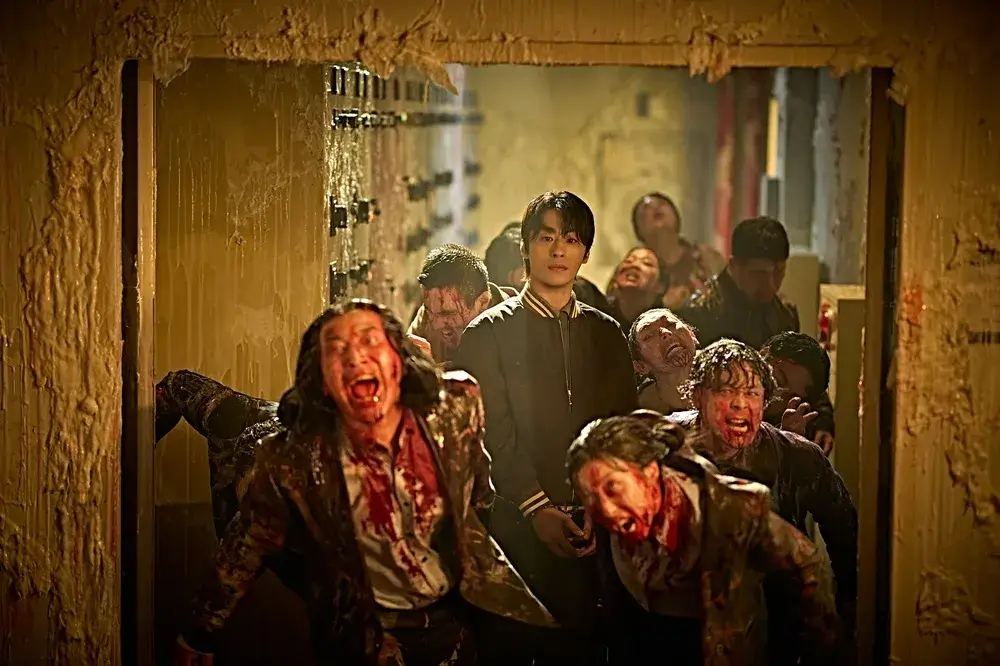
Zombies are normally terrifying because they are mindless. In Yeon Sang-ho’s Colony, they are terrifying because they think too well.
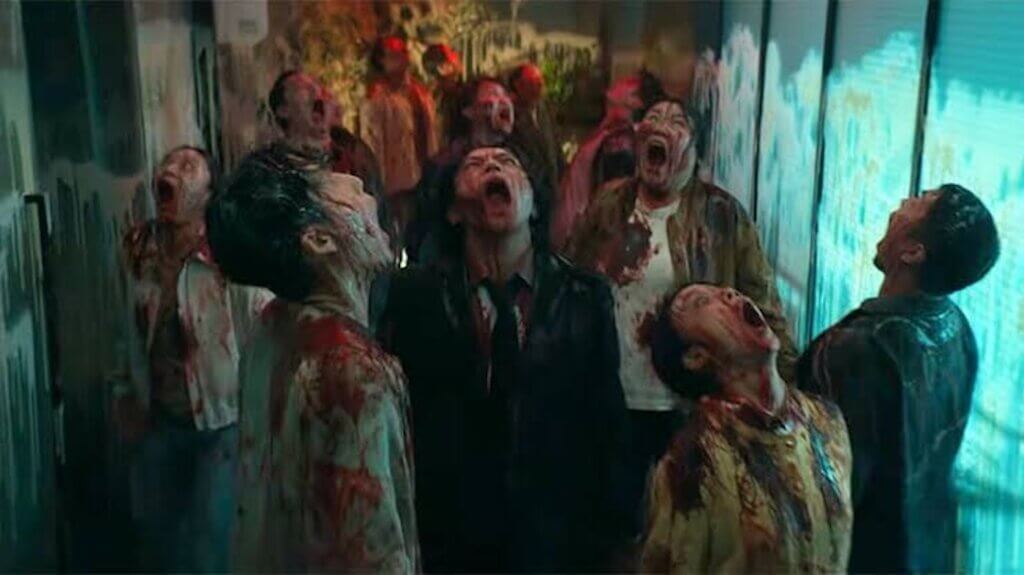
After a biological weapon is released inside a Seoul high-rise, the infected begin developing a collective intelligence. Each zombie becomes part of a neural network, sharing information through the strange white substance spreading throughout the building. They do not merely attack as a crowd. They observe, learn, and change tactics as a single evolving organism.
The survivors cannot compete with this network in terms of speed or efficiency. They remain physically separated, possess incomplete information, and frequently disagree about what to do. Yet these apparent weaknesses ultimately give the humans their best chance of survival. Their imperfect communication preserves the possibility of independent judgment, creative problem-solving, and voluntary cooperation.
Consequently, Colony becomes more than another survival story about humans fighting the undead. It tests an extreme form of collectivism against an equally unsustainable form of individualism. The humans prevail not by acting alone, but by cooperating without surrendering their individuality.
The traditional zombie represents the destruction of the individual. Once infected, a person loses their memories, personality, relationships, and moral agency. The body remains, but the person who once inhabited it has effectively disappeared. Sarah Juliet Lauro and Karen Embry (2008) make a similar observation in their examination of the zombie as a challenge to the autonomous human subject. The zombie is simultaneously an individual body and an interchangeable member of an undifferentiated mass.
Colony literalizes this idea by connecting its zombies neurologically. Infection does not just make everyone behave similarly. It absorbs individual bodies into a shared biological intelligence. As more people become infected, the colony gains more eyes, more physical power, and greater processing capacity.
This gives the zombie horde a form of perfect communication. Information does not need to be explained or interpreted. What one infected person sees can become available to the entire colony. There is no hesitation, argument, or misunderstanding between its members.


However, there is also no genuine cooperation. Cooperation normally implies that distinct individuals have agreed, either explicitly or implicitly, to pursue a shared objective. The zombies cannot consent because the network has eliminated the distinction between one member and another. They do not work together as individuals; they function as parts of one organism.
This is collectivism in its most extreme form. The individual has no moral importance outside the collective and no ability to oppose its decisions. Every body is expendable because every body serves the same intelligence.
Yeon Sang-ho has explored selfishness and cooperation throughout his zombie films. Train to Busan places strangers inside a confined space and gradually forces them to recognize their dependence on one another. Its most destructive character is not a zombie, but an executive who repeatedly sacrifices other passengers to protect himself.
Colony complicates that conflict. The enemy is no longer merely a crowd of aggressive bodies. It is a community whose members cooperate more effectively than the humans ever could. Unlike the sequel to Train to Busan, whose recycled spectacle I criticized in my review, Colony builds its action around a distinctive philosophical problem. Cooperation is still necessary, but cooperation itself has become morally ambiguous. The survivors must act collectively without becoming a collective consciousness.
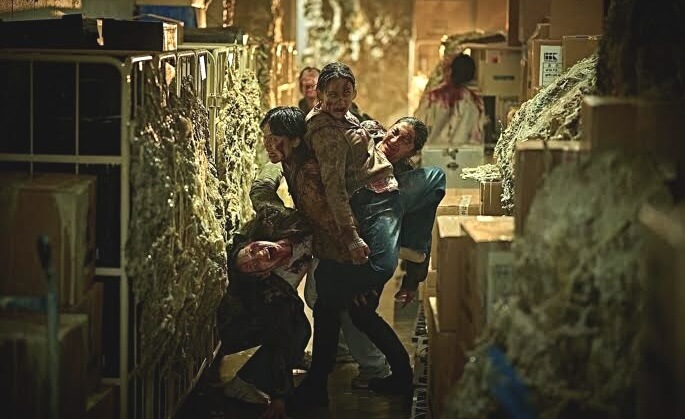
The difference is freedom. The human characters may share an immediate objective, but they do not share a mind. They retain separate relationships, fears, skills, loyalties, and interpretations of the crisis. This causes conflict, but it also enables them to make decisions that the colony cannot anticipate.
The contrast becomes clearest through the film’s use of security cameras and mobile communication. From the surveillance room, Hyun-hee watches the building through its CCTV system. She can see dangers that remain invisible to the survivors moving through the corridors. Using phones and messages, she instructs her brother Hyun-seok and the others where to go, when to move, and which routes to avoid.
This initially resembles the structure of the zombie network. One intelligence observes events from multiple perspectives and directs bodies throughout the building. Hyun-hee appears to occupy the position of a central mind, while the survivors function as her limbs.
There is nevertheless a crucial difference. Hyun-hee can provide information, but she cannot control the people receiving it. Her brother must interpret her directions, respond to immediate dangers, and decide whether to follow her instructions. She can see through cameras, but she cannot see through his eyes.
Human communication maintains a boundary between sender and receiver. A message can be misunderstood, questioned, ignored, or adapted. That makes human communication slower and less reliable than the colony’s biological connection. It also prevents information from becoming automatic obedience.
The distinction is especially apparent once the survivors realize that Young-cheol can direct the infected through his eyes. Covering his eyes disrupts his ability to control the horde (to a degree), while the humans shift their own communication to phones and group messages. They can change the structure of their network because no single method defines their identity.
The zombies possess a superior communication system, but the humans possess multiple systems. When one fails, they can improvise another.
It would be tempting to interpret Colony as a straightforward defense of individualism. The zombies share a single mind, while the heroes survive because they retain their separate identities. However, nobody in the building can survive through individual strength alone.

Se-jeong’s scientific knowledge is only valuable if she can communicate it to people capable of acting on it. Hyun-hee’s access to the cameras means nothing without survivors moving through the building. Hyun-seok’s physical abilities would be insufficient without his sister guiding him around dangers he cannot see.
The humans require one another. What distinguishes them from the infected is not independence from the group, but the preservation of autonomy within the group.
Psychologists Hazel Markus and Shinobu Kitayama (1991) distinguish between independent and interdependent understandings of personal identity. An independent self is understood through its internal characteristics and separation from others. An interdependent self is understood through relationships, obligations, and social context.
The survivors in Colony need both. They must remain independent enough to make judgments that differ from those of the majority, but interdependent enough to turn those judgments into coordinated action.
This is why the film should not be treated as a rejection of collectivism in every political or social sense. The zombie network does not represent ordinary community, public responsibility, or social solidarity. It represents compulsory unity: cooperation transformed into conformity and conformity pushed to the point where the self disappears.
At the opposite extreme, pure individualism would leave each survivor isolated and operating with dangerously limited knowledge. The alternative offered by the film is something closer to cooperative individualism or pluralistic solidarity. People share an objective without being reduced to interchangeable parts.
Research into group problem-solving helps explain why this arrangement can outperform a more uniform intelligence. Hong and Page (2004) demonstrate that, under certain conditions, groups employing different problem-solving approaches can perform more effectively than groups composed only of the individually strongest performers. The benefit comes from cognitive diversity. When one approach reaches a dead end, another person may see a possibility that the first person overlooked.
Similarly, Nemeth’s (1995) research suggests that disagreement can stimulate divergent thinking. A unanimous majority tends to narrow attention around one interpretation, while minority disagreement encourages people to examine a problem from multiple perspectives.
The infected in Colony can learn extremely quickly, but their learning always converges. Each observation is incorporated into the same system and directed toward the same objective. The network improves its existing strategy without allowing a genuinely independent perspective to challenge the assumptions behind that strategy.
The humans are considerably more chaotic. They argue, conceal information, take emotional risks, and occasionally refuse the group’s preferred course of action. Not every independent decision is sensible, but the ability to depart from consensus creates new possibilities.
Hyun-seok’s determination to return for his sister is a particularly important example. From the perspective of immediate group survival, returning is irrational. Yet his refusal to treat Hyun-hee as an expendable component distinguishes human cooperation from the zombie colony. The infected sacrifice bodies automatically. Hyun-seok decides for himself what another person is worth.
Hyun-hee’s final instructions similarly demonstrate the relationship between individual agency and collective survival. She uses her privileged view of the building to guide her brother toward safety, even as she recognizes that he cannot save her. Her sacrifice is not produced by a calculation shared throughout the group. It is a personal moral decision made possible by her particular knowledge, relationship, and position.

Individuality therefore contributes more than tactical unpredictability. It allows people to choose different values. The humans can decide that rescue, loyalty, or sacrifice matters more than simply maximizing the number of surviving bodies.
Tomasello et al. (2005) describe the foundations of human cooperation through the concept of “shared intentionality.” Human beings can understand one another as intentional agents, form a shared goal, and coordinate different roles in pursuit of it.
This does not require everyone to become psychologically identical. On the contrary, collaboration depends on recognizing the distinction between self and other. I understand what I am doing, what you are doing, and how our different actions contribute to something neither of us could accomplish alone.
That is precisely how the survivors oppose the colony. Hyun-hee watches. Hyun-seok moves. Se-jeong studies the infection and revises their understanding of it. Other survivors protect, communicate, and carry out separate tasks. Their efforts become collective without their minds becoming uniform.
The zombie network cannot reproduce this kind of cooperation because it no longer contains meaningful distinctions between “I,” “you,” and “we.” It possesses collective intelligence without intersubjectivity. Its members share information, but they cannot recognize one another as free individuals.
Director Yeon Sang-ho has explicitly connected the film’s hive mind to his concerns about artificial intelligence and hyperconnected societies. Yeon argues that systems built from generalized or majority thinking can weaken individuality and exclude perspectives that fall outside the dominant pattern (Winter, 2026).
This does not mean the colony is unintelligent. In many respects, it is more intelligent than any individual human. Its weakness is that intelligence has become detached from difference. It can accumulate information at extraordinary speed, but it cannot produce the kind of genuine dissent that changes how a problem is understood.
The title ultimately applies to both sides of the conflict. The infected constitute a biological colony: unified, efficient, and capable of sacrificing any member for the continuation of the whole. The survivors form a temporary human colony, but theirs is unstable, argumentative, and dependent on trust. They remain connected without becoming indistinguishable.
Human ingenuity wins the immediate battle, but not because human intelligence is inherently superior. No single survivor understands the situation better than the neural network does. The humans prevail because separate minds can generate separate possibilities.
The film therefore rejects the simple choice between collectivism and individualism. Extreme collectivism destroys the individual, while extreme individualism makes meaningful cooperation impossible. Survival depends on maintaining the tension between them.
Colony imagines humanity as a network of imperfectly connected people: capable of misunderstanding one another, resisting instructions, changing their minds, and choosing objectives the larger group did not authorize. These qualities make human cooperation inefficient, but they also make creativity and moral responsibility possible.
Colony also belongs to a broader tradition of zombie films that use the undead to question personhood, power, and collective behavior. I explore that tradition in 10 Philosophical Zombie Films About More Than Survival.
References
Hong, L., & Page, S. E. (2004). Groups of diverse problem solvers can outperform groups of high-ability problem solvers. Proceedings of the National Academy of Sciences, 101(46), 16385–16389. https://doi.org/10.1073/pnas.0403723101
Lauro, S. J., & Embry, K. (2008). A zombie manifesto: The nonhuman condition in the era of advanced capitalism. boundary 2, 35(1), 85–108. https://doi.org/10.1215/01903659-2007-027
Markus, H. R., & Kitayama, S. (1991). Culture and the self: Implications for cognition, emotion, and motivation. Psychological Review, 98(2), 224–253. https://doi.org/10.1037/0033-295X.98.2.224
Nemeth, C. J. (1995). Dissent as driving cognition, attitudes, and judgments. Social Cognition, 13(3), 273–291. https://doi.org/10.1521/soco.1995.13.3.273
Tomasello, M., Carpenter, M., Call, J., Behne, T., & Moll, H. (2005). Understanding and sharing intentions: The origins of cultural cognition. Behavioral and Brain Sciences, 28(5), 675–691. https://doi.org/10.1017/S0140525X05000129
Winter, V. (2026, June 20). The Interview: Director Yeon Sang-ho says AI doesn’t want our jobs, it wants our individuality. ABC News. https://www.abc.net.au/news/2026-06-20/yeon-sang-ho-colony-the-interview/106813376