



This essay contains major spoilers.
Scott Beck and Bryan Woods’ Heretic (2024) begins as a theological debate before gradually revealing that no honest debate was ever possible. Mr. Reed (Hugh Grant) appears eager to discuss religion with two young Mormon missionaries, Sister Barnes (Sophie Thatcher) and Sister Paxton (Chloe East). He has spent years studying different belief systems and presents himself as someone who just wants answers. Yet Barnes and Paxton are never treated as intellectual equals. They are subjects in a demonstration whose conclusion Reed selected long before they arrived.
For this reason, the central conflict in Heretic is not really between faith and atheism. It is between intellectual freedom and coercive certainty. Reed criticizes organized religion for demanding obedience, only to create his own closed system in which he decides what questions can be asked and what evidence will be accepted. His house transforms this philosophical contradiction into a physical environment. Every apparent choice leads deeper into a world he controls.
When Barnes and Paxton arrive at his home, they explain that they cannot enter unless another woman is present. Reed assures them that his wife is in the kitchen baking a pie. The smell appears to support his claim, allowing the missionaries to step inside without violating their rules. Only later does Barnes notice that the scent is coming from a blueberry-pie candle. There is no wife and no actual pie waiting upstairs.
This initial deception establishes Reed’s method. He does not force the missionaries through the front door. Instead, he manufactures the conditions under which they will enter willingly. He studies their rules and then provides the evidence needed to satisfy them. Their consent is technically present, but it has been obtained through a lie.
The same distinction is important when they attempt to leave. Reed claims that the front door cannot be opened because its lock is controlled by a timer. He remains calm, assuring them that another exit exists deeper inside the house. From that moment forward, Barnes and Paxton continue to make decisions, but the decisions no longer qualify as free in any meaningful sense. Reed has determined where they can go. He merely allows them to decide how they will get there.
His extended discussion of religion follows the same pattern. Reed produces a Monopoly board and explains how the familiar game developed from The Landlord’s Game. He then compares Radiohead’s “Creep” with “The Air That I Breathe” by the Hollies. These examples prepare the missionaries for his larger claim that modern religions are merely iterations of older belief systems.

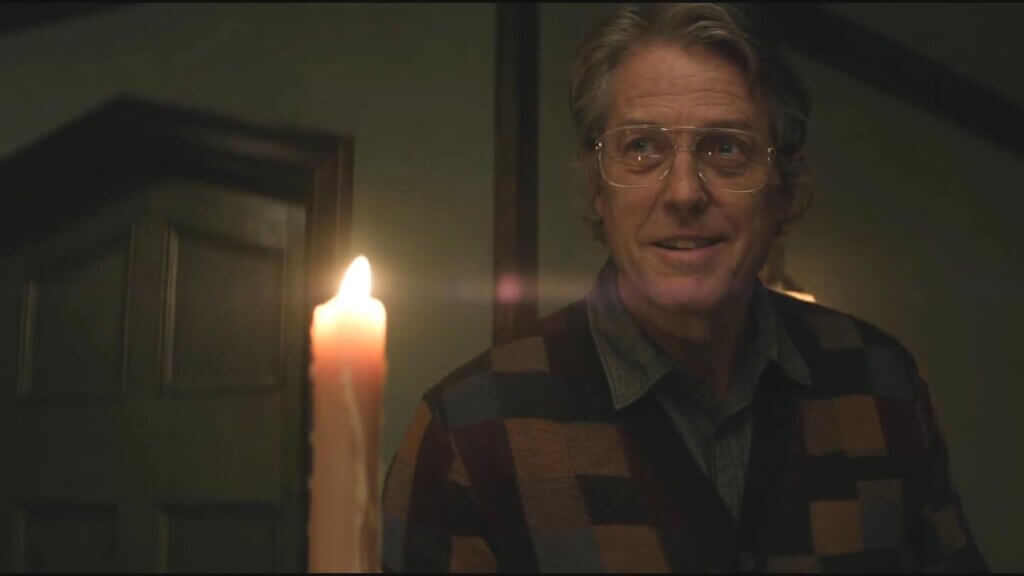
The presentation is clever, but its reasoning is far less conclusive than Reed imagines. Demonstrating that one cultural product resembles another does not prove that the newer version is false. The similarities between religious stories may reveal historical influence, but influence is not the same thing as invalidation. Reed moves from resemblance to causation and then from causation to disbelief without adequately defending either step.
His argument also relies on momentum. He moves rapidly between examples, preventing any one comparison from receiving much scrutiny. Barnes eventually interrupts and challenges some of his claims about the supposed parallels between Jesus and earlier religious figures. Reed does not seriously reconsider his position. He treats her objection as another predictable stage in his presentation.
This is the first indication that Reed’s skepticism has become dogmatic. He expects Barnes and Paxton to question their religion, but he never questions his own interpretation. His conclusions are presented as the inevitable result of education, while their beliefs are dismissed as products of indoctrination. He cannot imagine that an informed person might examine the same material and reach a different conclusion.
The two doors labeled “Belief” and “Disbelief” make this false openness explicit. Reed tells the missionaries that they must choose a door based on whether they still believe in God. Paxton initially considers choosing disbelief because she hopes it will provide the safest route out. Barnes refuses to make a confession she does not believe and insists that they enter through the door marked belief. The labels create the appearance of a decisive spiritual test. In reality, both doors lead to the same basement.
Reed has reduced an enormous range of philosophical positions to two words. There is no door for uncertainty. There is no space for a person who believes in God but doubts her church, nor is there room for an atheist who rejects Reed’s reasoning.
The physical structure of the house recalls Michel Foucault’s account of the examination as a mechanism that joins the production of knowledge with the exercise of power. As explained in the Stanford Encyclopedia of Philosophy’s discussion of Foucault, an examination does more than discover information about its subject. It establishes the examiner’s authority to define what the subject is.
Reed behaves like a teacher, but his lesson is inseparable from captivity. He observes how the missionaries respond to each claim and adjusts his tactics accordingly. Their answers do not determine what happens next. They simply tell him which form of pressure to apply.
In this sense, Reed is an anti-missionary. Barnes and Paxton approach his home hoping to persuade him to accept their faith. Reed wants to convert them to his worldview. The difference lies in the possibility of refusal. He could have declined their invitation and closed the door. Once the women enter his house, he eliminates that option for them.
Reed frequently treats missionary work and his own experiment as equivalent forms of manipulation. Mormonism undoubtedly has a complicated history involving authority, gender, and obedience. Yet the missionaries rely on conversation. Reed relies on imprisonment. By treating these methods as interchangeable, he avoids confronting the moral significance of his own violence.
The staged resurrection in the basement is the clearest example of Reed producing evidence through force. A frail woman appears and eats a poisoned blueberry pie. After she dies, Reed promises that Barnes and Paxton will witness her return from the dead. The arrival of Elder Kennedy at the front door briefly draws their attention away from the body. When they look again, a woman who appears to be the prophet has revived and begins describing what she saw after death.


Reed presents this as empirical proof. The missionaries have supposedly observed a miracle with their own eyes. However, Barnes immediately notices problems with the demonstration. The woman’s description resembles the near-death experience Barnes once had. More importantly, the resurrected prophet departs from Reed’s script and tells them, “It’s not real.”
When Barnes refuses to accept the performance as a genuine resurrection, Reed cuts her throat. He then removes a small object from her arm and claims that it is an electronic component. According to his new explanation, Barnes was never human. Her failure to resurrect proves that reality is a simulation. Paxton recognizes the object as a contraceptive implant.
This moment completely dismantles Reed’s claim to intellectual honesty. When his first experiment fails, he does not revise his theory. He invents a new theory that explains away the failure. The miracle proves him right if it succeeds, while the simulation proves him right if it fails. Since no possible result could disprove his position, his supposed skepticism has taken on the structure of the religious dogma he condemns.
Paxton then reconstructs the trick. A second woman replaced the dead prophet while everyone was distracted by Elder Kennedy’s arrival. The trapdoor beneath the room allowed Reed to move the bodies without being seen. What appeared supernatural was stagecraft.
Paxton’s ability to expose the deception is especially important because Reed repeatedly treats her as the weaker of the two missionaries. Barnes appears more confident, so Reed directs most of his intellectual attention toward her. He assumes that Paxton will simply follow whichever authority speaks most forcefully.
Miranda Fricker’s concept of testimonial injustice describes what happens when prejudice causes someone’s credibility as a knower to be unfairly diminished. Reed does not merely disagree with the missionaries. He assumes their youth and religious commitment make serious thought impossible for them. His treatment of Paxton adds another layer to this prejudice. He sees her politeness as proof of intellectual weakness.
Paxton survives because Reed never fully recognizes her capacity to reason. She notices the contraceptive implant and identifies the mechanics behind the resurrection. Later, she understands why Reed planted her bicycle-lock key in her coat. His condescension creates the opening through which she begins to dismantle his performance.
The key leads Paxton into the deepest section of the house, where she discovers several emaciated women locked in cages. Reed has created his own congregation, though its members are prisoners rather than followers. Their bodies have become props in the theological argument he has been rehearsing upstairs.
This revelation gives physical form to Reed’s conclusion. He believes that control is the one true religion underlying every other belief system. The caged women are meant to prove that he can make people follow rituals, impersonate prophets, and testify to miracles if he exerts enough power over them.
Yet the scene also exposes the circular nature of his thinking. Reed wants to prove that religion is control, so he constructs a religion based entirely on control. He then presents his own creation as evidence that every religion must function the same way. Once again, the conclusion is built into the experiment.
His insistence that Paxton personally discover the cages is part of the performance. She did not escape his maze or uncover a secret he wanted to keep hidden. Reed planted the key because he wanted her to reach this room. Even her apparent rebellion has been incorporated into his plan. What matters to him is not that she understands his theory, but that she arrives at the exact words he has chosen for her.
The gendered quality of Reed’s control is impossible to ignore. He invents a wife to lure young women into his home, then confines other women beneath it. Knowledge gives him the language to disguise his behavior as philosophical inquiry. Beneath the lectures and diagrams, however, his project resembles the familiar structure of a patriarchal cult.

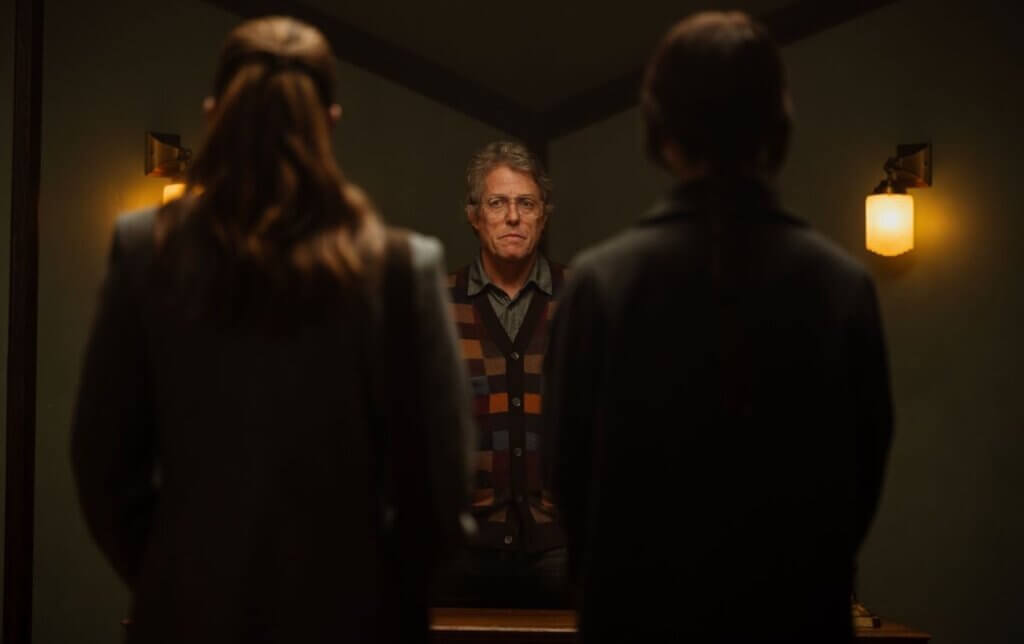
A similar structure appears in The Other Lamb, in which a male leader turns his personal desires into religious law. His authority depends on convincing the women around him that his rules come from somewhere beyond himself. Reed takes the opposite rhetorical route, rejecting supernatural authority altogether, but the material result is much the same. One man appoints himself the final judge of what women may know and where they may go.
This also connects Heretic to The Nun, a film about a woman forced into a religious life without meaningful consent. Both films show how institutions can preserve the appearance of choice while ensuring that only one outcome is permitted. Reed recreates this structure on a smaller scale. His doors invite a decision, but the architecture has already decided for the women.
Barnes and Paxton resist him through cooperation. Before the staged resurrection, Barnes secretly gives Paxton a letter opener and establishes “magic underwear” as the signal to attack. Reed stops the first attempt by killing Barnes, but Paxton keeps the weapon. When Reed follows her into the chamber containing the caged women, she finally drives it into his neck.
Reed manages to stab her in return. As they bleed on the basement floor, he turns to prayer for one final exercise in humiliation. Paxton readily admits that prayer has not been shown to produce the measurable results people often demand from it. She does not claim that prayer will close her wound or guarantee divine intervention. Instead, she describes it as a way of directing compassionate thought toward another person.
This answer escapes Reed’s system because it does not treat prayer as a supernatural technology. If prayer were only a request that could be tested by whether God grants it, Reed could dismiss it as a failed experiment. Paxton assigns it moral value even when it changes nothing outside the person praying. Her faith remains meaningful without becoming proof.
Kierkegaard’s understanding of faith is useful for a proper reading of Heretic. As summarized in the Stanford Encyclopedia of Philosophy’s discussion of fideism, Kierkegaard treats faith as a commitment maintained in the presence of objective uncertainty. Complete evidence would change the nature of the commitment. Faith is not a scientific conclusion waiting to be verified.
Paxton accepts this uncertainty more honestly than Reed does. She does not know whether God will save her. Reed, for all his supposed skepticism, cannot tolerate any uncertainty at all. He requires a final theory that explains religion, human behavior, and the suffering he inflicts. His confidence functions as protection against the possibility that his conclusions might be wrong.
This is also why the film does not end by proving Paxton’s beliefs. Barnes rises long enough to kill Reed with a wooden plank, but the circumstances remain unclear. She may have survived her wound for a few additional minutes. Her return could also be read as an answer to Paxton’s prayer.
After Barnes collapses, Paxton escapes from the house and emerges into the snow. A butterfly lands on her hand, recalling her earlier wish to return after death as a butterfly and visit the people she loves. Then it disappears.
The image provides no definitive answer. It could represent divine intervention, a hallucination, or Paxton’s own death. The vanishing butterfly ensures that none of these interpretations can be proven. Unlike Reed, the film finally allows uncertainty to remain.
This ambiguity places Heretic alongside films such as Winter Light, discussed in my list of absurdist films. In Bergman’s film, spiritual anguish arises from God’s silence. No miracle arrives to settle the matter. The absence of certainty becomes the condition under which faith must either survive or disappear.
By contrast, Reed cannot permit silence. He fills every unanswered question with another lecture and every contradiction with another trick. His greatest fear may not be religious belief at all. It may be the existence of a question he cannot control.
Heretic does not vindicate Mormon doctrine, nor does it refute atheism. Barnes remains willing to criticize her church, while Paxton acknowledges that prayer may have no external effect. Their victory lies in refusing to let Reed define the limits of thought for them.
The film’s true heresy is therefore the rejection of compulsory certainty. Paxton escapes the house without choosing either of Reed’s positions. She continues to believe, but her faith has room for doubt. Reed offers belief and disbelief as opposing doors, though both lead to the same prison. Paxton finds freedom by rejecting the architecture that made those seem like the only choices.