


Horror has always been philosophical, even when it pretends otherwise. Its monsters test the boundaries separating human from animal, living from dead, natural from supernatural, and self from other. Horror asks what remains of morality when ordinary social rules collapse. It also forces us to confront an especially peculiar aesthetic question: why do we deliberately seek out images and stories designed to frighten or disgust us?
Art horror takes these questions a step further. Instead of treating horror primarily as a vehicle for suspense, violence, or spectacle, art horror uses the genre to examine problems involving identity, desire, political authority, bodily autonomy, religion, knowledge, and the nature of reality. Its narratives are frequently ambiguous, while its formal techniques can be experimental, surreal, or deliberately disorienting.
The films on this list were chosen according to three general principles. First, they are lesser-known works rather than familiar studio productions. Second, each film presents substantial philosophical material that could support classroom discussion or further research. Finally, the films combine artistic experimentation with the emotional structure that philosopher Noël Carroll calls “art-horror.”
This list proceeds chronologically. The respective number of each film does not represent its quality or philosophical importance.
What Is Art Horror?
The expression “art horror” can be misleading because it is commonly used in two distinct ways.
In contemporary film criticism, art horror usually means horror influenced by arthouse cinema. These films tend to emphasize atmosphere, visual composition, ambiguity, symbolism, and psychological complexity. They may avoid conventional jump scares, clear explanations, and easily identifiable villains. Under this definition, an art-horror film is simply a horror film that adopts the methods or ambitions of art cinema.
Noël Carroll uses the expression differently. In his influential essay “The Nature of Horror” and subsequent book The Philosophy of Horror, Carroll uses “art-horror” to describe the emotional state produced by horror fiction. It distinguishes our response to fictional monsters from the natural horror we might feel when confronted with a real disaster or atrocity.
For Carroll, art-horror is generally composed of two reactions: fear and disgust. The monster must appear threatening, but it must also seem impure. We do not merely believe that it can injure us. We experience it as something that violates the categories through which we understand the world.
The vampire is both living and dead. The werewolf is both human and animal. The possessed person is simultaneously a familiar individual and an alien presence. Other monsters are incomplete, formless, fused together, or capable of passing between supposedly incompatible states.
Carroll’s account of impurity owes a considerable debt to anthropologist Mary Douglas. In Purity and Danger, Douglas argues that ideas about pollution and taboo are connected to systems of classification. What a society calls impure is frequently something that refuses to remain within its assigned category. Dirt, in this sense, is not a substance with an intrinsic essence. It is something appearing where a particular symbolic order says it should not be (Douglas, 1966).
The horror monster produces a similar disturbance. It destabilizes the difference between things that should remain separate. This explains why so many horror films concentrate on contaminated bodies, unnatural reproduction, possession, transformation, and the return of the dead.
Julia Kristeva’s concept of abjection offers a related, although not identical, way of understanding this response. The abject is something expelled so that the self can preserve its boundaries, yet it continually returns to disturb those boundaries. Blood, corpses, bodily waste, and decaying flesh are disturbing because they reveal that the apparently stable human subject is inseparable from material processes it would prefer to deny (Kristeva, 1982).
Carroll’s theory is partly cognitive. We must interpret the monster as threatening and impure before the appropriate emotional response can occur. It is not enough for a film merely to display something unpleasant. The creature must occupy a particular place within the narrative, and the audience’s response usually parallels the fear and revulsion shown by the film’s human characters.
Carroll also uses this theory to address the paradox of horror. If fear and disgust are unpleasant, why do audiences pay to experience them? His answer is that viewers are attracted by the process of disclosure. Horror narratives invite us to discover whether the monster exists, determine what it is, and learn whether it can be defeated. The pleasure of horror therefore comes partly from curiosity and cognitive discovery rather than from fear considered in isolation (Carroll, 1990).
Nevertheless, Carroll’s definition has its limitations. It appears to exclude horror stories about entirely human killers, while atmospheric films may produce horror without presenting a clearly defined monster. It can also be difficult to determine whether a film intends to arouse art-horror or merely happens to contain a threatening, apparently supernatural figure.
I previously explored some of these problems in “Jonathan Glazer’s Birth and the Definition of Art-Horror.” Glazer’s film satisfies several of Carroll’s conditions, yet it remains uncertain whether it is actually intended to produce horror. The case suggests that a checklist of monsters and emotions cannot always establish a film’s genre.
The following list therefore employs both meanings of art horror. These are formally ambitious films that use horror as a philosophical language, but they also generate fear, disgust, abjection, or categorical uncertainty in something close to Carroll’s sense.
10 Best Art Horror Films for Philosophy Students
10. The Cremator (Juraj Herz, 1969)

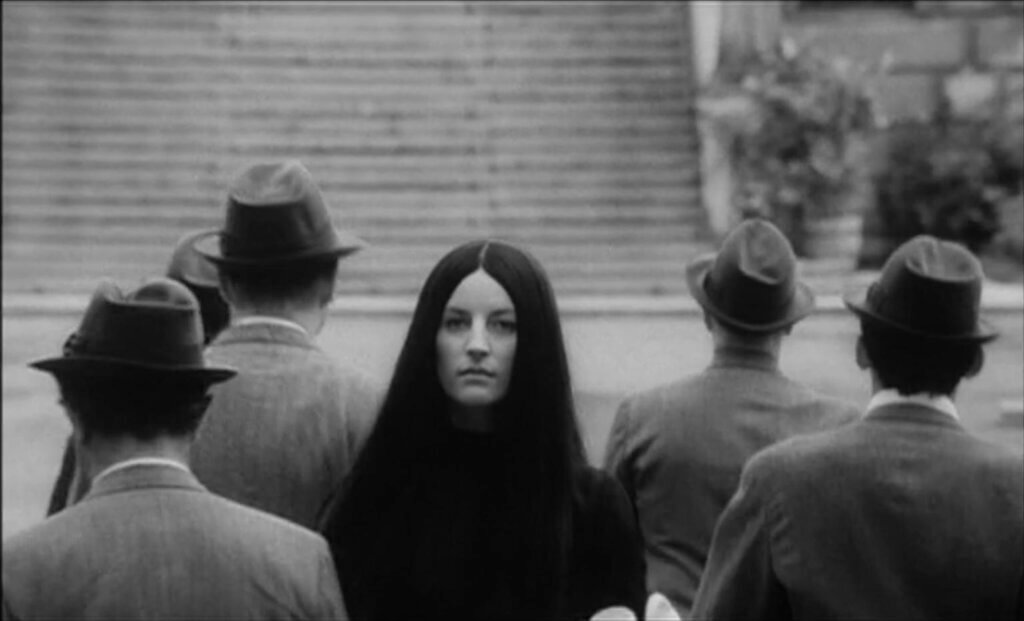
Set in Prague during the rise of Nazism, The Cremator follows Karel Kopfrkingl, an outwardly respectable crematorium employee who believes that cremation releases the soul from earthly suffering. His eccentric spiritual beliefs initially appear harmless. Once the Nazi authorities discover that these beliefs can be redirected toward their own political objectives, however, Kopfrkingl’s philosophy of liberation becomes a justification for murder.
Juraj Herz combines expressionist photography, grotesque comedy, and fragmented editing to depict the gradual occupation of an individual’s consciousness by totalitarian ideology. Kopfrkingl does not experience himself as evil. He believes he is assisting others by releasing them from bodily existence. His crimes emerge from a closed system of reasoning in which every objection is reinterpreted as further evidence of his benevolence.
The film can therefore be studied alongside existentialist accounts of bad faith and Hannah Arendt’s analysis of the banality of evil. Kopfrkingl avoids moral responsibility by turning himself into an instrument of what he considers a higher historical and spiritual necessity.
As the Criterion Collection notes, the film links the protagonist’s descent into madness with the seductions of fascist ideology. Its horror does not depend upon a conventional supernatural monster. Instead, it asks whether a human being becomes monstrous when ideology removes the distinction between compassion and extermination. This makes The Cremator an instructive challenge to Carroll’s monster-centered definition of horror.
9. Ganja & Hess (Bill Gunn, 1973)


After being stabbed with an ancient ceremonial object, anthropologist Hess Green develops an uncontrollable dependency on blood. He later begins a relationship with Ganja Meda, the widow of the man responsible for his transformation. What follows is not a conventional vampire story but a meditation on addiction, Christianity, Black identity, erotic dependency, and the desire to escape mortality.
Bill Gunn employs fragmented editing, ritual imagery, and an unstable narrative perspective. Vampirism is never reduced to a simple metaphor. It simultaneously represents compulsion, privilege, colonial inheritance, spiritual alienation, and a form of freedom that immediately becomes another kind of imprisonment.
Hess possesses wealth, education, and apparent independence. Yet his immortality makes genuine autonomy impossible. He is sovereign over ordinary human limitations but completely dependent upon the bodies of others. This contradiction gives the film its existential dimension. Freedom without mortality becomes an empty repetition of appetite.
The vampire also exemplifies Carroll’s idea of categorical impurity. Hess is alive and dead, powerful and dependent, cultivated and predatory. Nevertheless, the deepest horror comes from the possibility that his monstrous appetite is only an intensified version of ordinary human desire.
The film’s Christian imagery introduces a further philosophical problem. If salvation requires renouncing desire, does redemption restore Hess’s humanity or destroy the only identity still available to him? Ganja & Hess never provides an easy answer.
Readers interested in a deeper examination of the film should consider Christopher Sieving’s Pleading the Blood: Bill Gunn’s Ganja & Hess, the first full-length study of the film and one that draws on Gunn’s archived papers, screenplay drafts, storyboards, and interviews with its principal creative participants.
8. Begotten (E. Elias Merhige, 1989)

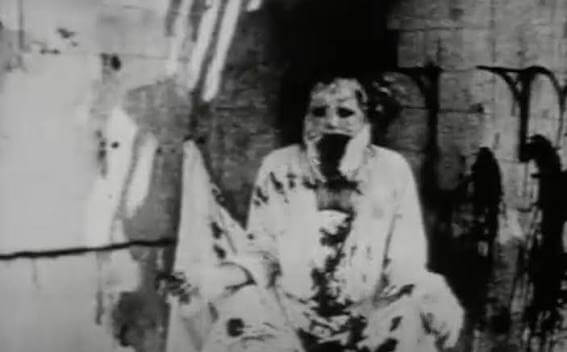
Begotten begins with a godlike figure destroying itself. Mother Earth emerges from the remains, and an earth-born creature is subsequently subjected to a cycle of ritualized violence. There is no conventional dialogue, and the film’s severely degraded black-and-white photography makes bodies, landscapes, and objects difficult to distinguish from one another.
The result resembles an archaeological fragment from a religion that never existed. Rather than explaining creation through divine intelligence or benevolent design, Begotten presents existence as the product of violence, decomposition, and involuntary reproduction.
The film invites comparison with philosophical pessimism. Its universe resembles Arthur Schopenhauer’s conception of existence as blind striving: life perpetuates itself without possessing any final purpose that could justify its suffering. It can also be interpreted through Nietzsche’s eternal recurrence, although the cycle depicted here offers none of the affirmative potential Nietzsche associates with accepting recurrence.
From Carroll’s perspective, the film is especially significant because impurity infects its entire world. There is no stable separation between god and matter, parent and offspring, organism and environment, or creation and destruction. The monster is not one isolated being. Monstrosity is an ontological condition.
The film may frustrate anyone looking for a decipherable allegory. In any case, that resistance is part of its philosophical value. Begotten confronts viewers with a cosmos that appears meaningful while persistently refusing to disclose what its meaning might be.
7. The Reflecting Skin (Philip Ridley, 1990)

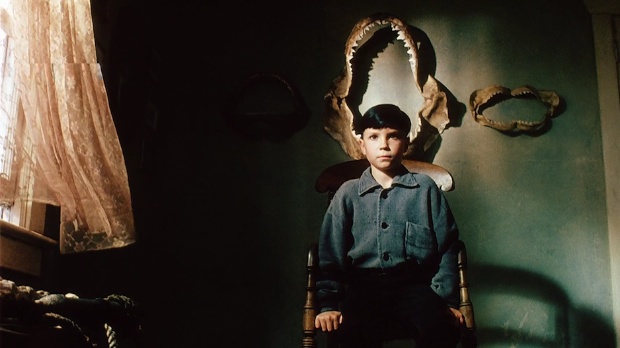
Set in a remote farming community, The Reflecting Skin is presented largely from the perspective of Seth, a young boy who interprets the disturbing events around him through fantasy. After hearing stories about vampires, Seth becomes convinced that a mysterious local widow is one of the undead.
The film initially appears to concern a supernatural threat. Gradually, however, it becomes apparent that Seth’s mythology is concealing forms of violence he cannot comprehend. The vampire offers him an explanation for adult sexuality, grief, cruelty, and death. It is a false explanation, but it may be the only explanation his limited experience permits him to construct.
This makes The Reflecting Skin a film about epistemology. Seth does not passively observe the world. He organizes it through concepts, stories, and assumptions inherited from others. The film demonstrates how perception is shaped by interpretive frameworks long before we become capable of evaluating them.
Its philosophical horror lies in the difference between innocence and ignorance. Innocence is ordinarily treated as a form of moral purity, yet Seth’s ignorance repeatedly contributes to the suffering of others. The inability to understand evil does not prevent someone from participating in it.
The film also complicates Carroll’s theory. If the supernatural monster exists only in Seth’s interpretation, is the audience experiencing art-horror or witnessing a categorical mistake? The imagined vampire may be impure, but the actual violence is frightening precisely because it is human.
6. The Addiction (Abel Ferrara, 1995)

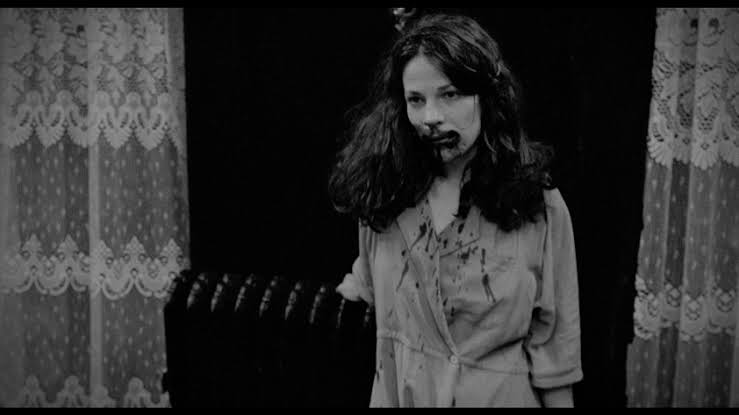
Kathleen Conklin is a philosophy graduate student in New York who is attacked by a vampire and develops an escalating hunger for blood. Her transformation unfolds alongside discussions of guilt, historical atrocity, free will, and the human capacity for evil.
The Addiction treats vampirism as both a physical dependency and a moral condition. Kathleen initially describes herself as the victim of forces outside her control. Hunger appears to excuse her actions. Yet every attempt to deny responsibility becomes another stage in her corruption.
The film draws upon existentialism, Christian theology, and Hegel’s master-slave dialectic. Kathleen attempts to become the dominant consciousness rather than the passive victim, but her apparent power remains dependent upon exploiting other people. Like the Hegelian master, she discovers that domination cannot provide genuine independence.
Images of historical atrocities broaden her personal addiction into a theory of collective evil. The vampire is not merely an abnormal individual invading an otherwise moral society. She is an intensified expression of violence already contained within human history.
The British Film Institute describes the film as an allegory concerned with addiction and the nature of evil. Its central question is whether evil enters the self from outside or reveals something that was present all along.
Carroll’s impure monster becomes ethically productive here. The vampire’s mixture of life and death corresponds to Kathleen’s mixture of agency and compulsion. She is responsible and not responsible, victim and aggressor, diseased and morally culpable.
5. Taxidermia (György Pálfi, 2006)

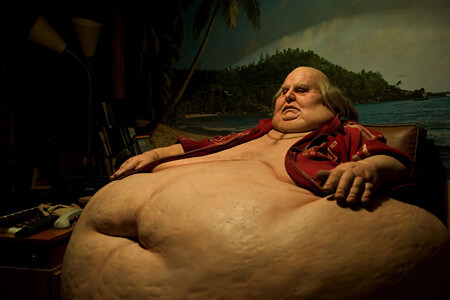
Taxidermia traces three generations of Hungarian men: a sexually frustrated military orderly, a competitive eater celebrated under Communism, and a taxidermist who preserves dead bodies while living in near-total isolation.
The film uses grotesque bodily excess to transform modern Hungarian history into a material history of appetite. Sexual desire, patriotic competition, consumption, excretion, obesity, and preservation become political as well as biological processes.
Each generation is disciplined by a different social order. The military body is subjected to authority and humiliation. The Communist body becomes an instrument of state competition. The final body is turned into an aesthetic object and commodity. History does not simply occur around these characters; it reorganizes their flesh.
The film can be approached through Marxist theories of alienation and commodity fetishism. The competitive eater’s body has value only as a productive spectacle, while the taxidermist attempts to defeat mortality by transforming organic life into a permanent object. In doing so, he becomes both artist and raw material.
It also invites comparison with Michel Foucault’s account of disciplinary power. Political institutions do not merely forbid certain actions. They manufacture useful bodies, regulate appetites, and define which forms of physical existence are socially intelligible.
MUBI’s synopsis of the film describes the three generations in relation to wartime frustration, Communist-era competition, and taxidermy. These episodes are connected by abjection. The substances civilization tries to conceal continually return, exposing political history as a history written upon the body.
4. A Field in England (Ben Wheatley, 2013)

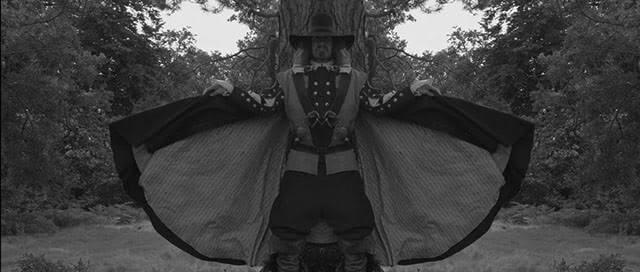
During the English Civil War, a group of deserters enters a seemingly empty field. They fall under the control of an alchemist who forces them to search for buried treasure. After consuming mushrooms, the men become increasingly unable to distinguish coercion from choice, hallucination from revelation, or historical reality from supernatural repetition.
The field operates as a closed philosophical experiment. Ordinary political institutions have temporarily disappeared, yet freedom does not follow. One structure of domination is merely replaced by another.
A Field in England can be read alongside Thomas Hobbes. Removed from civil authority, the deserters do not discover an authentic, peaceful condition. They enter a world organized by fear, hunger, violence, and competition. The alchemist establishes power through superior knowledge; or, at least, through his ability to convince the others that he possesses it.
This creates an epistemological problem. His authority depends upon controlling what counts as reality. The men cannot determine whether he commands supernatural forces or is simply manipulating their terror and intoxication. Power belongs to the person capable of imposing an interpretation upon ambiguous events.
The BFI’s discussion of the film emphasizes its Civil War setting, alchemical imagery, and hallucinatory descent. Its horror arises from the collapse of causal explanation. The field may be cursed, psychologically transformative, or entirely indifferent. Each possibility is disturbing for a different reason.
3. Evolution (Lucile Hadžihalilović, 2015)

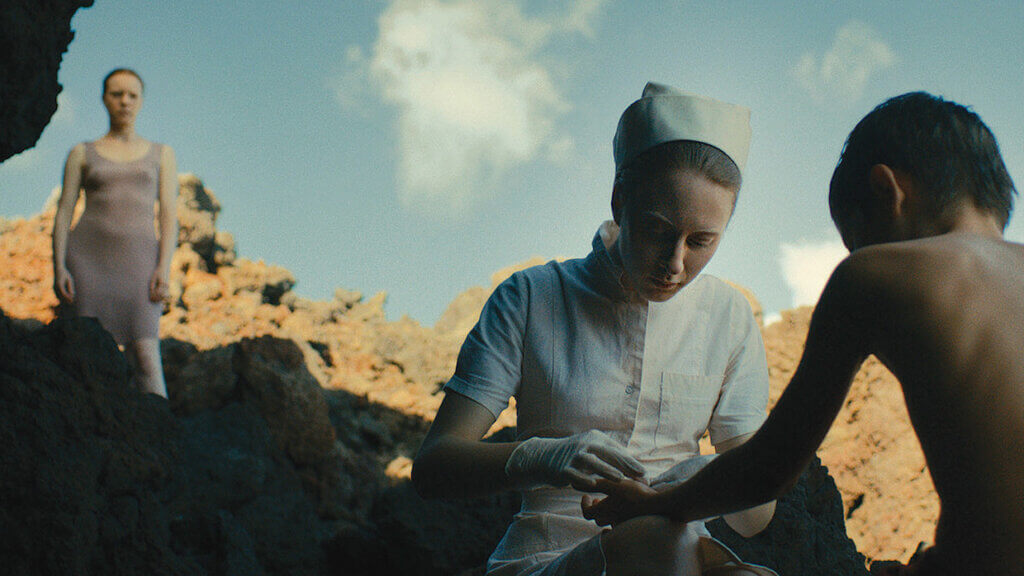
On an isolated island populated only by women and young boys, Nicolas becomes suspicious of the medical procedures performed at the local hospital. The adults insist that these procedures are necessary, but their explanations never correspond with what Nicolas observes.
Evolution is a film about bodies governed by institutions. Medicine, reproduction, education, and maternal care merge into a single system of surveillance. The boys are told that their treatment is natural, even as every aspect of the process suggests that nature itself has been reorganized.
The film is particularly suited to Michel Foucault’s concept of biopolitics: the use of institutional knowledge to manage bodies, reproduction, health, and populations. Medical authority is frightening because it does not present itself as violence, but rather as care.
The film also develops questions about bodily autonomy and gender. Pregnancy, sexual development, and motherhood are detached from their familiar biological categories. Male and female, parent and child, human and aquatic life begin to overlap. According to Carroll’s theory, these category violations are precisely what make the creatures and procedures horrifying.
The International Film Festival Rotterdam describes the film as an esoteric story of growth centered on an island, a hospital, and mysterious operations. Yet the hospital may be more frightening than any individual creature. It represents an entire organization of knowledge in which Nicolas’s body belongs to others before it belongs to him.
2. The Untamed (Amat Escalante, 2016)


In a provincial Mexican community, a troubled family becomes connected to an extraterrestrial creature hidden in a secluded building. The creature offers extraordinary sexual pleasure, but contact with it can also result in injury or death.
Amat Escalante combines social realism with science fiction and body horror. The human relationships surrounding the creature are marked by domestic violence, machismo, repression, homophobia, and frustrated desire. The alien does not introduce dysfunction into a healthy community. Instead, it gives physical form to desires the community is already unable to acknowledge.
The Untamed lends itself to a Lacanian reading. The creature resembles jouissance: an overwhelming enjoyment that exceeds ordinary pleasure and threatens the stability of the subject pursuing it. The characters do not simply want satisfaction. They want an impossible experience capable of breaking through the limitations imposed by social identity.
It can also be approached through queer theory. Publicly enforced heterosexual respectability exists alongside concealed desires, suggesting that the supposedly natural social order requires continual acts of denial and aggression. The alien is treated as unnatural, yet it exposes the violence supporting what society calls normal.
The BFI describes The Untamed as a film about “domestic abuse, addiction, repression and homophobia” that combines horror and science fiction with social realism.
The creature is also an unusually clear example of Carrollian impurity. It is alien yet intimate, pleasurable yet lethal, biological yet almost formless. It does not merely threaten the characters’ bodies. It destroys the categories through which they understand their desires.
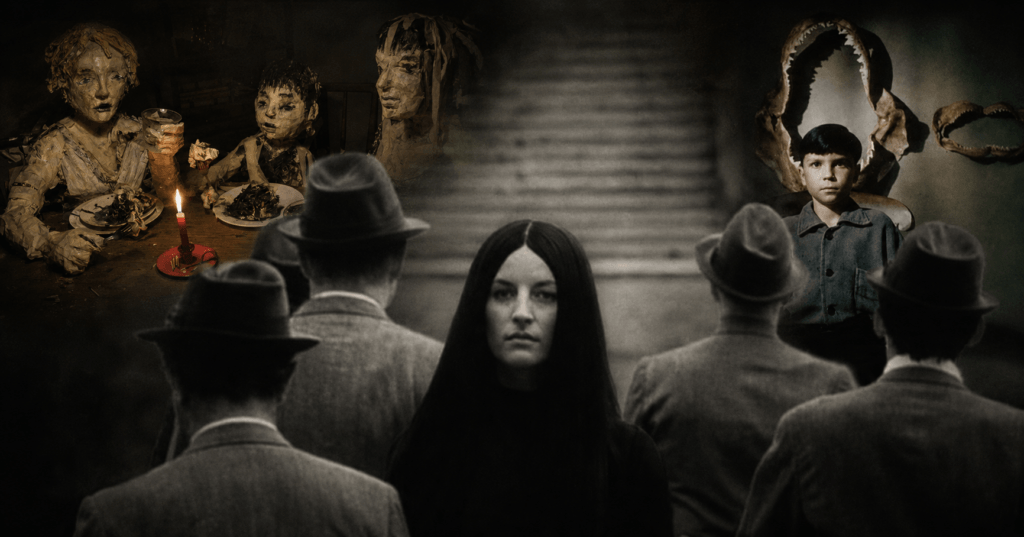
1. The Wolf House (Cristóbal León and Joaquín Cociña, 2018)

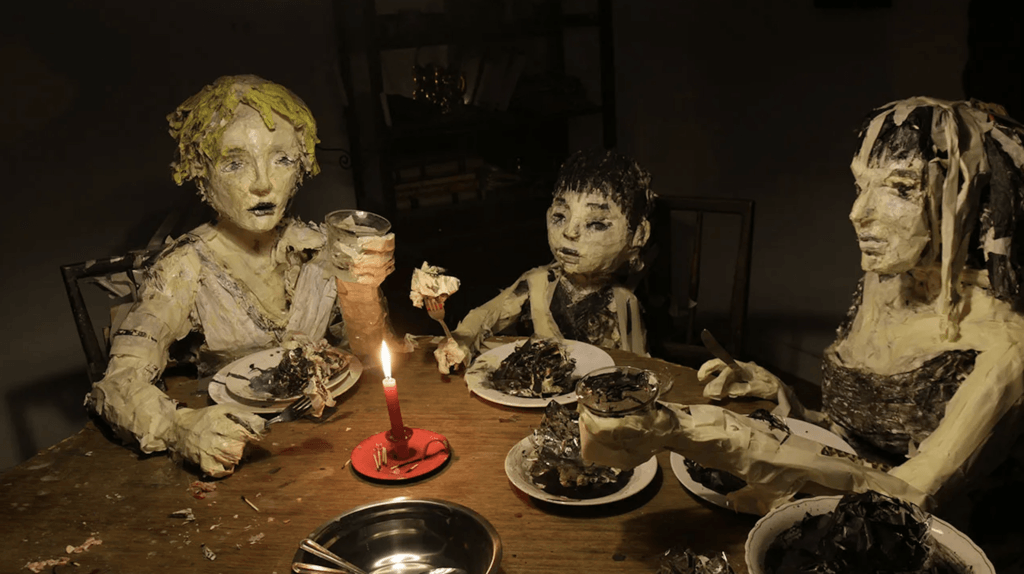
María escapes from a colony of German religious fanatics in Chile and seeks refuge in an isolated house. Inside, two pigs gradually assume human characteristics while the walls, furniture, and bodies surrounding María continually dissolve and reform.
Inspired by the history of Colonia Dignidad, The Wolf House presents itself as an animated fairy tale produced by the colony’s leadership. This framing device transforms the film into a study of propaganda. María’s escape is retold from the perspective of the institution she has rejected, allowing liberation to be reclassified as disobedience, selfishness, and moral corruption.
The film’s stop-motion technique is philosophically inseparable from its subject. Nothing maintains a stable form. Figures emerge from walls, painted bodies become three-dimensional, and apparently solid objects melt into new identities. Carroll’s categorical impurity becomes the governing principle of the film’s visual world. The distinctions between human and animal, subject and environment, living and inanimate matter cannot be preserved.
The house can be interpreted as an ideological apparatus. Although María has physically escaped the colony, its language and values continue to organize her imagination. Authority no longer needs to stand over her because it has been internalized.
There is also a Platonic dimension to the film. María struggles within a world of manufactured images whose creators claim to explain reality. However, unlike the prisoner leaving Plato’s cave, she cannot simply step outside the representation. Every possible escape has already been incorporated into the colony’s story.
According to the L’Alternativa Film Festival synopsis, the house responds to María’s emotions and gradually becomes a nightmarish world. The ultimate monster is therefore not only the wolf, the house, or the religious colony. It is an ideology capable of entering the imagination and speaking with the victim’s own voice.
Runners-Up and Honorable Mentions
- The White Reindeer (Erik Blomberg, 1952): A Finnish folk-horror film about transformation, female desire, marriage, and the social construction of monstrosity.
- Kuroneko (Kaneto Shindō, 1968): A ghost story concerned with revenge, Buddhist ethics, sexual violence, and the conflict between personal obligation and political authority.
- Valerie and Her Week of Wonders (Jaromil Jireš, 1970): A surreal examination of adolescence, religious authority, sexual identity, and the instability of innocence.
- The Hourglass Sanatorium (Wojciech Jerzy Has, 1973): A dreamlike meditation on memory, death, Jewish identity, and the possibility that subjective time can resist historical destruction.
- Alucarda (Juan López Moctezuma, 1977): A study of religious repression, possession, bodily autonomy, and the tendency of institutions to manufacture the deviance they claim to eliminate.
- Tetsuo: The Iron Man (Shinya Tsukamoto, 1989): An industrial nightmare about technology, sexuality, urban alienation, and the disappearance of the boundary between organism and machine.
- Institute Benjamenta (Stephen and Timothy Quay, 1995): An enigmatic story of institutional discipline, hierarchy, submission, and the existential absurdity of training people to become servants.
- Trouble Every Day (Claire Denis, 2001): A restrained but disturbing examination of desire, cannibalism, scientific responsibility, and the ethical consequences of treating another person as an object of appetite.
- November (Rainer Sarnet, 2017): An Estonian folk-horror film combining animism, Christianity, material scarcity, unrequited desire, and the commodification of the soul.
- In Fabric (Peter Strickland, 2018): A surreal critique of consumerism in which a cursed dress connects commodity fetishism, labor, advertising, desire, and bodily destruction.
Conclusion
Art horror is particularly useful for philosophy students because it gives abstract concepts a physical form. Alienation becomes a body that no longer belongs to itself. Ideology becomes a house that changes shape around its inhabitants. Repression becomes a creature offering unbearable pleasure, while political history appears as hunger, illness, and mutilated flesh.
Noël Carroll’s theory helps explain why such images disturb us. Horror monsters are threatening because they violate the categories upon which ordinary understanding depends. However, the films on this list also demonstrate that monstrosity is not confined to supernatural creatures. A political institution, medical system, ideology, or structure of desire can become monstrous when it makes stable identity, and moral responsibility, impossible.
Works Cited
Carroll, Noël. “The Nature of Horror.” The Journal of Aesthetics and Art Criticism, vol. 46, no. 1, 1987, pp. 51–59.
Carroll, Noël. The Philosophy of Horror, or Paradoxes of the Heart. Routledge, 1990.
Douglas, Mary. Purity and Danger: An Analysis of Concepts of Pollution and Taboo. Routledge, 1966.
Hanscomb, Stuart. “Existentialism and Art-Horror.” Sartre Studies International, vol. 16, no. 1, 2010, pp. 1–23.
Kristeva, Julia. Powers of Horror: An Essay on Abjection. Translated by Leon S. Roudiez, Columbia University Press, 1982.