



Originally published July 13, 2020. Substantially updated August 2026.
Marxism has had a long relationship with cinema, stretching from the Soviet Montage movement of the 1920s to contemporary films about labor, inequality, colonialism, and global capitalism. Yet a film does not become Marxist simply because it includes poor characters, criticizes wealthy people, or depicts an unequal society.
Marxist films examine how economic systems shape human relationships. They may focus on workers and owners, reveal forms of exploitation that ordinarily remain hidden, or challenge the individualism that dominates much of popular cinema. Some adopt an explicitly revolutionary position. Others are less direct but still invite a persuasive Marxist interpretation.
What Makes a Film Marxist?
Marxism originated primarily in the work of Karl Marx and Friedrich Engels. In The Communist Manifesto, Marx and Engels describe the history of class society as a history of conflict between groups with opposing economic interests.
Under capitalism, the most important conflict is between the bourgeoisie, who own capital and the means of production, and the proletariat, who must sell their labor. This relationship allows owners to accumulate wealth from the value produced by workers.
Marx’s critique of capitalism goes beyond the existence of wealthy and poor people. It concerns ownership, labor, exploitation, alienation, ideology, and the conversion of human activity into commodities. Capitalism influences not only where people work or how much money they have, but also how they understand themselves and one another.
This is particularly relevant to cinema. Films can reproduce the values of capitalism by celebrating competition, private wealth, individual success, and the exceptional hero. They can also expose or challenge those values by placing individual characters within larger economic and social systems.
The Stanford Encyclopedia of Philosophy’s overview of Marx provides a more extensive introduction to Marx’s analysis of capitalism, class, exploitation, and ideology.
Marxist Film Theory and Aesthetics
Marxist film theory is closely associated with Sergei Eisenstein and the Soviet filmmakers of the silent era. Eisenstein believed that editing could create meaning by placing images in conflict with one another. Rather than allowing one shot to flow invisibly into the next, dialectical montage encourages viewers to recognize the collision between competing ideas.
In Battleship Potemkin, for example, images of disciplined military violence are placed against images of frightened civilians and collective rebellion. The individual shots provide information, but their juxtaposition produces a broader argument about oppression and resistance. The British Film Institute’s introduction to Eisenstein explains how he used montage to construct political meaning.
Soviet filmmakers also challenged the individual protagonist associated with Classical Hollywood Cinema. Instead of treating history as the achievement of an exceptional hero, films such as Battleship Potemkin and Strike give narrative power to workers, sailors, and other collective groups.
Marxist cinema is not limited to Soviet Montage. Italian Neorealism examined the material conditions of working-class life. Anti-colonial filmmakers connected imperial power to economic exploitation. Jean-Luc Godard used fragmented narratives and Brechtian techniques to interrupt passive viewing, while contemporary filmmakers have examined domestic labor, consumer culture, technology, debt, and global production.
For this reason, it is helpful to distinguish between an explicitly Marxist film and a film that supports a Marxist interpretation. Battleship Potemkin openly promotes revolutionary solidarity. A film such as Fight Club, by comparison, provides a powerful critique of consumer capitalism but offers a deeply compromised response to it.
How These Films Were Selected
For this list, I prioritized films that do at least one of the following:
- Foreground labor, ownership, exploitation, or class relations.
- Develop or complicate class consciousness.
- Use narrative or cinematic form to challenge capitalist ideology and individualism.
Not every selection satisfies these criteria in precisely the same way. Some are explicitly revolutionary, while others expose contradictions without offering a clear political solution. The list is arranged chronologically rather than ranked, with the aim of showing how Marxist ideas have appeared across different countries, periods, genres, and cinematic movements.
12 Marxist Films for Philosophy Students
The following films approach Marxism through different combinations of narrative, style, and political argument. Together, they show how cinema can examine class struggle, labor, colonialism, ownership, ideology, and collective action.
1. Battleship Potemkin (Sergei Eisenstein, 1925)

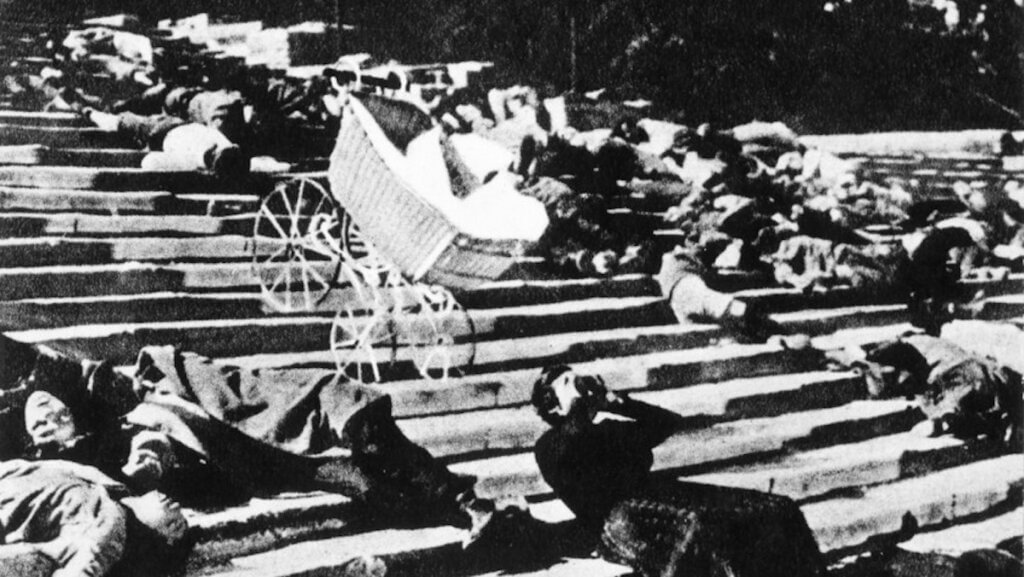
Battleship Potemkin remains one of the most influential examples of Marxist cinema. Set during the Russian Revolution of 1905, it follows sailors who mutiny against their officers after enduring brutal conditions aboard the battleship Potemkin.
Eisenstein does not present the rebellion as the achievement of a single hero. The sailors act collectively, and their revolt spreads when the people of Odessa gather around the body of a dead crew member. Personal suffering becomes the basis for class consciousness and political solidarity.
The Odessa Steps sequence turns editing into an ideological argument. The uniform movement of the Tsarist soldiers contrasts with the panic and vulnerability of the civilians below them. Individual victims appear throughout the sequence, but the violence is directed against the population as a whole.
The film is unapologetically propagandistic. Yet its importance extends beyond the political system that produced it. Eisenstein demonstrates how editing can make structures of power visible and transform spectatorship into an explicitly political experience.
2. Metropolis (Fritz Lang, 1927)

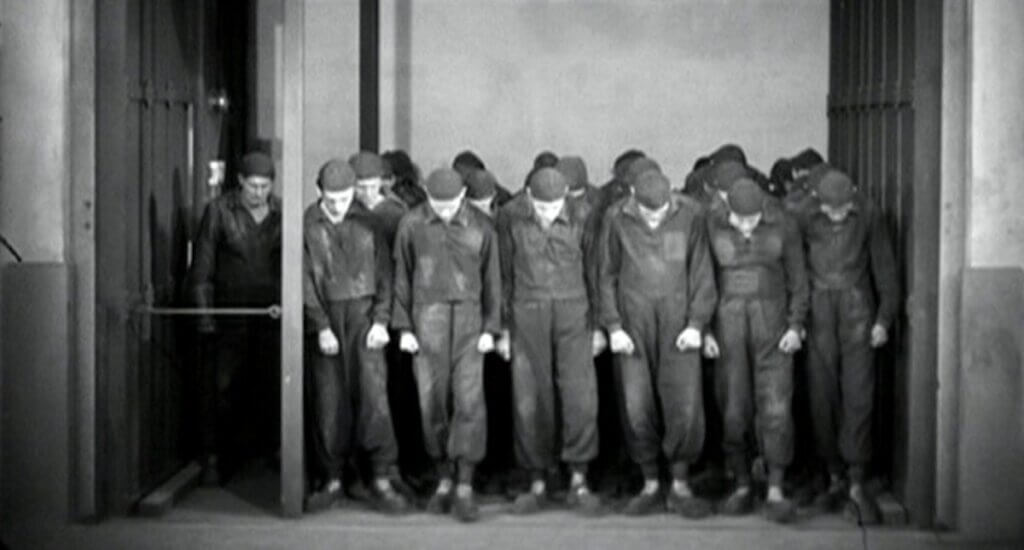
Fritz Lang’s Metropolis presents class division through the physical design of its city. Wealthy residents enjoy gardens, athletic facilities, and towering buildings above ground, while workers live below the city and operate the machinery that sustains it.
The machines appear almost religious in their demand for sacrifice. When Freder witnesses an industrial accident, he imagines the machinery as Moloch, an ancient deity consuming workers as offerings. Their labor has ceased to serve human needs. Instead, human beings exist to sustain production.
This makes Metropolis highly compatible with a Marxist interpretation, but its politics are more complicated than its imagery initially suggests. The film recognizes exploitation and class antagonism, yet its famous conclusion calls for reconciliation between workers and owners through a mediator. It does not advocate worker control over production or the abolition of the system.
Metropolis is therefore valuable partly because of its contradictions. It visualizes class inequality with extraordinary force while retreating from the revolutionary implications of its own social criticism.
3. Rome, Open City (Roberto Rossellini, 1945)

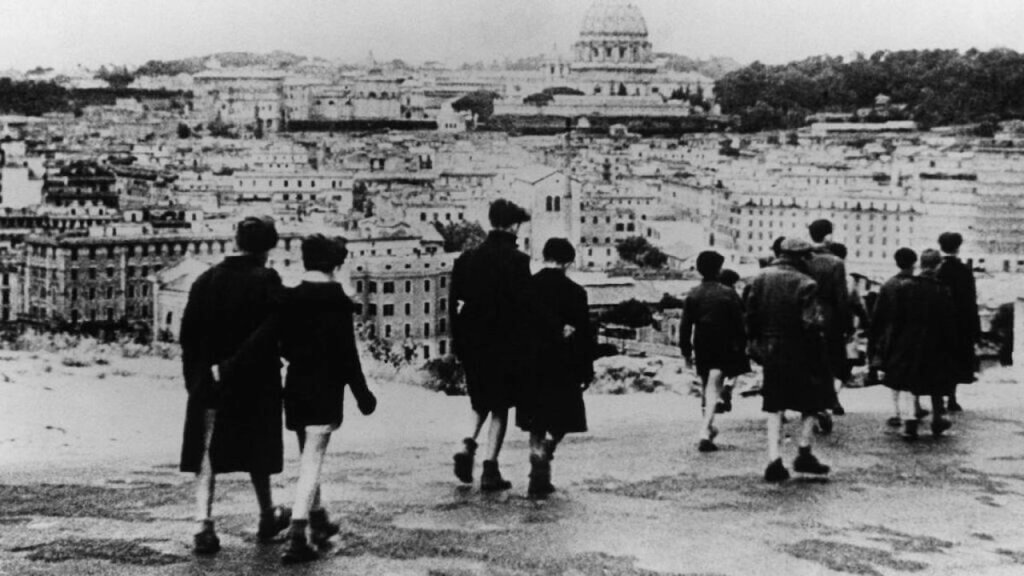
Roberto Rossellini’s Rome, Open City emerged from the devastation of the Second World War and became a foundational work of Italian Neorealism. It follows members of the Italian Resistance during the Nazi occupation of Rome, including Communist organizer Giorgio Manfredi and Catholic priest Don Pietro Pellegrini.
The film is not exclusively Marxist. Its Resistance includes Communists, Catholics, workers, women, and children whose political and religious differences become secondary to their opposition to fascism. That coalition is central to the film’s moral and political force.
Rossellini also turns material scarcity into part of the film’s form. Damaged locations, limited resources, and an uneven mixture of professional and nonprofessional performers contribute to a world in which political struggle cannot be separated from hunger, housing, labor, and survival.
Rather than reducing fascism to the cruelty of a few villains, Rome, Open City shows how authoritarian power enters homes, workplaces, churches, and intimate relationships. Resistance becomes a collective obligation sustained by people whose individual actions may appear small but acquire meaning through solidarity.
4. La Terra Trema (Luchino Visconti. 1948)
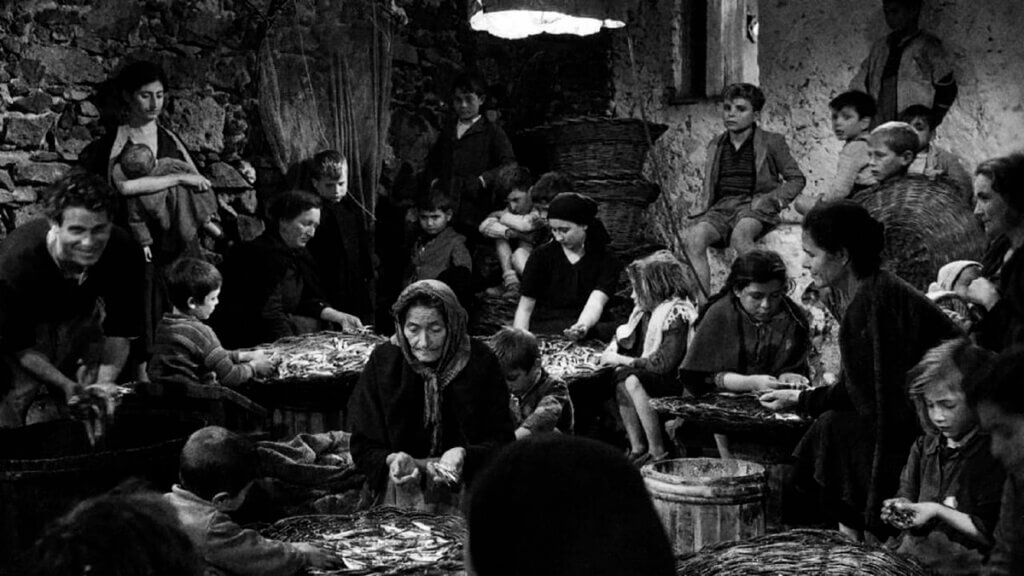
Luchino Visconti’s La Terra Trema follows a family of Sicilian fishermen who attempt to escape exploitation by the wholesalers who control the local fishing economy. Instead of selling their labor and catch under unfavorable conditions, the family purchases a boat and tries to work independently.
Their plan fails after a storm destroys the boat and leaves them with debts they cannot repay. The tragedy is not simply the result of bad luck or poor individual judgment. The family enters a market whose terms have already been established by people with greater wealth, security, and control.
Visconti filmed in the Sicilian village of Aci Trezza and used local residents rather than professional actors. The approach connects Italian Neorealism to a Marxist interest in material conditions, working-class communities, and forms of labor usually excluded from commercial cinema.
The film also complicates the fantasy that individual entrepreneurship offers an easy escape from exploitation. The family may temporarily possess its own means of production, but ownership alone cannot protect it from debt, market power, or economic isolation.
5. Salt of the Earth (Herbert J. Biberman, 1954)

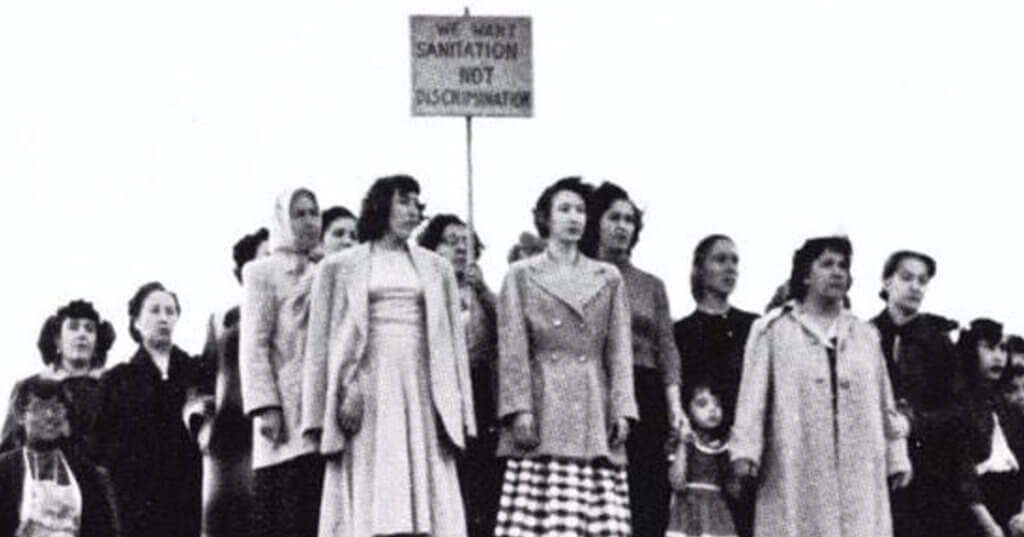
Salt of the Earth dramatizes a strike by Mexican American zinc miners in New Mexico. Many of the people involved in the production had connections to organized labor, while director Herbert J. Biberman, screenwriter Michael Wilson, and producer Paul Jarrico had been targeted by the Hollywood blacklist.
The film initially concentrates on the conflict between workers and the company. However, it gradually reveals another struggle within the workers’ own homes. The miners demand equality from their employers while resisting the efforts of their wives to challenge domestic inequality.
When a court order prevents the men from maintaining the picket line, the women take their places. Their participation expands the meaning of labor and demonstrates that class solidarity cannot function while gender hierarchy remains unchallenged.
This intersection of class, race, and gender makes Salt of the Earth more sophisticated than a straightforward piece of pro-union propaganda. The film argues that exploitation operates through multiple social relationships, including some that oppressed workers may reproduce themselves.
The film was selected for the National Film Registry, and the Library of Congress describes it as a pro-union work shaped by discrimination against minorities and women.
6. The Battle of Algiers (Gillo Pontecorvo, 1966)


Gillo Pontecorvo’s The Battle of Algiers reconstructs the struggle between the Algerian National Liberation Front and French colonial authorities during the Algerian War. Its grainy black-and-white cinematography, location shooting, and use of nonprofessional performers give the film the appearance of documentary footage.
Pontecorvo pays close attention to the strategies used by both the FLN and the French military, but the film should not be described as politically neutral. Its perspective remains fundamentally anti-colonial. The apparent balance makes the mechanisms of occupation and resistance more visible rather than placing them on equal moral ground.
Colonialism is presented as an economic and spatial system as well as a military one. French residents occupy the modern European quarter, while Algerians live under surveillance and restriction in the Casbah. Movement between these spaces is controlled by checkpoints, policing, and racial classification.
The film also refuses to reduce liberation to one charismatic protagonist. Individuals are arrested or killed, but the resistance continues because it belongs to a population rather than a single leader.
7. Weekend (Jean-Luc Godard, 1967)

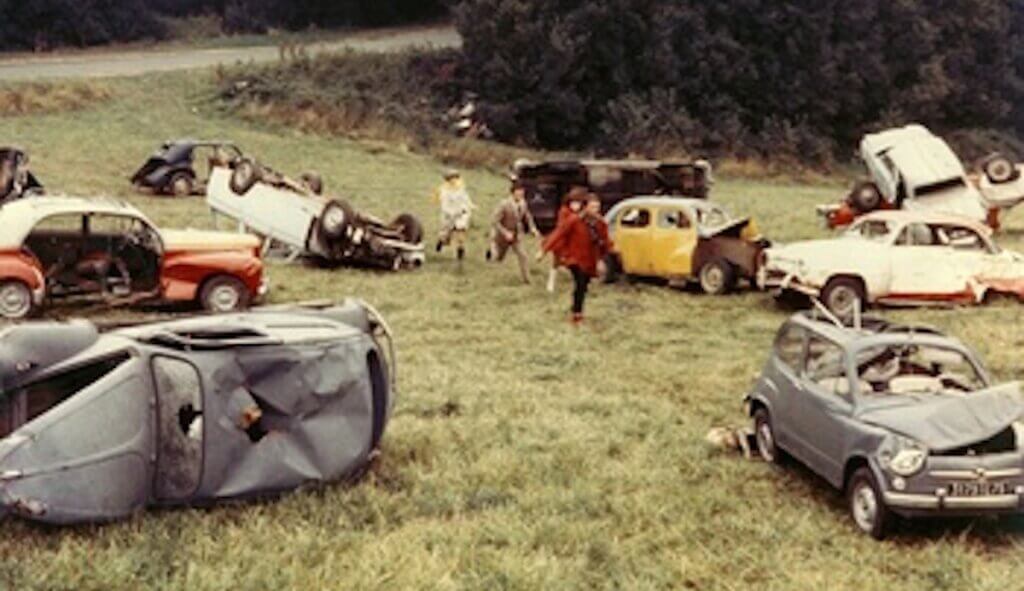
Jean-Luc Godard incorporated Marxist theory into many of his films, but Weekend attacks bourgeois culture through both narrative and form. Roland and Corinne travel across France while plotting to secure an inheritance, encountering traffic jams, political speeches, violence, literary figures, and revolutionaries along the way.
The couple treats nearly everything as property. Their marriage, family relationships, sexuality, and willingness to commit murder are shaped by possession and personal advantage. Other people are valuable only when they can provide money, access, or convenience.
Godard refuses to package this criticism inside a conventional narrative. Extended tracking shots, direct addresses, interruptions, title cards, and abrupt tonal changes prevent the audience from settling into passive identification with the protagonists. The film continually reminds us that we are watching a constructed object.
The cannibalistic revolutionaries who appear near the conclusion do not provide a coherent political alternative. Instead, Weekend pushes bourgeois consumption toward grotesque absurdity until people themselves become things to consume.
8. Fight Club (David Fincher, 1999)

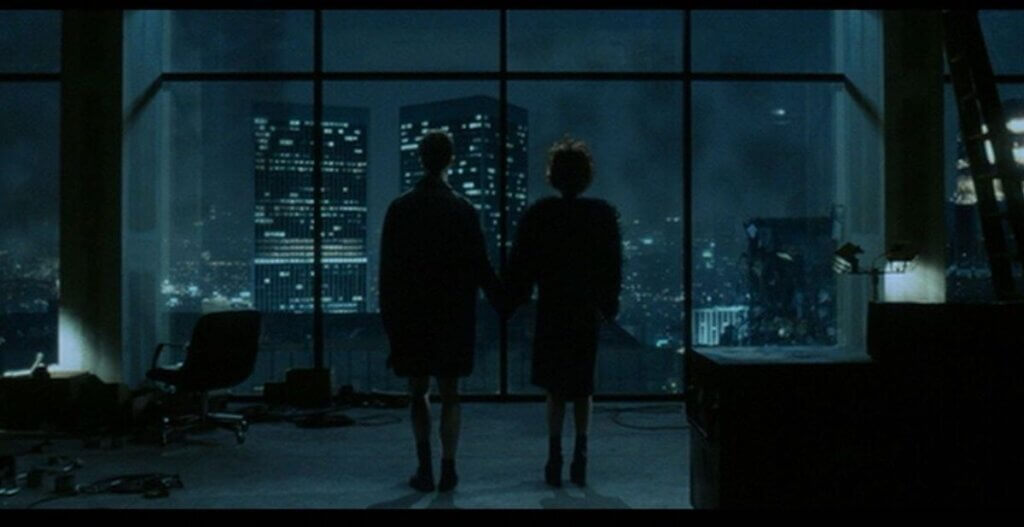
Fight Club begins with alienation. Its unnamed narrator performs meaningless corporate work, travels between identical offices, and attempts to construct an identity through furniture, clothing, and other consumer goods. His possessions promise individuality but leave him living a life assembled from mass-produced commodities.
Tyler Durden appears to offer an escape. Fight club provides physical experience, male companionship, and a rejection of professional status. Project Mayhem later directs this resentment toward financial institutions and the system of debt.
Yet the film does not present Tyler’s program as a convincing Marxist solution. Project Mayhem replaces consumer conformity with militarized conformity. Its members surrender their names, repeat slogans, obey a charismatic leader, and treat violence as a substitute for political organization.
This contradiction makes Fight Club useful for Marxist analysis without making it an unequivocally Marxist film. It identifies genuine forms of alienation under capitalism, but its rebellion becomes authoritarian and intensely individualistic. The narrator recognizes that the existing system has failed him, yet the alternative he creates reproduces many of the same structures of domination.
9. House of Pleasures (Bertrand Bonello, 2011)

Bertrand Bonello’s House of Pleasures, also released as House of Tolerance and L’Apollonide: Souvenirs de la maison close, examines labor inside a luxurious Parisian brothel at the beginning of the twentieth century.
The women appear to live within an environment of comfort and abundance, but nearly everything around them belongs to someone else. Their clothing, rooms, food, and continued employment generate debts that make leaving increasingly difficult. Even intimacy becomes labor performed for clients with the money to purchase it.
Bonello avoids organizing the film around a single protagonist. Individual women receive attention, but the repetition of work, preparation, waiting, and abuse gradually creates a collective portrait. Their bodies possess enormous commercial value while their lives remain economically precarious.
The film also exposes the dependence of bourgeois luxury on concealed labor. The brothel’s ornate surfaces and elaborate rituals disguise the system of debt and commodification sustaining them. Beauty does not soften exploitation. It helps make exploitation marketable.
10. Parasite (Bong Joon-Ho, 2019)


Bong Joon Ho’s Parasite examines class through labor, architecture, smell, and physical space. The struggling Kim family gradually gains employment in the wealthy Park household by presenting themselves as unrelated tutors, drivers, and domestic workers.
Their deception gives them temporary access to wealth but no control over it. The Parks’ home depends on the labor of people who cook, clean, drive, teach, and maintain the illusion that the family’s comfort requires little effort. The workers remain visible when needed and disposable when they become inconvenient.
The house translates class hierarchy into physical space. The Parks live above the city behind walls and landscaped gardens. The Kims occupy a semi-basement where they can see the street but cannot escape its sewage, fumigation, or flooding. Beneath both families is another hidden level of poverty.
Significantly, the working-class characters do not unite against the wealthy family. They compete for the same limited positions and direct much of their violence toward one another. Parasite presents class consciousness as something capitalism repeatedly prevents, turning workers into rivals while leaving the underlying structure intact.
11. Neptune Frost (Saul Williams and Anisia Uzeyman, 2021)


Saul Williams and Anisia Uzeyman’s Neptune Frost connects digital technology to the physical labor and natural resources required to produce it. Set in an Afrofuturist version of Burundi, the film follows escaped coltan miner Matalusa and Neptune, an intersex runaway whose presence disrupts the technological and political systems surrounding them.
Matalusa joins a community of hackers formed by workers escaping exploitation. Their resistance exposes a contradiction frequently concealed by consumer technology: devices associated with freedom and connectivity depend on minerals extracted through dangerous labor and unequal global relationships.
The hackers transform technology from an instrument of surveillance and extraction into a means of collective resistance. Their rebellion is anti-capitalist, anti-colonial, and inseparable from the film’s rejection of fixed gender categories.
Its form is equally important. Neptune Frost combines musical performance, science fiction, poetry, political theory, and nonlinear imagery. Rather than adopting the familiar structure of an individual hero overcoming adversity, it creates a collective world in which liberation depends on new relationships between workers, bodies, resources, and machines.
12. I Love Boosters (Boots Riley, 2026)

Boots Riley’s I Love Boosters follows Corvette and the Velvet Gang, a group of professional shoplifters who target wealthy fashion designer Christie Smith after she appropriates one of Corvette’s designs. What begins as an attempt to steal Smith’s inventory develops into a broader movement involving retail and factory workers.
The film questions why some forms of appropriation are treated as legitimate business while others are criminalized as theft. Christie can profit from other people’s designs and labor because property law recognizes her authority. The Velvet Gang’s actions challenge that authority by taking commodities outside the system that assigns and protects their exchange value.
Riley also connects luxury consumption in the United States to labor elsewhere in the world. Fashion does not materialize inside an elegant store. It depends on designers, retail employees, factory workers, transportation networks, and other forms of labor hidden behind the finished product.
Like Sorry to Bother You, the film uses absurdism rather than realism to make capitalism appear strange. Its collective protagonists, international labor politics, and rejection of conventional narrative logic make it one of the most explicitly Marxist films on this list.
Honorable Mentions
A comprehensive history of Marxist cinema would extend far beyond twelve films. The following selections approach labor, capitalism, colonialism, and class consciousness from several additional directions.
Marxist Horror and Class Allegory
George A. Romero’s Night of the Living Dead (1968) and Dawn of the Dead (1978) connect social collapse to race, authority, consumerism, and collective survival. Both also appear in my list of philosophical zombie films.
Galder Gaztelu-Urrutia’s The Platform (2019) reduces class hierarchy to a vertical prison in which food descends from privileged inmates to those below them. Its allegory is blunt, but its central question remains effective: can individual restraint solve a problem created by the structure itself?
Godard and Revolutionary Cinema
Jean-Luc Godard and Jean-Pierre Gorin’s Tout va bien (1972) examines labor conflict, media, consumer culture, and the position of intellectuals after the political upheavals of May 1968.
Godard’s later Film Socialisme (2010) offers a much more fragmented consideration of history, property, Europe, and political memory.
Labor and Class Consciousness
Mario Monicelli’s The Organizer (1963) follows textile workers attempting to organize a strike under dangerous working conditions.
Elio Petri’s The Working Class Goes to Heaven (1971) examines factory labor, productivity, alienation, and the difficulty of building solidarity among workers with different political interests.
These films were also suggested by readers of the original version of this article, whose comments helped demonstrate how many important traditions and national cinemas could be included.
Marxism in American Cinema
Martin Ritt’s The Front (1976) examines the Hollywood blacklist and the repression of artists accused of Communist sympathies.
Boots Riley’s Sorry to Bother You (2018) turns corporate labor, racial performance, union organizing, and the commodification of workers into a surreal comedy that becomes increasingly difficult to separate from horror.
Frequently Asked Questions
What makes a film Marxist?
A Marxist film examines how ownership, labor, class, and material conditions shape human relationships. It may promote collective action, reveal forms of exploitation, challenge capitalist ideology, or use cinematic form to resist conventional individualism. However, films can also support a Marxist interpretation without explicitly endorsing Marxism.
What is Marxist film theory?
Marxist film theory studies the relationship between cinema, ideology, class, and economic power. It asks how films represent workers and owners, whose interests their stories serve, and whether their visual and narrative structures reinforce or challenge the dominant social order. Soviet Montage, Italian Neorealism, anti-colonial cinema, and the work of filmmakers such as Jean-Luc Godard have all contributed to this tradition.
Is Parasite a Marxist film?
Parasite supports a strong Marxist interpretation because it focuses on labor, inequality, class hierarchy, and competition among workers. However, it does not offer an explicitly Marxist program or present class solidarity as a solution. Its pessimism comes partly from showing how effectively the existing system prevents that solidarity from developing.
Conclusion
These twelve films do not present a single definition of Marxist cinema. Some openly support revolutionary politics, while others reveal the contradictions of capitalism without proposing a clear alternative. Together, they demonstrate how films can make labor, ownership, exploitation, ideology, and class conflict visible.
This is still far from a comprehensive list. If there is another Marxist film that deserves to be included, feel free to share it in the comments.
Sources and Further Reading
- Karl Marx and Friedrich Engels, The Communist Manifesto
- Karl Marx, Stanford Encyclopedia of Philosophy
- Where to Begin with Sergei Eisenstein, British Film Institute
- Salt of the Earth, Library of Congress
- House of Pleasures, The Criterion Collection
- Neptune Frost, Kino Lorber
- Boots Riley on I Love Boosters and Capitalism, The Guardian