


Originally published June 3, 2017. Substantially updated August 25, 2026.
What Is an Existential Film?
The term “existential film” is often applied loosely to any story about loneliness, death, or the apparent meaninglessness of life. But an existential film does more than create a mood of despair. It places a person in a world without guaranteed answers and asks what that person will make of their freedom.
This list uses Jean-Paul Sartre as its main philosophical reference point. Sartre’s famous formula, “existence precedes essence,” means that people are not born with a finished identity or predetermined purpose. We define ourselves through our actions and choices.
That does not mean people are free from physical, social, or economic limitations. Existential freedom is always situated. We make choices within circumstances we did not necessarily choose, but we remain responsible for what we do with those circumstances. Attempts to deny our freedom or hide behind a predetermined identity become what Sartre calls “bad faith.”
Existentialism is also not synonymous with atheism, nihilism, or absurdism. Sartre was an atheist, but philosophers including Søren Kierkegaard and Gabriel Marcel developed religious forms of existential thought. Existentialism may begin with the absence of guaranteed meaning, but it does not necessarily conclude that nothing matters. It asks how people create meaning through the lives they choose to lead.
For a broader collection that extends beyond existentialism, my guide to films about the meaning of life considers how purpose can emerge through work, relationships, memory, faith, and attention to ordinary experience. For related but distinct philosophical traditions, see my guides to absurdist films and metaphysical films.
I originally published this list in 2017. For this update, I have tightened its definition of existential cinema, expanded the philosophical analysis, and added three films: Waking Life, Everything Everywhere All at Once, and I Saw the TV Glow. The selections are presented chronologically rather than as an objective ranking.
To qualify for the list, a film must:
Center on a human subject confronting freedom, responsibility, identity, or meaning.
Treat choice as an essential part of the narrative rather than a superficial theme.
Recognize that freedom exists within material, social, and psychological limitations.
Show how actions—or the refusal to act—help define a person.
Support substantial discussion of authenticity, bad faith, alienation, mortality, or existential anxiety.
13 Best Existential Films for Philosophy Students
1. Bicycle Thieves (Vittorio De Sica, 1948)


In postwar Rome, Antonio Ricci finally finds work pasting advertising posters, but the job requires a bicycle. His family pawns its bed linens to retrieve one, only for the bicycle to be stolen during his first day on the job. Antonio and his son Bruno spend the day searching the city as his desperation gradually erodes his moral certainty.
Bicycle Thieves complicates the existential emphasis on freedom by placing Antonio in circumstances that make meaningful choice almost impossible. Poverty does not eliminate his agency, but it severely limits the options available to him. His eventual actions raise an uncomfortable question: how responsible is someone for a choice made under conditions approaching coercion?
Questions for discussion: Does Antonio’s final decision define him, or does it primarily reveal the conditions imposed upon him? Can freedom remain meaningful when every available option causes harm?
2. Wild Strawberries (Ingmar Bergman, 1957)


In Wild Strawberries, Isak Borg, an elderly physician and professor, travels to receive an academic honor accompanied by his daughter-in-law, Marianne. Encounters along the road trigger memories, dreams, and nightmares that force him to reconsider the emotional distance that has defined his life.
Isak cannot change his past, but Bergman does not treat him as permanently determined by it. The journey gives him an opportunity to recognize the person he has made of himself and choose how he will relate to others during the time that remains. His crisis is not simply about approaching death. It concerns whether honest self-recognition can still produce meaningful change.
Questions for discussion: Does recognizing past failure create a responsibility to change? Can someone become more authentic near the end of life, or has their identity already been established by their actions?
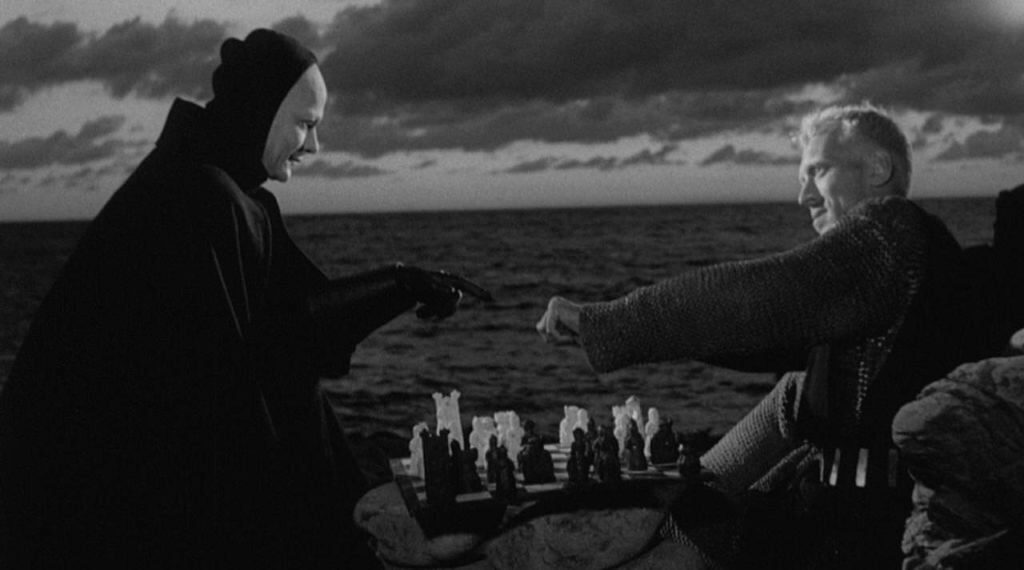
3. The Seventh Seal (Ingmar Bergman, 1957)

Returning from the Crusades during the Black Death, the knight Antonius Block encounters Death and challenges him to a game of chess. Block no longer possesses the religious certainty that once gave his life direction. He wants knowledge of God, but receives only silence.
His attempt to delay death cannot ultimately succeed in The Seventh Seal. What remains within his control is how he uses the time the game provides. Block’s desire to perform one meaningful act turns the film away from pure despair and toward existential responsibility. Meaning is not guaranteed by the universe; it emerges through an action chosen in full awareness of mortality.
Questions for discussion: Does an action need to defeat death to be meaningful? Can Block’s final choices compensate for the life he believes he has wasted?
4. The 400 Blows (François Truffaut, 1959)

In The 400 Blows, Antoine Doinel is a young boy whose conflicts with his parents, teachers, and other authority figures gradually push him outside respectable society. Adults repeatedly define him as dishonest, disobedient, or delinquent, but Truffaut keeps the film close to Antoine’s subjective experience.
Antoine exercises freedom, but never from a neutral position. His choices are shaped by neglect, humiliation, and the identities other people impose upon him. The film’s famous final image offers physical escape without explaining what that freedom will mean. Antoine reaches an open space, yet still has no clear destination or ready-made self waiting for him.
Questions for discussion: How much of Antoine’s identity is chosen, and how much is imposed? Does escape provide freedom if a person has no meaningful project to pursue?
5. 2001: A Space Odyssey (Stanley Kubrick, 1968)


2001: A Space Odyssey places individual human life against an evolutionary process extending across millions of years. During a mission to Jupiter, astronaut Dave Bowman confronts HAL 9000, an artificial intelligence whose apparent perfection conceals an increasingly dangerous conflict.
Kubrick’s film is more metaphysical than conventionally Sartrean, but its view of humanity remains existentially provocative. Human beings are never presented as finished creatures with a stable essence. They create tools, become dependent upon them, and repeatedly cross boundaries that transform what it means to be human. Bowman’s journey ultimately suggests existence as an unfinished process of becoming.
Questions for discussion: Can humanity possess a fixed essence if it is always evolving? Does technology increase human freedom, or expose how dependent that freedom has become?
6. Solaris (Andrei Tarkovsky, 1972)


Psychologist Kris Kelvin travels to a space station orbiting Solaris, a planet whose sentient ocean appears capable of materializing people from the crew members’ memories. Kelvin is confronted by Hari, a physical recreation of his deceased wife who may be produced from his guilt as much as his recollection of her.
The situation forces Kelvin to make decisions without knowing what Hari truly is. She may be a copy, an independent consciousness, or a projection that cannot exist apart from him. Tarkovsky makes that uncertainty ethically important: Kelvin must decide whether responsibility depends upon another being’s origin or upon the relationship created through their actions.
Questions for discussion: Does Hari’s uncertain identity reduce Kelvin’s responsibility toward her? Can guilt produce authentic care, or does it keep a person trapped in the past?
7. The Big Lebowski (Joel and Ethan Coen, 1998)


Jeffrey Lebowski, better known as the Dude, is mistaken for a millionaire who shares his name and becomes entangled in a kidnapping plot involving debt, deception, and a ruined rug. The people around him cling to identities and belief systems that provide the appearance of certainty, even as the mystery repeatedly collapses into confusion.
The Dude’s decision to “abide” can be interpreted as an authentic rejection of other people’s expectations. It can also be read as evasion: a passive identity that allows him to avoid taking responsibility for his life. The film’s existential value lies in that ambiguity rather than in presenting the Dude as a philosophical ideal.
Learn more about the mythos behind The Big Lebowski from my experiences attending Lebowski Fest.
Questions for discussion: Is the Dude living authentically, or hiding from his freedom? Can acceptance become another form of bad faith?
8. Waking Life (Richard Linklater, 2001)


In Waking Life, an unnamed young man moves through a series of dreamlike encounters in which philosophers, artists, and strangers discuss free will, identity, alienation, mortality, and the possibility of living authentically. As the conversations continue, he becomes increasingly uncertain whether he is dreaming or capable of waking at all.
Few narrative films address existential philosophy as directly as Waking Life. Its shifting rotoscope animation denies the viewer a stable physical world, while its characters repeatedly argue over whether people actively choose their lives or merely observe them. The film’s central challenge is to stop existing as a passive spectator.
Questions for discussion: Is awareness meaningful if it never leads to action? If free will cannot be proven, must people still live as though their choices matter?
9. I Heart Huckabees (David O. Russell, 2004)


Environmental activist Albert Markovski hires two “existential detectives” to explain a series of coincidences he believes may reveal a larger purpose. Their philosophy of universal interconnectedness is challenged by Caterine Vauban, a former student who argues for a far more nihilistic understanding of existence.
Unlike most films on this list, I Heart Huckabees turns philosophical disagreement into dialogue and comedy. Yet its competing systems also tempt Albert to avoid responsibility by allowing someone else to explain his life. The existential question is not simply which philosophy is correct, but whether any complete system can substitute for choosing how to live.
Questions for discussion: Does philosophy help Albert act authentically, or provide new ways to avoid responsibility? Can a belief system explain existence without determining it?
10. Anomalisa (Charlie Kaufman and Duke Johnson, 2015)


Michael Stone is a customer-service expert who experiences everyone around him—including his wife and son—as possessing the same face and voice. During a business trip, he meets Lisa, whose appearance and voice seem unique, and temporarily imagines that she can rescue him from his emotional isolation.
The stop-motion design in Anomalisa makes Michael’s subjectivity visible, but it does not confirm that everyone else is genuinely interchangeable. His alienation may result from his inability to recognize other people as subjects with lives independent of his own. What appears to be an existential search for connection gradually looks more like bad faith and self-deception.
Questions for discussion: Is Michael trapped by his perception, or responsible for it? Does his idealization of Lisa recognize her individuality or reduce her to another role in his life?
11. Things to Come (Mia Hansen-Løve, 2016)


Nathalie is a philosophy professor whose carefully structured life begins to unravel when her husband leaves, her mother dies, and her professional circumstances become less secure. The beliefs she has spent years teaching must now confront the instability of her own existence.
In Things to Come, freedom first appears as loss. Nathalie does not choose the events that dismantle her old identity, but she must choose what to do once that identity no longer determines her. The film’s quiet power comes from treating existential freedom as something that can feel frightening, lonely, and unexpectedly liberating at the same time.
Questions for discussion: Is Nathalie freed by her losses, or merely forced to adapt to them? What is the difference between understanding freedom intellectually and experiencing it personally?
12. Everything Everywhere All at Once (Daniel Kwan and Daniel Scheinert, 2022)


Evelyn Wang is overwhelmed by a failing laundromat, an IRS audit, her strained marriage, and her deteriorating relationship with her daughter. Contact with alternate universes reveals countless versions of the person she might have become had she made different choices.
The multiverse in Everything Everywhere All at Once initially appears to make every individual decision insignificant. If every possibility exists somewhere, no single life seems essential. Yet the film rejects the conclusion that nothing matters. Meaning is not uncovered as a hidden law of the universe; it is created through Evelyn’s decision to pay attention, show kindness, and remain connected to the people immediately around her.
Questions for discussion: Does the existence of every possible life make the present life meaningless? Can kindness function as an existential commitment rather than a universal moral command?
13. I Saw the TV Glow (Jane Schoenbrun, 2024)


Owen is a lonely teenager whose connection with a classmate, Maddy, revolves around a mysterious late-night television series called The Pink Opaque. As the boundary between the series and everyday life becomes unstable, Owen is confronted by the possibility that the identity he accepts may not be his authentic self.
I Saw the TV Glow turns bad faith into existential horror. Owen senses that another way of existing may be possible, but recognizing that possibility would require him to reject the identity, security, and reality offered by his surroundings. Time becomes terrifying because every refusal to choose allows an inauthentic life to harden around him.
Questions for discussion: Is refusing to choose still a choice? What happens when authenticity threatens the social reality that makes a person feel safe?
More Existential Films
No list of existential cinema can be comprehensive. The following films approach similar questions from different philosophical and stylistic directions.
Mortality, Grief, and the Passage of Time
- Ikiru (Akira Kurosawa, 1952)
- Hiroshima Mon Amour (Alain Resnais, 1959)
- Harold and Maude (Hal Ashby, 1971)
- Melancholia (Lars von Trier, 2011)
- A Ghost Story (David Lowery, 2017)
- After Yang (Kogonada, 2021)
Identity, Authenticity, and Self-Deception
- Casablanca (Michael Curtiz, 1942)
- Persona (Ingmar Bergman, 1966)
- American Beauty (Sam Mendes, 1999)
- Adaptation (Spike Jonze, 2002)
- The Worst Person in the World (Joachim Trier, 2021)
Alienation and the Search for Meaning
- The Vanishing (George Sluizer, 1988)
- Requiem for a Dream (Darren Aronofsky, 2000)
- Synecdoche, New York (Charlie Kaufman, 2008)
- Another Earth (Mike Cahill, 2011)
- Perfect Days (Wim Wenders, 2023)
Frequently Asked Questions
What makes a film existential?
An existential film places human subjectivity, freedom, responsibility, or the creation of meaning at the center of its narrative. Its characters are not merely searching for answers. Their choices help determine who they become.
Are existential films always depressing?
No. Existentialism frequently addresses anxiety, death, alienation, and the absence of guaranteed meaning, but it can also emphasize liberation and possibility. I Heart Huckabees uses comedy, while Everything Everywhere All at Once ultimately treats created meaning as a source of hope.
What is the difference between existentialism and absurdism?
Existentialism is a broad philosophical tradition concerned with freedom, subjectivity, responsibility, and authentic existence. Absurdism focuses more specifically on the conflict between the human demand for meaning and a universe that provides no definitive answer. The traditions overlap, but they are not interchangeable.
Is existentialism the same as nihilism?
No. Nihilism generally denies that life possesses meaningful value. Existentialism argues that meaning is not predetermined, but many existentialists maintain that people create value through their actions and commitments.
Which existential film should a philosophy student watch first?
The Seventh Seal is an accessible starting point because it turns doubt, mortality, and the search for meaning into a clear dramatic conflict. Waking Life is more philosophically explicit, while Everything Everywhere All at Once provides the most approachable contemporary example.
Conclusion
These films do not present one unified version of existentialism. Some emphasize freedom, while others concentrate on mortality, alienation, responsibility, or the difficulty of living authentically. What connects them is their refusal to treat human identity as complete or predetermined.
An existential film asks what people make of themselves when the world offers no final explanation. The answers vary, but they are always expressed through choices, actions, and the consequences that follow.
For a closer examination of Sartre’s argument that people create meaning through their decisions, read On Sartre’s Existentialism and the Meaning of Human Existence.
Which existential film would you add to the list?
Sources and Further Reading
Crowell, Steven. “Existentialism.” The Stanford Encyclopedia of Philosophy.
https://plato.stanford.edu/entries/existentialism/
Sartre, Jean-Paul. Existentialism Is a Humanism. Lecture delivered in 1945 and published in 1946.
https://www.marxists.org/reference/archive/sartre/works/exist/sartre.htm
Sartre, Jean-Paul. Being and Nothingness. Translated by Hazel E. Barnes. Washington Square Press, 1992.
de Beauvoir, Simone. The Ethics of Ambiguity. Translated by Bernard Frechtman. Citadel Press, 1948.