


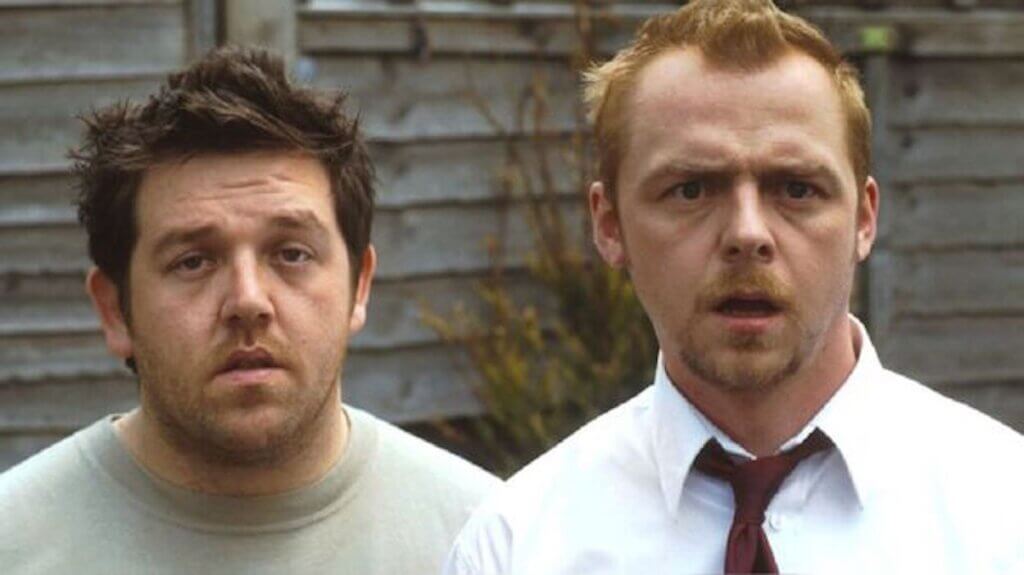
Following the success of The Evil Dead series in the 1980s and early 1990s, the popularity of the zombie horror-comedy, or “Zom Com,” steadily increased throughout the 1990s and 2000s. This popularity solidified conformity in certain narrative components of the subgenre, particularly in its gender roles and relations. While the comedy in The Evil Dead films mostly derives from the over-the-top violence and zany one-liners, its spiritual Zom Com successors, such as Braindead (1992), Shaun of the Dead (2003), and Doghouse (2009), take a different path. Instead, these Zom Coms make the emasculated male hero trying to fight off the undead as the source of humor.
Moreover, the women serve as the source of this emasculation. Women are the first link in the causal chain that forces the men toward the threat (zombies) that they are ill-equipped to handle. Thus, in contemporary zombie horror-comedies, oppressive female emasculates the male protagonist. This emasculation renders the protagonist incapable of repelling the zombie hordes, which serves as both a source of intensified horror and comedy.
Defining Horror and Zombie Comedy
First, it is important to note how the Zom Com functions within the genre of horror-comedies. In Noël Carroll’s essay, “Horror and Humor,” Carroll argues that we identify and distinguish many genres by certain character types that inhabit their narrative worlds (Carroll 147). In the horror film, for example, the most central character type is the monster. By Carroll’s definition, a monster must meet three criteria: the monster cannot be explained by contemporary science, the monster must be threatening, and the monster must be impure, with this impurity arising from a violation or contradiction of cultural categories (Carroll 150). As the reanimated dead, zombies are certainly inexplicable by modern science. They are also threatening in that they attempt to kill and eat living people, and they are impure because they occupy the contradictory categories of being both living and dead.
However, the presence of a monster is not sufficient for a comprehensive definition of horror. Monsters can exist in films without producing what Carroll refers to as the emotion of “art-horror” (Carroll 149). Horror films, whether they are successful in producing art-horror or not, are “generally designed to guide audience response” (Carroll 149). Therefore, the second necessary condition of a horror film is the intention of the filmmaker to produce art-horror in the audience, with the object of that emotion being the monster. This can be read in a horror film through the reactions that characters have toward the monster, with the implication that the audience should reciprocate those reactions (Carroll 150).
Combining Horror and Comedy
While all three of these Zom Com films meet the requirements (with the zombies constituting monsters and being the object of art-horror), they also have the intention of producing comic amusement in the audience. The emotions of art-horror and comic amusement may seem incompatible at first glance, but Carroll argues that they actually work well together because they share the attribute of being “necessarily linked to the problematization, violation, or transgression of standing categories, norms, and concepts” (Carroll 152).
In comedy, the incongruity theory involves “the bringing together of disparate or contrasting ideas or concepts” (Carroll 153). Thus, what causes a sense of impurity in the monster of a horror film can also create comic amusement in certain contexts. For the genre of horror-comedy, this most often requires the subtraction of the second attribute of a monster (that it must be threatening). Once the filmmaker removes the frightening elements of a monster and it no longer poses a threat to the characters, it becomes a scientifically inexplicable contradiction of categories. When this happens, the monster is capable of producing comic amusement for the audience (Carroll 153).
However, while the comedy in a horror-comedy film can be achieved by removing the threatening attribute of a monster, it is not a necessary requirement of the genre. In Braindead, Shaun of the Dead, and Doghouse, the threat posed by the monster(s) remain throughout the films. Yet, the films are still comedic. The filmmakers accomplish this through the characterization of the male hero and his female counterparts.
Opposing Gender Roles in Post-Apocalyptic Settings

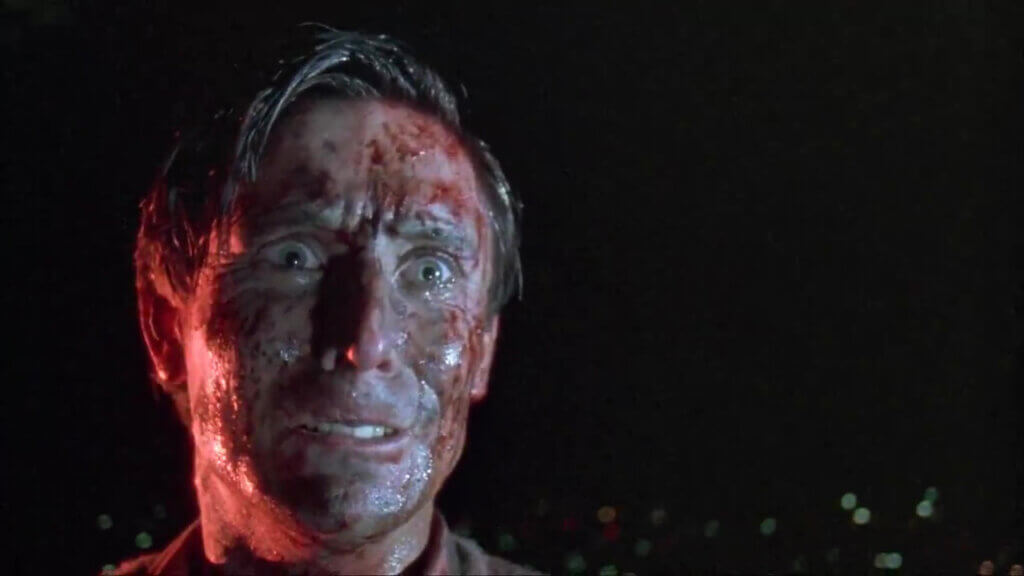
In Katherine Low’s essay on gender representation and biblical allegory in post-apocalyptic films, she argues that it is the learned expectation of audiences that the male hero will require certain traits to take on whatever threatens humanity (Low 12). When viewing a film that presents an end-of-times scenario in which a male protagonist faces an all-pervasive threat, the audience has the “active expectation of masculine behavior” (Low 5). The “American fascination with the lone sacrificial male hero who prevails in the end through his strength” further perpetuates this expectation (Low 12).
This characterization is further exemplified in the film that originated the tropes of the modern zombie genre, George Romero’s Night of the Living Dead (1968). The central male character, Ben, acts as the traditional male hero that audiences anticipate when he takes action to try to save the group of survivors and becomes increasingly violent to fight off the zombies (Bishop 204). In post-apocalyptic horror films, audiences expect a singular, strong male to fight and defeat the monstrous threat.
» You Might Like: Trainspotting and the Dilemma of Scottish National Identity
In contrast to this conception of the male hero is the secondary female character. Within the established audience expectations of the genre, this character functions either as a sexual prize for the male hero or a sexualized barrier that distracts the hero from his goals (Low 15). In either case, the women are only defined in relation to the male hero and do not “command primary action in the film” (Low 16).
Instead, the male hero holds power over both the action of the narrative and the female body, whereas the women’s only purpose is the sexual fulfillment of the male. In short, audiences have come to expect “a sexualized femininity…[and] an active and violent masculinity” from the female counterpart and the male hero, respectively (Low 16).
Defying Audience Expectations
While the characters of Braindead, Shaun of the Dead, and Doghouse all exist in post-apocalyptic scenarios in which some kind of virus or biological disaster is causing a threat to all of humanity, the gender representations do not align with audience expectations, and by extension cultural norms. In fact, the gender representations and relations directly contradict the cultural norms that have been established for such a post-apocalyptic setting. In these contemporary Zom Coms, the male protagonists exist in a “state of enigmatic stasis where goals are unreachable” (Pagano 81). The male “hero” is stripped of his productive, action-guiding nature and emasculated by the oppressive female, rendering him ineffectual against the zombie hordes.
Braindead
In Peter Jackson’s Braindead (released as Dead Alive in North America), Lionel is a shy, self-effacing man. He faces daily abuse from his overbearing mother, Vera. When Lionel develops an attraction to another woman, Paquita, Vera becomes jealous. While secretly pursuing Lionel and Paquita on their date, Vera is bitten by a Sumatran Rat-Monkey. She eventually turns into a zombie and starts killing people, creating more zombies.
Lionel tries to hide his mother in the basement and contain the outbreak, but she escapes. During the final battle, Lionel finally stands up to Vera, who has mutated into a giant, zombie-rat hybrid. Once Lionel embraces his masculinity to defeat his mother, he is able to live happily with Paquita.
Shaun of the Dead
Similarly to Braindead, the male hero in Shaun of the Dead is initially inadequate when trying to defeat the zombies. The film establishes the title character, Shaun, as lazy and unmotivated. He lives with his best friend, Ed, who is equally lazy and unmotivated. The tension between Shaun and his girlfriend, Liz, is established early and quickly leads to Shaun getting dumped.
After a night of heavy drinking, Shaun wakes up to find that the dead have risen from their graves. With Ed’s help, he decides to find Liz and his mother and save them all from the epidemic. However, the majority of their group ends up turning into zombies due, in part, to a series of poor decisions made by Shaun. However, in the end, Shaun and Liz survive and live happily together, with Ed as their pet zombie.
Doghouse
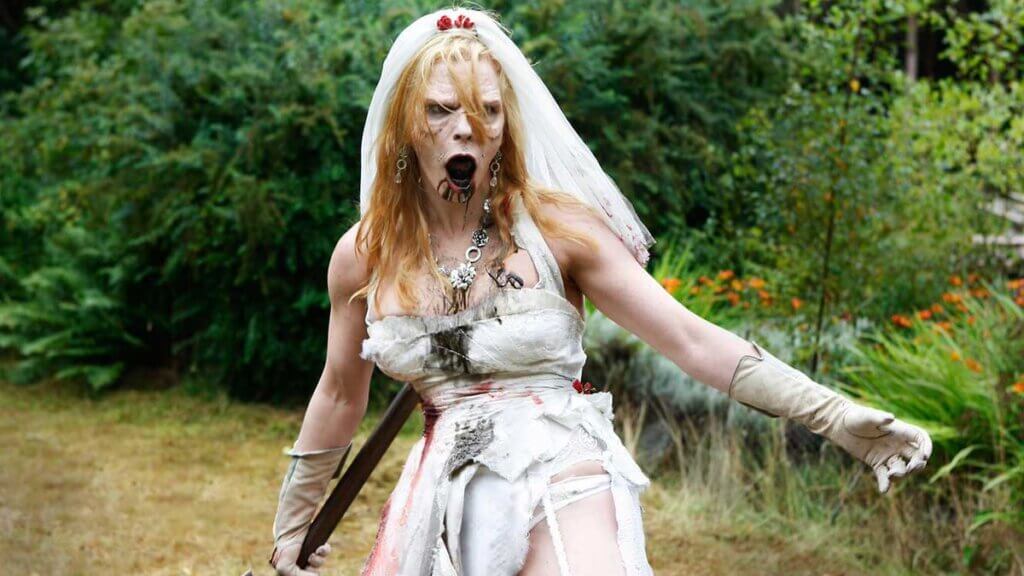
In Doghouse, seven male friends go on a “boy’s weekend” to escape the respective women in their lives. They also want to help the central member of their group, Vince, get over his recent divorce. Each member of the group feels trapped and emasculated by their respective girlfriends and wives. They attempt to escape and flaunt their masculinity, only to face a horde of man-hating female zombies at their destination. After the zombie women kill four of them, Vince and three others bareky make it out alive. As they drive away, the survivors laugh about their ruined vacation.
Emasculation Forms the Basis of the Zom Com
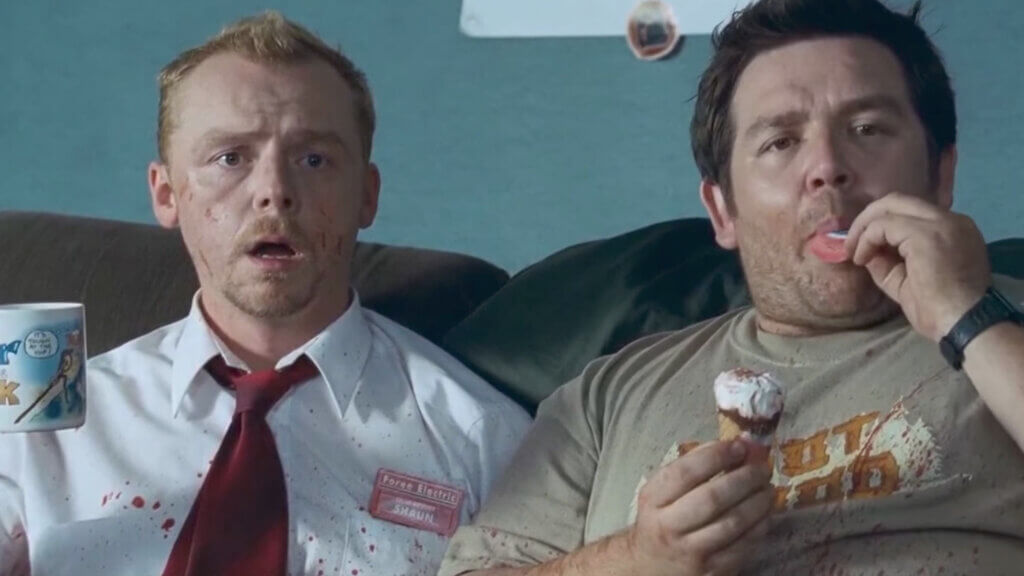
In all three films, the male hero, and occasionally his male compatriots, are emasculated. This emasculation functions as the source of intensified horror and comedy for the spectator. While the zombies always serve as the object of horror, the art-horror is intensified by the inadequacy of the male hero. In a post-apocalyptic scenario, audiences come to expect a singular male hero to show aggressive masculinity and capably handle any threat (Low 5).
However, Lionel, Shaun, and Vince contradict this expectation. They are weak, relatively unintelligent, and unprepared to fight or even cope with the existence of the zombie threat. By making these characters ineffectual, the tension is heightened in the film. Having an unmotivated or timid protagonist of this sort decreases the likelihood that the characters will make it out alive, thus amplifying the threat that the zombies pose and intensifying the emotion of art-horror for the spectator.
However, the shift from hero to ineffectual coward also functions as the source of comedy in these films. As Carroll argues, horror and comedy share the trait of being necessarily involved in the application of contradictory or problematic categories. Much like with the impurity of horrific monsters, incongruity comedy involves the “inappropriate transgressions of norms or commonplace expectations” (Carroll 154). In these Zom Coms, the comedy arises from the denial of our expectations regarding gender representation. The spectator expects to see a strong, masculine hero, but instead, the male protagonists are nothing of the sort.
Emasculating the Men in the Zom Com
For example, in Braindead, the story repeatedly associates Lionel with maternity and objects of the home life. Typically (particularly in traditional Western society), audiences associate these qualities with femininity. In one such instance, a group of zombies pursues Lionel into the laundry room. In order to escape, he drops a pile of linens on them. Shortly after this, Lionel breaks through a wall using a laundry iron. During an earlier scene, Lionel, attempting to care for the zombified baby of a deceased friend, wheels the child around the park in a stroller. Even this proves too much for him. He loses control of the stroller and must chase after it before someone discovers the child’s condition. Lionel even tries to diffuse the situation and appear “normal” by imitating a nearby woman playing with her child.
Analyzing the “Hero”
In this way, Lionel functions as a contradiction and regressive version of the traditional male hero. This Zom Com functions as an “inversion of the hero’s journey, proceeding through the inner spaces of the home and the maternal body” (Badley 44). In all of these examples, it is Lionel’s contradiction of common expectations that becomes comedic. He is feminine rather than masculine. As a result, he is ineffectual rather than effective against the zombie horde.
In Shaun of the Dead, viewers identify Shaun as underachieving and undeserving of a relationship with Liz. In his review of the film, Roger Ebert notes that Liz is “smart and ambitious and wants to get ahead in the world” whereas Shaun and Ed are slackers who “maintain their slothful gormlessness in the face of urgent danger” (Ebert 7). Rather than associating Shaun with objects of femininity, the film simply portrays Shaun as lacking a strong, masculine drive. If the male hero drives the action of the narrative, and Shaun is markedly lazy and unmotivated, then he lacks a key feature of what it is to be a man in the horror genre, and is therefore inadequate as the male hero.
In Doghouse, the male characters, particularly Vince, are presented as ineffectual through physical inferiority to the female zombies. When the men arrive at their destination, the female zombies are stronger and much more physically aggressive than the men. In the end, their only hope for survival is to run away. The men are simply incapable of defeating the female monsters due to physical inadequacy. In this way, the expectation of a strong, masculine hero is undermined by the stronger female monsters.
Reinforcing Traditional Roles
However, in all three films, it is only when the protagonists rediscover their masculinity that they are able to defeat, or at the very least evade the zombies. Lionel must confront his mother about her terrible treatment and ultimately kill her, while Shaun must rescue Liz and kill the zombified version of his mother as well. Though the men of all three films must come to similar revelations to overcome the threat, the conclusions drawn in Doghouse are more overtly misogynistic than Braindead and Shaun of the Dead. This is most evident when Vince “realizes, having fought tooth and nail with one hell-bent [woman] after another… [that] no woman is worth the bother” (Wigley 60). In all three films, the male hero can only reaffirm his masculine qualities and defeat the monstrous threat when he frees himself of the oppressive female.
In the Zom Com, the Women Oppress the Men


All three films feature a male antihero who amplifies the emotion of art-horror and produces comic amusement. However, it is also necessary to address the narrative cause of the male’s ineffectuality. The traditional idea of the woman is a powerless secondary character. Her only function is to fulfill the male hero’s sexual needs. However, the women of the contemporary Zom Com operate in a very different way.
The women of these Zom Com films contradict our expectations. They act in a way that justifies and intensifies the male protagonist’s shortcomings. Rather than merely being sexualized objects of male desire, the women function as oppressive, powerful characters. They also cause the initial emasculation of the protagonist. In this context, the woman is defined through her ability to metaphorically “remove the phallus” in the narrative. She becomes a threat to the man as a “castrating woman,” resulting in a feminized male (Patterson 106). While the story is still driven by men, it is the women that emasculate the men and push them toward the zombie threat.
Overbearing Wives, Mothers, and Girlfriends
In Braindead, the mother, Vera, is domineering and works to make Lionel believe that he is incapable of existing without her. When Lionel falls for Paquita, it is only Vera’s overbearing nature that leads to her own infection. Without his controlling mother or the intrusion of Paquita in their lives, Lionel would not be the emasculated hero.
In Shaun of the Dead, Liz initially emasculates Shaun when she dumps him. This confirms that he is a lackluster boyfriend and bruises his ego. Shaun’s mother also emasculates him by berating Shaun and treating him like a child for not respecting his stepfather.
Finally, in Doghouse, the story depends on the initial emasculation imposed on the male. Moreover, the film insists that any form of intimate relations with a woman will ultimately emasculate the men. Vince and his friends try to free themselves of women, only to find that this is impossible. The women initially force the men towards the threat, and this threat also happens to be female. Once the female zombies physically have emasculated them, Vince and the remaining survivors flee. In the end, they must shamefully return to the women they disdain.
Conclusion
It is important to note that this trend is not isolated to these three films. The emasculated male/oppressive female relationship prevails in many other contemporary zombie-comedies. Viewers may remember similar relationships between Francesco and the unnamed widow in Dellamorte Dellamore (1994), Columbus and Wichita in Zombieland (2009), and “R” and Julie in Warm Bodies (2013). In each film, the intensified horror and humor come from a contradiction in our expectations, and by extension our conception of cultural norms.
A weak, ineffectual hero (oppressed by the female) replaces the strong male hero who embodies traditional notions of masculinity. By being weaker, the men are inept against the monstrous threat, which serves to increase the tension caused by the threat and simultaneously allow for comic amusement. Ultimately, these elements have shifted the zombie-comedy subgenre into a more reactionary state.
While the monsters are not always defeated in the contemporary Zom Com (in Doghouse they are simply left to become someone else’s problem), they are still represented as entities that should be defeated. More importantly, the male characters only defeat or escape the zombies when they rediscover their lost masculinity. Though the films start with non-traditional character types (weak male/strong female), the narratives end up reinforcing traditional gender roles and institutions. Each film promotes its own version of a strong male in a monogamous, heterosexual relationship with a weaker female. Ultimately, the Zom Com subgenre reinforces the very contradictions that work to produce art-horror and comic amusement for the audience.
For a broader account of how zombie cinema uses the undead to examine power, identity, and social order, see 10 Philosophical Zombie Films About More Than Survival.
Sources:
Badley, Linda. “Zombie Splatter Comedy from Dawn to Shaun: Cannibal Carnivalesque.”
Zombie Culture: Autopsies of the Living Dead. Ed. Shawn McIntosh and Marc Leverette. Lanham, MD: Scarecrow, 2008. 35-54. Print.
Bishop, Kyle. “Raising the Dead.” Journal of Popular Film and Television 33.4 (2006): 196-205. Print.
Carroll, Noël. “Horror and Humor.” Journal of Aesthetics & Art Criticism 57.2 (1999): 145-60. Print.
Ebert, Roger. “Shaun of the Dead.” Rev. of Shaun of the Dead. Chicago Sun-Times [Chicago] 24 Sept. 2004. 7. Print.
Low, Katherine. “Satan’s Seductress and the Apocalyptic Hero: The Body in American Apocalyptic Films at the Turn of the Century.” Journal of Religion & Film 13.2 (2009): 1-16. Print.
Pagano, David. “The Space of Apocalypse in Zombie Cinema.” Zombie Culture: Autopsies of the Living Dead. Ed. Shawn McIntosh and Marc Leverette. Lanham, MD: Scarecrow, 2008. 71-86. Print.
Patterson, Natasha. “Cannibalizing Gender and Genre: A Feminist Re-Vision of George Romero’s Zombie Films.” Zombie Culture: Autopsies of the Living Dead. Ed. Shawn McIntosh and Marc Leverette. Lanham, MD: Scarecrow, 2008. 103-15. Print.
Wigley, Samuel. “Doghouse.” Rev. of Doghouse. Sight & Sound Aug. 2009: 58-60. Print.